Connecting texts without flattening their differences
By UK A Level English Language · independent study · myAudience
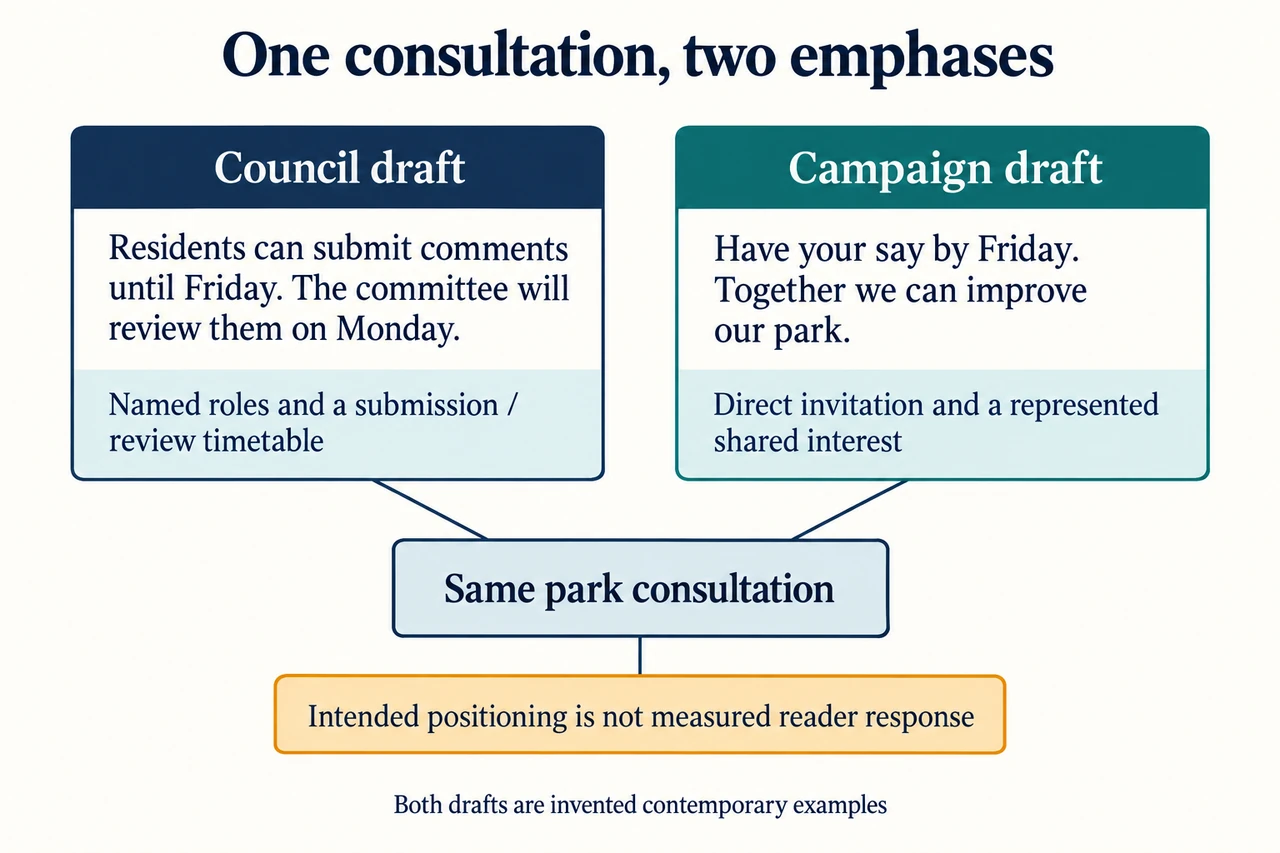
myAudience original rendered educational illustration. Image: illustration, not a documentary photograph. · Original generated educational concept plate; retained generation provenance; no third-party text or logos.
Connecting texts without flattening their differences
Comparative analysis needs a shared question. Two texts can concern the same event while representing it differently, and an answer should explain that relationship rather than write two disconnected lists. Choose a conceptual axis, such as how participants are positioned, and compare relevant evidence from both texts. Different numbers of devices do not automatically establish which text is clearer, more persuasive or more sophisticated.
Our original council draft says: ‘Residents can submit comments until Friday. The committee will review them on Monday.’ The original campaign draft says: ‘Have your say by Friday. Together we can improve our park.’ Both are invented contemporary examples about the same park consultation. They are not historical documents, a sample of real councils or supplied examination texts. Their controlled contrast isolates choices while leaving real-world reception unmeasured.
The council wording names residents and a committee as separate participants. ‘Can submit’ presents an available action; ‘will review’ presents a future commitment within this draft. The pronoun ‘them’ connects the second clause to comments in the first, providing textual cohesion. The Friday-to-Monday sequence outlines procedure. Neither tense nor naming proves that a real review occurred or that the process would be fair.
The campaign’s imperative ‘Have your say’ addresses the reader directly. Its idiomatic wording frames commenting as an opportunity for participation. ‘Together’ and ‘we’ construct an inclusive relation, but the membership of we needs context: campaign organisers, residents or a broader community could be included. ‘Our park’ similarly represents shared attachment without proving legal ownership or universal agreement.
‘Can’ does different work within the two drafts. The council’s ‘can submit’ concerns an available procedure; the campaign’s ‘can improve’ proposes a collective possibility or capacity. Analyse the complete clauses rather than concluding that the presence of the same modal makes their functions identical. Likewise, the council supplies an explicit review day that the campaign omits. One frame foregrounds administration; the other foregrounds participation.
A comparison becomes stronger when it recognises mixed purposes. The council draft can encourage participation while explaining procedure. The campaign draft communicates a deadline while seeking engagement. Neither has only one function. Claims about effectiveness would need evidence such as whether readers understood the deadline and review process, not simply whether the wording sounds warmer to one analyst.
Connect evidence through a line of argument. A model paragraph might contrast named institutional actors with an inclusive pronoun, explain how that difference positions participants, and then qualify the inclusive reading because we remains context-dependent. Avoid a formula that mentions both texts mechanically while leaving their relationship unexplained. Precise terminology is useful when it carries an analysis; it cannot replace contextual reasoning.
The plate links procedure and timetable with participation and shared identity under a common consultation. These labels summarise the displayed original clauses rather than claiming the complete character of real institutions. Its footer identifies both drafts as contemporary inventions. Authentic older/contemporary comparison, historically located change and global text variety remain separate course requirements; an invented formal tone cannot supply a genuine date or archival provenance. Image: illustration, not a documentary photograph.
Worked example: Compare how the two invented drafts position residents and organise the same park consultation.
The two invented drafts concern the same consultation but make different aspects prominent. The council wording organises participation through named roles and a timetable, while the campaign wording constructs a more collective relationship. This is a difference in emphasis, not evidence that one text has an exclusively informative purpose and the other an exclusively persuasive one.
‘Residents can submit comments until Friday’ names a category of eligible participants and an available action. The subsequent ‘The committee will review them on Monday’ introduces a different actor and connects to comments through ‘them’. The sequence therefore distinguishes submission from review and places them on separate days. That organisation gives the reader procedural information, although it does not guarantee that an actual committee will follow the proposed process.
The campaign’s imperative ‘Have your say’ positions the reader directly as someone who can participate. Unlike a neutral instruction to submit comments, the idiom can frame the action as exercising a voice. ‘Together’ and ‘we’ then present improvement as a collective possibility. The possessive ‘our’ similarly represents attachment to the park. However, these forms do not identify every member of the collective or establish that all residents share the campaign’s priorities.
The modal can appears in both drafts but should not be treated as having an identical contextual function. In ‘can submit’, it relates to access to a stated procedure; in ‘can improve’, it suggests capacity or possibility for a shared outcome. The second draft also supplies a Friday reference, so its more participatory framing does not remove the practical deadline. Conversely, the council draft’s offer of participation can have an encouraging function despite its institutional vocabulary.
The council’s explicit Monday review date gives information that the campaign does not include. Whether that omission matters depends on the communicative task. A short invitation might legitimately direct readers elsewhere for procedure, whereas a complete information notice would need sufficient details. The provided drafts do not contain those surrounding resources, so the analyst should not invent them.
The strongest conclusion is that one draft foregrounds a staged process and the other foregrounds participation and shared identity. Evidence from both supports this comparison, but actual comprehension, trust or participation would require reader and process evidence. An integrated answer explains that contextual limit rather than using warmer wording as a substitute for measured effectiveness.
Answer: The council draft separates named participants and Friday submission from Monday review; the campaign draft directly invites participation and represents a shared interest through together, we and our. Both combine information and encouragement. These invented contemporary drafts establish differences in textual positioning, not successful persuasion, universal agreement or historical dating.
Check your understanding: A learner dates the campaign draft to 1880 because it sounds formal. Evaluate this claim and explain what would be needed for an authentic older/contemporary comparison.
Answer: The claim is unsupported and contradicts the supplied provenance: both drafts are original contemporary teaching inventions. Formality is not a reliable dating method, and the campaign’s direct address or inclusive pronouns are not exclusive to one historical period. Authentic comparison needs a genuinely dated text, its production and circulation context, reliable provenance and appropriate evidence about the linguistic features under discussion. Reusing these invented words with an old date would manufacture historical data. The pair remains useful for analysing functions and representations, but it cannot close the requirement to study unfamiliar older texts or establish a history of language change.
Why: A justified answer keeps the supplied linguistic forms and evidence exact, explains alternatives and limits, and does not invent speaker intentions, research outcomes or assessed completion.