Evaluating language attitudes and writing for a public audience
By UK A Level English Language · independent study · myAudience
myAudience original rendered educational illustration. Image: illustration, not a documentary photograph. · Original generated educational concept plate; retained generation provenance; no third-party text or logos.
Evaluating language attitudes and writing for a public audience
Language attitudes concern judgments about varieties, speakers and uses, not just descriptions of grammatical forms. A writer may prefer a register for a particular task or make a much broader claim about the people who use it. Separate those claims before evaluating evidence. A notice that is difficult to understand does not establish that its writer is careless, and a dialect feature does not measure intelligence or moral worth.
Consider two original invented editorials. A says: ‘Only careless writers use informal words in notices. Formal language always prevents confusion.’ B says: ‘A notice should fit its readers and purpose. We need evidence before claiming one style works best.’ These are practice texts, not published attitudes research or a historical sample. A combines a judgment about writers with an absolute claim about outcomes; B asks for contextual evidence.
A’s ‘only’ excludes alternatives while ‘always’ gives its comprehension claim universal scope. ‘Careless’ evaluates people rather than specifying a measurable feature of the notice. Identify these linguistic choices, then test the warrant connecting wording to judgment. A confusing instruction might result from an omitted deadline, unfamiliar terminology or contradictory information; none is established simply by labelling its register informal.
Give competing positions their strongest defensible form. Institutions can reasonably seek consistent notices, accurate instructions and accessible language. Shared conventions may help readers locate essential information. Those goals do not require the claim that all formal wording works or that informal writers lack care. B’s contextual approach also needs scrutiny: fitting readers is not a measurable achievement until audience, task and evaluation criteria are declared.
A comprehension inquiry would define the information readers must recover and compare appropriately matched versions. Reader familiarity, vocabulary, layout and prior knowledge can influence performance alongside register. Counts of a feature cannot substitute for comprehension responses, and a small unequal-genre sample cannot establish a general causal effect. Report the actual evidence and uncertainty rather than inventing a study that conveniently confirms a preferred position.
Writing for non-specialists requires an argument as well as accessible vocabulary. State the issue, explain a precise example and show why the distinction matters. Define a term such as register through its use rather than displaying unexplained terminology. Qualify evidence without burying the recommendation. The original response below models an information-and-persuasion blend; it is neither an authentic examination script nor a student’s assessed submission.
Revision should connect a language choice to a plausible audience need. Replacing ‘lexical deficit’ with a concrete account of missing information avoids presenting speakers as deficient while making the issue clearer. A direct question can invite reflection, but it does not prove that readers will agree. Commentary distinguishes intended positioning from measured reception and recognises that even careful wording may be misunderstood in another context.
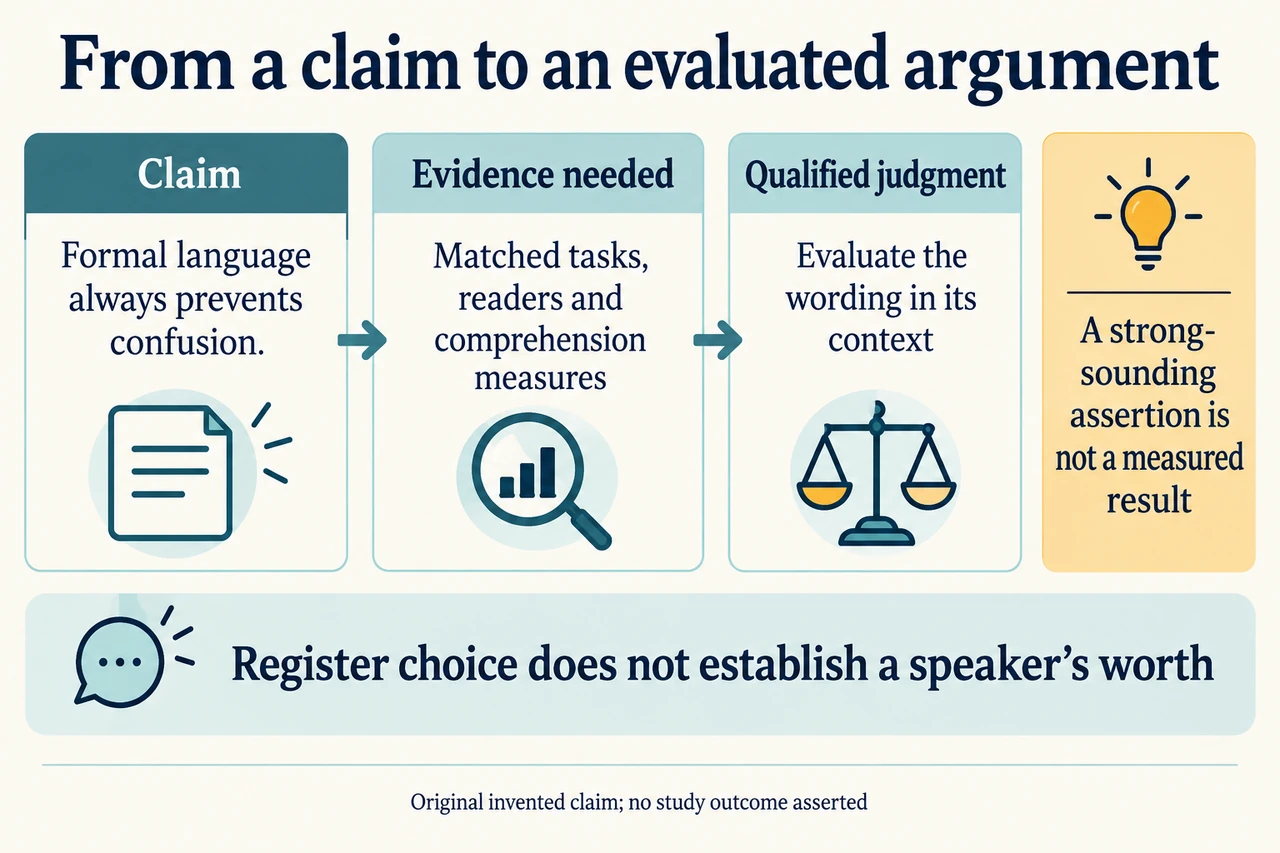
The plate traces a supplied claim to the evidence it would need and then to a qualified judgment. Its arrows organise an argument, not a demonstrated causal chain. The amber card distinguishes confidence of assertion from measured result; the lower statement rejects a speaker-worth inference. The related original response and analysis explain each of those limits without pretending that all discourse-writing routes or language-attitude theories have been assessed. Image: illustration, not a documentary photograph.
Worked example: Evaluate the two invented editorials, distinguishing linguistic choices, legitimate institutional aims and unsupported claims.
Editorial A represents informal register as evidence of a writer’s carelessness, then presents formal register as a universal solution to confusion. Editorial B offers a more conditional account based on readers and purpose. B is the better warranted position within these supplied texts, but its recommendation still needs an explicit account of what would count as successful communication.
A’s restrictive ‘Only’ and absolute ‘always’ are central to its argument. The first ties an informal choice to a negative judgment of a person; the second claims an invariant reader outcome. Neither clause supplies an example, a comprehension measure or evidence from matched contexts. ‘Careless’ is therefore an evaluative label rather than an operational definition of how a notice fails. Identifying its connotations is useful, but the larger problem is the unsupported inference from register to character.
The institutional concern should not be dismissed. Notices often need consistent deadlines, identifiable responsibilities and accurate directions. Readers might benefit from familiar conventions that make these details easy to find. However, those legitimate aims support evaluating particular instructions; they do not establish that every formal text is clear. Formal terminology can be unfamiliar, while informal wording can communicate a precise time and action. Those are possibilities to investigate rather than universal counterclaims.
B’s ‘should’ recommends contextual fit, and ‘We need evidence’ positions its producer and readers as participants in evaluation. This framing avoids A’s fixed hierarchy, yet the inclusive pronoun does not establish that everyone agrees. Nor does the demand for evidence supply that evidence. A useful inquiry would define the task readers perform and check whether they recover the intended information, while accounting for prior knowledge, layout and differences beyond register.
The public response should therefore explain the distinction without replacing one stereotype with another. An accessible example can show why a clear deadline matters more than a broad label, while a qualified recommendation can respect an institution’s responsibility to communicate accurately. It should not promise a measured improvement that has not been tested.
The justified conclusion is that A overgeneralises from unspecified language choices to both character and comprehension. B provides a sounder starting point, conditional on a transparent evaluation of particular readers and tasks. This is an assessment of two invented arguments, not evidence that real populations hold either attitude or respond in the same way.
Original public response (part1): Does a notice become clear simply because it sounds formal? Imagine a message that says the collection will happen ‘at an appropriate time’. Its vocabulary may sound official, but a reader still cannot tell when to arrive. A shorter instruction, ‘Collect your book at the desk before four on Friday’, supplies an action, a place and a deadline.
This does not mean that informal language is always better. A technical notice may need precise terms, and readers may expect a familiar format. The useful question is what a particular audience needs to understand and do. Register means a pattern of language associated with a situation; it is not a certificate of a speaker’s intelligence or care.
Original public response (part2): Before replacing a whole style, check the information. Is the deadline stated? Is responsibility clear? Could an unfamiliar term be explained? Where possible, ask readers to identify the action and timing, then compare their answers with the intended message. Keep the conditions similar so a different layout or missing detail does not quietly decide the result.
Schools and other institutions have good reasons to seek accurate communication. They can pursue that aim without labelling entire varieties or their users as deficient. Evaluate the notice, explain the evidence and revise the wording that causes a specific problem. Clear communication is a task to investigate, not a quality guaranteed by an impressive label.
Answer: Commentary on the original public response: The opening question challenges the absolute claim while inviting reflection rather than attacking its producer. The contrasting invented instructions make missing timing concrete. A short definition makes register accessible to a non-specialist audience; separating it from intelligence avoids reproducing the editorial’s speaker stereotype. The checklist moves from explanation to practical evaluation, and the final paragraph recognises legitimate institutional aims. These are intended effects and choices, not measured reader responses. The example does not establish that formal vocabulary itself caused confusion: one version lacks information, so a causal experiment would need better controlled variants.
Check your understanding: A school bans a dialect feature after counting it in a tiny sample with unequal genres. Evaluate the argument fairly and specify evidence that could change your conclusion.
Answer: The school can legitimately seek accurate, accessible communication, but an unequal sample of feature counts cannot establish that a dialect causes misunderstanding or that its users are deficient. Define the feature, sampling units and genres; inspect contexts and distribution rather than just totals. A task-specific inquiry could compare otherwise matched notices and transparently measure whether relevant readers recover the intended action, deadline and responsibility. Consider familiarity, layout and vocabulary as alternatives. Evidence of a reproducible comprehension problem under suitable conditions could justify revising that wording for that task, not judging speakers generally or banning a whole variety. Consultation and fair participation matter; the teaching sample supplies neither a measured effect nor statistical significance.
Why: A justified answer keeps the supplied linguistic forms and evidence exact, explains alternatives and limits, and does not invent speaker intentions, research outcomes or assessed completion.