A focused inquiry and original-writing commentary
By UK A Level English Language · independent study · myAudience
myAudience original rendered educational illustration. Image: illustration, not a documentary photograph. · Original generated educational concept plate; retained generation provenance; no third-party text or logos.
A focused inquiry and original-writing commentary
A focused investigation asks a question its data can answer. ‘How do these two scripts formulate requests?’ is narrower than ‘How do all people communicate?’ This lesson uses invented planning-chat scripts to practise design and analysis without collecting private messages. A controlled example can reveal methodological choices, but it cannot establish population frequencies or replace a student’s own appropriately supervised and authenticated non-exam assessment.
Script A contains ‘Move the box, please’, ‘Could you bring the label?’ and ‘Write the time here’. Script B contains ‘Could you move the box?’, ‘Bring the label, please’ and ‘Would you write the time here?’ Every line is original and synthetic. There are three request turns in each script. No ages, relationships, voices, pauses or outcomes are supplied, so none should be invented in the interpretation.
Define the coding before counting. For this chosen exercise, classify each whole request turn as imperative-form or modal-interrogative-form. Code ‘please’ separately as an explicit token regardless of category. A has two imperative-form requests and one interrogative-form request; B has one and two respectively. Each has one please token. These categories describe forms within six chosen lines, not measured politeness or successful cooperation.
Pilot the rule against an ambiguous example. ‘Can you move it?’ may function as a request, while ‘Can this machine move it?’ may ask about capacity. Form alone does not resolve every contextual function. Record inclusion decisions, specify how disagreements would be considered and distinguish utterances from word tokens. If real research is later planned, follow the supervising teacher’s requirements and permission, minimisation and secure-handling arrangements rather than publishing identifiable messages.
Evaluate the comparison before making a social claim. B has the higher proportion of modal-interrogative forms, two out of three against one out of three. A’s proportion of imperative forms is higher. That contrast was constructed by the author, with no representative sampling or genuine speaker choice. Topic, relationship and actions are not controlled empirical variables here. Counts can demonstrate a coding procedure without proving that one group is more considerate.
Original information writing begins with purpose and audience. Our draft, ‘Bring everything soon. Put it over there’, leaves timing, items and location vague. A revised practice note says, ‘Bring the empty box and its label to the library desk before four on Friday. Ask the desk if an item is missing.’ The revision supplies concrete referents and a deadline, but the place and time are fictional design choices, not actual event instructions.
A commentary explains how the revision changes language and information. Specific noun phrases replace ‘everything’; a named location replaces context-dependent ‘there’; the deadline narrows ‘soon’. The conditional second sentence offers a response to a foreseeable problem. These choices aim to make the intended action identifiable. Because the revision also adds information, any improved comprehension could not be attributed to grammatical form alone without further controlled evidence.
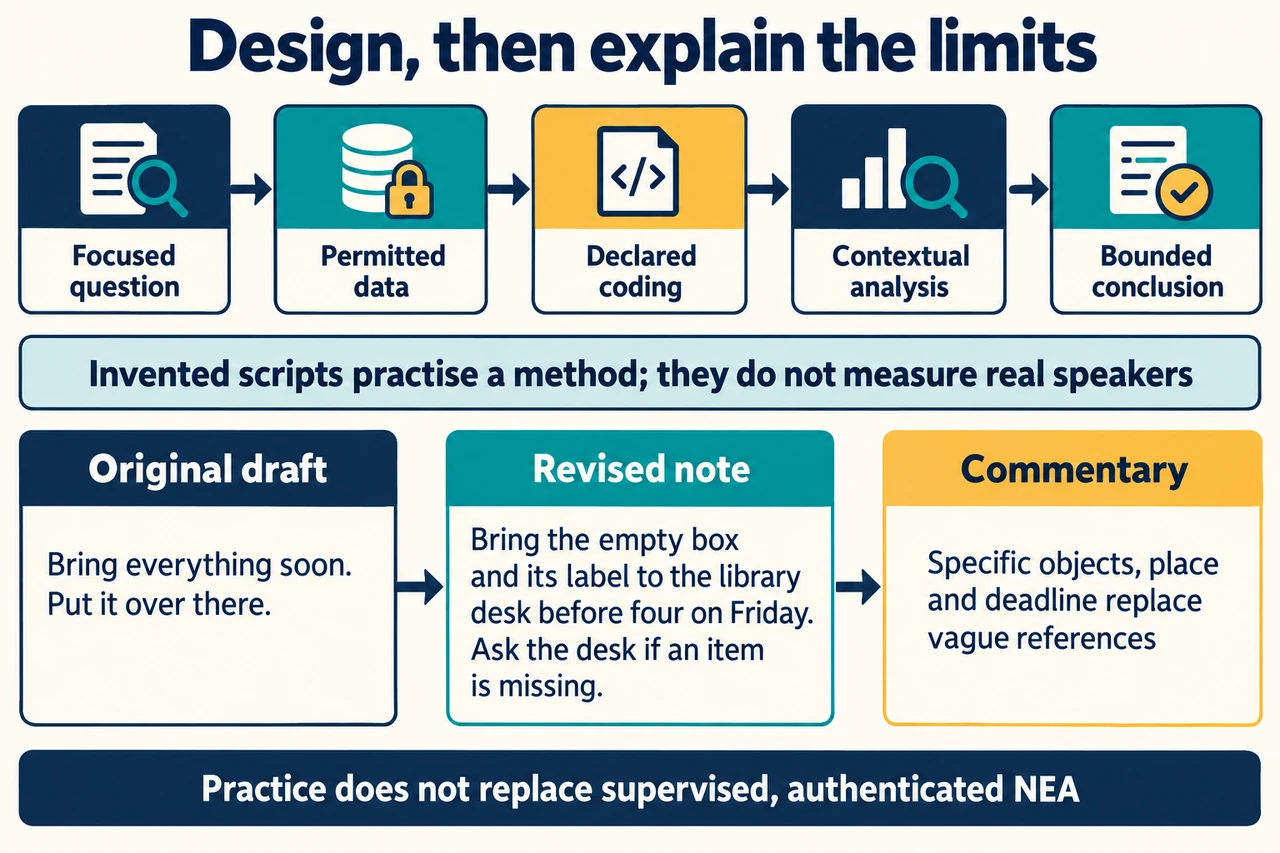
The plate keeps investigation stages separate from drafting and commentary: a question leads to permitted data, coding and a bounded conclusion, while an original draft is revised and evaluated. Its arrows represent a designed workflow, not completed coursework or a validated research result. Real NEA requires the learner’s own work, appropriate supervision, authentication and assessment; reading this model supplies practice rather than those external requirements. Image: illustration, not a documentary photograph.
Worked example: Evaluate the six-line synthetic inquiry, then explain the original note’s revision without claiming completed NEA or measured effectiveness.
The inquiry can demonstrate transparent coding of request forms in two invented scripts, but it cannot answer a question about real speaker groups. Its defensible question is how these six supplied request turns differ in grammatical form. Stating that boundary first prevents an attractive numerical comparison from becoming an unsupported social explanation.
Each script contains three turns. Under the declared rule, A has two imperative-form requests and one modal-interrogative-form request; B has one imperative and two interrogatives. Interrogative proportions are therefore one third and two thirds respectively. The same denominator makes this comparison straightforward, but the values describe an author-designed exercise, not a sampled population. Each script also contains one explicit please token, showing why that count should be recorded separately rather than built into an automatic politeness score.
Coding requires a functional inclusion rule as well as a structural category. A question about someone’s ability may resemble a request, while the wording of an actual request can be imperative. A pilot should identify ambiguous turns and document decisions consistently. In a real inquiry, surrounding discourse and appropriate transcription might help, but no audio, relationships or performed actions are supplied here. It would be unjustified to invent hesitation, warmth or successful cooperation.
The information-note revision offers a separate writing example. Replacing ‘everything’ with ‘the empty box and its label’ gives identifiable objects, while ‘the library desk’ replaces the context-dependent location ‘there’. ‘Before four on Friday’ narrows the vague timing ‘soon’. The added conditional sentence anticipates a missing item and specifies a place to ask. Together these choices aim to support an audience that does not share the writer’s immediate situation.
However, the revision changes information as well as linguistic form. If readers later understood it better, a comparison could not isolate a purely grammatical cause without controlling those differences. The commentary should therefore explain intended effects and acknowledge unmeasured reception, rather than declaring the rewrite scientifically proven.
The overall judgment is that the exercise supplies a usable coding demonstration and a reasoned writing commentary. It does not supply independently collected data, representative findings or authenticated NEA. A learner’s assessed investigation would require their own suitable question, permitted evidence, references and teacher-supervised work under the specification’s actual conditions.
Original practice draft: Bring everything soon. Put it over there.
Original revised note: Bring the empty box and its label to the library desk before four on Friday. Ask the desk if an item is missing.
Answer: The synthetic scripts contain modal-interrogative requests in 1 of 3 A turns and 2 of 3 B turns, with one please token in each. The revised note replaces vague items, place and timing with specific referents and a deadline, but also adds information, so no isolated grammar effect is measured. This practice does not replace permitted real evidence, original work or supervised authenticated NEA.
Check your understanding: A learner wants to publish identifiable family messages and submit this teaching model as their own NEA. Explain an acceptable alternative, including why the numerical exercise cannot replace real-data evidence.
Answer: Do not publish identifiable private messages or present a course model as independently produced work. Consult the supervising teacher about an appropriately focused question, suitable permitted data and the specification’s authentication requirements. Permission, data minimisation, anonymisation and secure handling must match the context; simply removing a name may not prevent identification. Develop original analysis and referenced writing within the allowed supervision and feedback rules. The synthetic six-line comparison can help practise coding, but its proportions were chosen by the author and do not measure real speakers. Suitable real evidence and an honest methodological account are needed for an investigation, while assessed original writing requires the learner’s own selected style-model work, drafting and commentary. No automated lesson certifies those external steps.
Why: A justified answer keeps the supplied linguistic forms and evidence exact, explains alternatives and limits, and does not invent speaker intentions, research outcomes or assessed completion.