A mineral identification is an argument, not a colour guess
By UK A Level Geology · independent study · myAudience
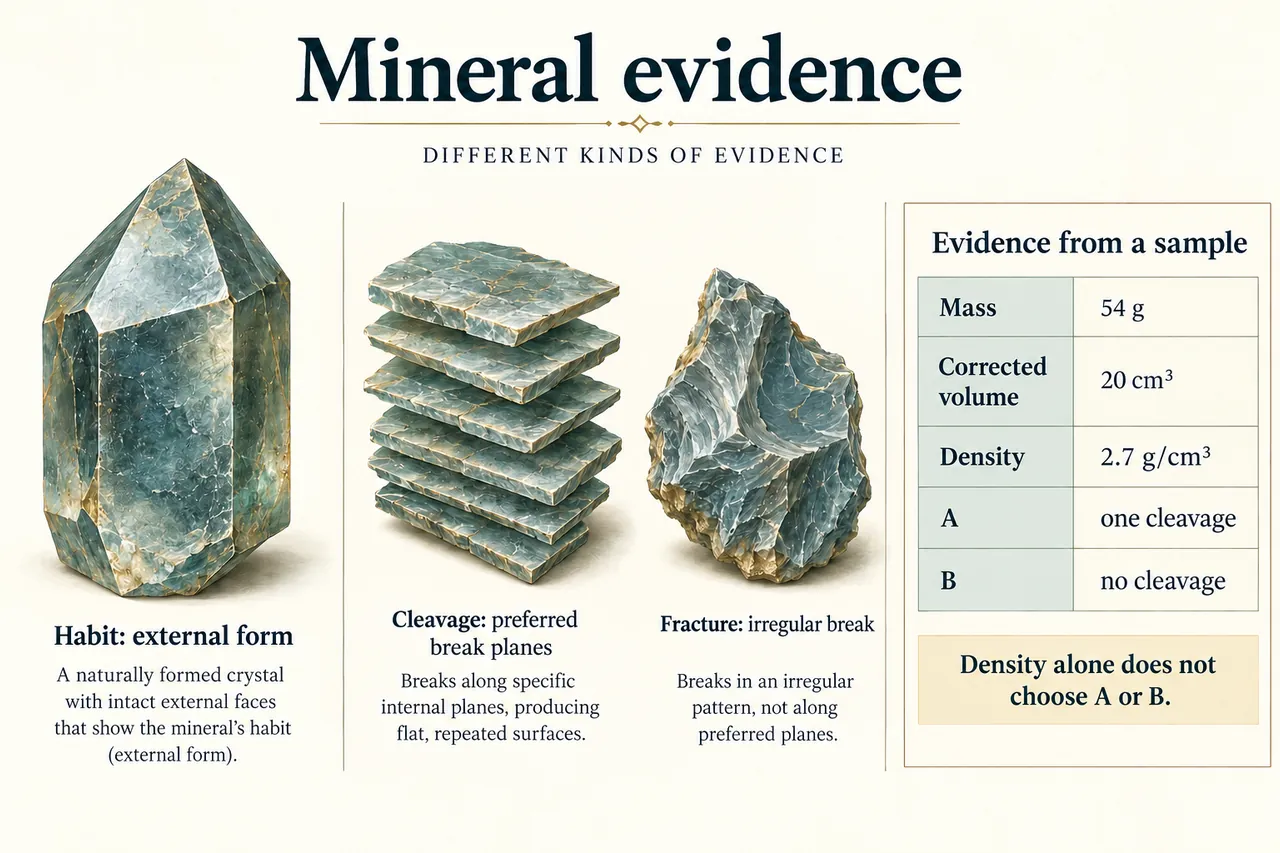
Image: illustration, not a documentary photograph. Numerical examples are stipulated; spatial sections and rock textures are schematic. · Original generated project artwork; no source textbook or examination-board figures reused.
A mineral identification is an argument, not a colour guess
Mineral identification links an observation to an explanation. A mineral has a characteristic internal structure and composition, while a rock can contain several minerals, glass or other components. A commercial description such as economic mineral is broader than the scientific definition: it can include useful rocks and hydrocarbons. We should therefore ask what the word means in the specific claim before treating every extracted material as one crystalline mineral.
An external crystal shape is its habit; cleavage describes preferred directions along which a crystal breaks. These can both reflect internal structure, yet they are not interchangeable observations. A flat face on an intact crystal does not establish that it repeatedly breaks along that plane. Irregular fracture is a different break pattern. Identification becomes stronger when we describe the observed surface before assigning the underlying mechanism.
Hardness concerns resistance to scratching. The Mohs ordering is a relative comparison, not a linear scale: a mineral assigned twice another index is not thereby twice as resistant. Density asks a different question, mass per unit volume. The expression rho = m/V requires corrected specimen volume and compatible units. A displacement measurement can be biased by air bubbles, dissolving material or the support used to hold a sample; supplied corrected volumes avoid claiming that an uncorrected setup has measured the specimen alone.
The fictional table in this lesson deliberately gives two candidates the same density. That design makes the limitation visible: repeating the density calculation cannot discriminate them. A separate cleavage observation changes the balance of evidence. A defensible identification considers consistency, possible confounding observations and candidates missing from the table. It is not a colour-matching game, and an uncertain provisional identification can still be a well-reasoned scientific conclusion.
Evaluated model — Dividing the supplied mass by displaced volume gives 54/20 = 2.7 g/cm³. The unit matters: this is mass per volume, not a mass or a relative hardness. That result is compatible with both candidates in the deliberately restricted table, so it cannot by itself choose A. Reporting many additional decimal places would add no information because the supplied measurements do not support them. The repeated smooth break plane supplies a second observation. If it represents a genuine cleavage plane produced along a preferred internal structural direction, it fits A better than the no-cleavage description of B. We should nevertheless separate observation from interpretation: an externally flat crystal face or an accidental planar fracture is not automatically cleavage. Repetition across broken fragments would strengthen this part of the inference.
The best provisional conclusion is therefore A, with a stated reason and a stated uncertainty. A is not proved merely by matching two properties. An identification table can omit other minerals with similar properties, and the observed volume could be biased by trapped air or unaccounted support displacement. Those are alternative explanations of agreement, not reasons to discard evidence altogether. An additional supplied hardness observation could test whether A remains consistent with the complete property set. Agreement among independent properties is more persuasive than repeated statements about colour. This exercise evaluates fictional observations; it does not demonstrate that a learner has safely used an identification kit, recognised an unfamiliar specimen or completed the practical endorsement.
Unfamiliar transfer — If a second specimen has mass 54 g and corrected volume 18 cm³, and candidate C has density 3.0 g/cm³, does matching C settle its identity? Reasoned response: 54/18 = 3.0 g/cm³ supports C on this property, but identity still requires the other distinguishing evidence and uncertainty. A volume correction changes a substantive inference; it is not permission to choose whichever measurement fits a desired answer.
The plate separates intact external habit from repeated cleavage surfaces, then deliberately gives both candidates density 2.7 g/cm³. Notice that the table cannot choose a candidate until another property is considered. Its labels describe fictional observations, not a tested natural specimen.
Worked example: A supplied table says candidate A has density 2.7 g/cm³ and one perfect cleavage, candidate B density 2.7 g/cm³ and no cleavage. A specimen has mass 54 g, displaced volume 20 cm³ and a repeated smooth break plane. Evaluate which candidate is better supported; explain what cannot yet be concluded.
Compute density from corrected volume: 54 / 20 = 2.7 g/cm³.
Both candidate densities match, so density cannot discriminate.
A repeated cleavage plane supports A rather than B, subject to reliable observation.
Answer: Candidate A is better supported by cleavage, while both match the stipulated density. Confirm further distinguishing properties and measurement uncertainty before assigning a real mineral identity.
Check your understanding: If a second specimen has mass 54 g and corrected volume 18 cm³, and candidate C has density 3.0 g/cm³, does matching C settle its identity?
Answer: 54/18 = 3.0 g/cm³ supports C on this property, but identity still requires the other distinguishing evidence and uncertainty. A volume correction changes a substantive inference; it is not permission to choose whichever measurement fits a desired answer.
Why: Accept equivalent valid reasoning that states assumptions and evaluates limitations; a correct value alone does not establish the geological inference or practical competence.