What crystal size can and cannot tell us
By UK A Level Geology · independent study · myAudience
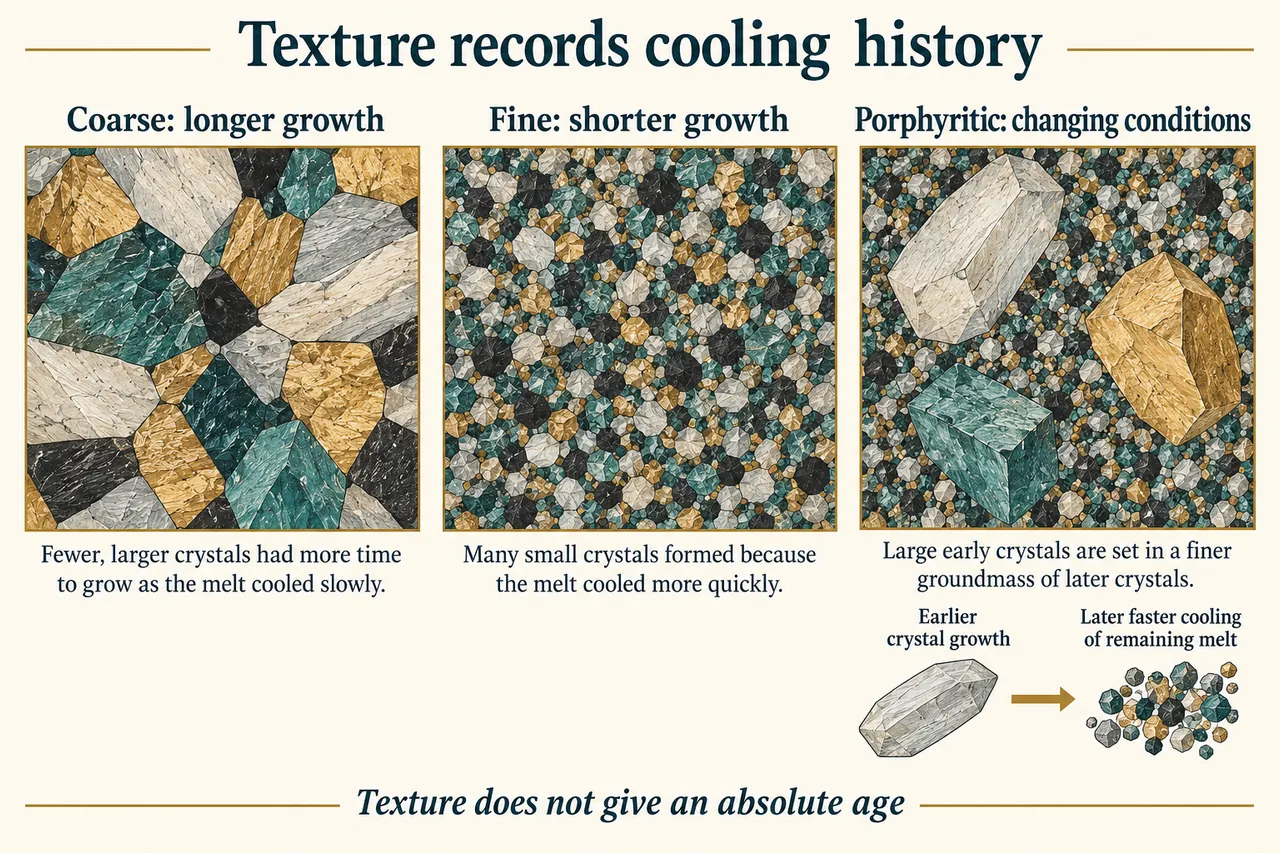
Image: illustration, not a documentary photograph. Numerical examples are stipulated; spatial sections and rock textures are schematic. · Original generated project artwork; no source textbook or examination-board figures reused.
What crystal size can and cannot tell us
Igneous texture records the interaction of crystal nucleation, growth and solidification in a melt. A crystal population can develop as the melt cools, but the final pattern also depends on composition and other growth conditions. Comparing otherwise similar materials is therefore important when using size as evidence. Texture is a record to interpret; it is not an embedded stopwatch that tells us a universal cooling time.
Coarse interlocking crystals are commonly consistent with slower cooling below the surface, whereas rapid cooling near the surface commonly produces a finer texture. Subsequent uplift and erosion can expose an intrusion that originally solidified at depth. Consequently, finding a coarse rock at the surface does not mean it originally cooled there. Nor does a fine texture alone identify its entire chemical composition or prove a particular named volcanic setting.
A porphyritic texture contains relatively large crystals in a finer groundmass. One plausible explanation is earlier crystal growth followed by a change that causes the remaining melt to cool more rapidly. The large and small crystals are then different parts of a connected history, rather than evidence that the specimen is simply a mixture of two unrelated rocks. Evidence from minerals and contacts can strengthen or challenge this interpretation.
We classify texture and mineral assemblage separately before combining them into a rock identification. A coarse crystalline pattern is not exclusively igneous, because metamorphic recrystallisation can also produce interlocking grains. An entirely glassy material also reminds us that rapid cooling can inhibit crystallisation; not every igneous sample is wholly crystalline. A good inference uses the observable pattern, plausible processes and alternative histories without claiming that one attractive illustration proves them.
Evaluated model — X is consistent with a history in which crystals had substantial time to grow before the melt fully solidified. A common explanation is relatively slow cooling below the surface. This connects observable texture to a physical process, but it does not provide an absolute age. Coarse texture cannot tell us whether solidification occurred last year or hundreds of millions of years ago. Y suggests that growth conditions changed. Some crystals could have grown during an earlier slower-cooling stage, after which the remaining melt cooled more quickly and formed the fine groundmass. The interpretation explains why two size populations can coexist in one rock. It is more informative than describing Y simply as fast cooled, which would leave its larger crystals unexplained.
The comparison assumes that composition and other growth conditions are sufficiently similar for cooling to be a useful contrast. Nucleation, melt chemistry and crystal growth also affect texture, so it is sensible to seek mineral assemblages and evidence of the rock's field relationships. A textbook illustration should show these textures schematically and identify its boundaries, rather than imply that a rendered grain is a measured crystal. The claim that Y must be older confuses a cooling history with an age relationship. Two stages within Y tell us about its internal sequence, not whether its first stage predates X. Establishing an age comparison would require separate evidence such as cross-cutting relationships or suitable radiometric ages with uncertainties. Thus a two-stage interpretation is plausible, while the asserted older age is unsupported by the stipulated observations alone.
Unfamiliar transfer — An illustrated sample is entirely glassy. Must every part have cooled faster than every crystal in Y? Reasoned response: Glassy texture is consistent with crystallisation being inhibited during rapid cooling, but the stipulated image provides neither measured cooling rates nor enough compositional information for a universal comparison. Reject the every-part/every-crystal claim.
Follow the coarse, fine and mixed-size textures, then the porphyritic timeline. The large crystals have an earlier growth history than the remaining fine groundmass in this bounded interpretation. The rendering does not supply absolute ages, a measured grain size or a universal cooling rate.
Worked example: Fictional X and Y have comparable composition. X has coarse interlocking crystals; Y has some large crystals surrounded by fine groundmass. Compare their plausible cooling histories and evaluate the claim that Y must be older.
Comparable composition limits one confounder.
Coarse interlocking crystals support relatively slow cooling allowing longer crystal growth for X.
Large crystals in fine groundmass support a change in Y’s crystallisation history.
Texture alone supplies no absolute age ordering between specimens.
Answer: X plausibly crystallised comparatively slowly; Y plausibly records earlier growth followed by finer groundmass formation. Neither texture proves Y is older than X.
Check your understanding: An illustrated sample is entirely glassy. Must every part have cooled faster than every crystal in Y?
Answer: Glassy texture is consistent with crystallisation being inhibited during rapid cooling, but the stipulated image provides neither measured cooling rates nor enough compositional information for a universal comparison. Reject the every-part/every-crystal claim.
Why: Accept equivalent valid reasoning that states assumptions and evaluates limitations; a correct value alone does not establish the geological inference or practical competence.