Follow grains from transport to rock
By UK A Level Geology · independent study · myAudience
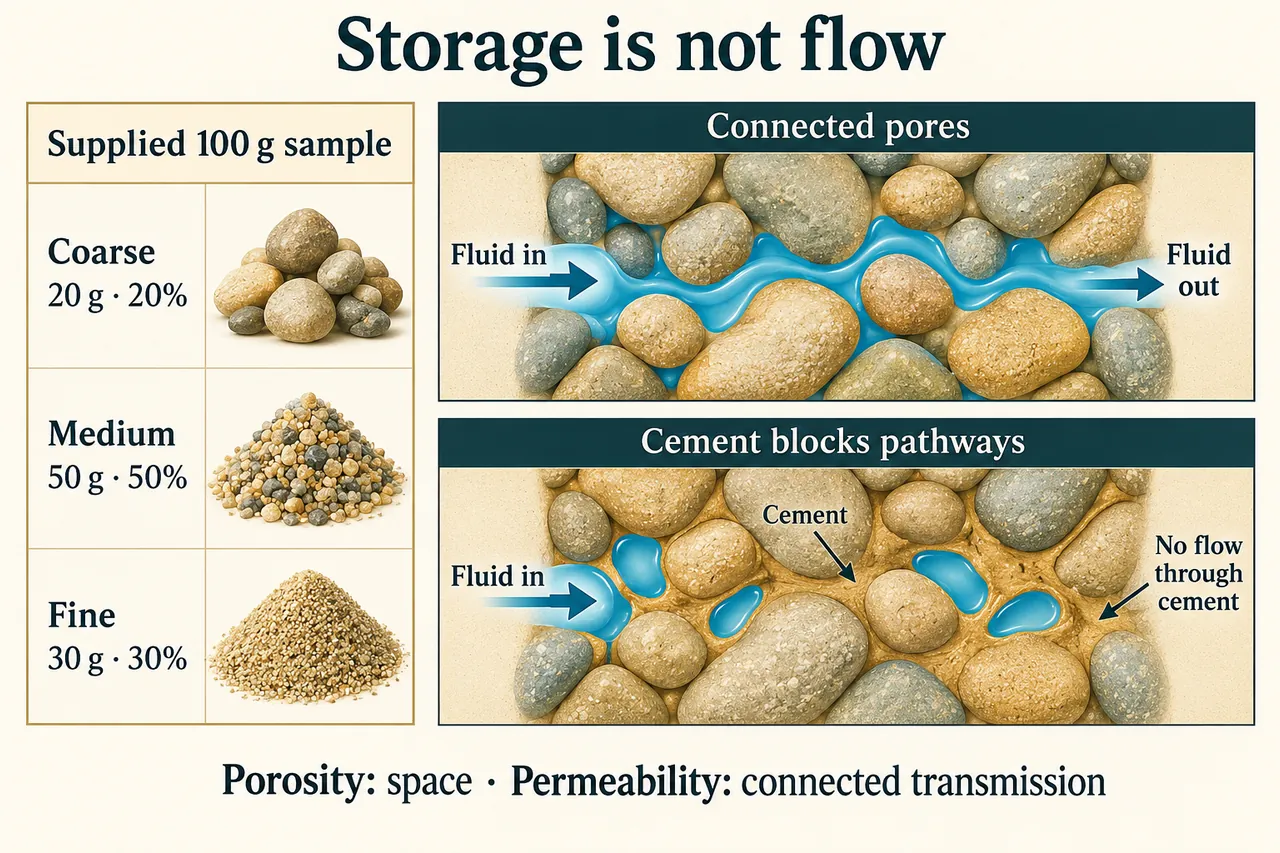
Image: illustration, not a documentary photograph. Numerical examples are stipulated; spatial sections and rock textures are schematic. · Original generated project artwork; no source textbook or examination-board figures reused.
Follow grains from transport to rock
Sediment begins with material made available by weathering and erosion, then transported and deposited under particular conditions. Deposition does not immediately make a hard rock: later compaction and cementation can transform loose sediment. Separating these stages helps explain why observations of a finished rock can record several processes. A rounded grain and a pore-filling cement need not have formed at the same time.
Grain size, rounding and sorting answer different descriptive questions. Sorting concerns the spread of sizes, whereas rounding concerns grain outlines; neither is the same as how densely grains are packed. Changes in transport conditions can influence the distribution, but a size class is not a unique environmental fingerprint. To infer an environment we also examine sedimentary structures, composition and wider relationships, with the limits of sampling made explicit.
A sieve dataset is a mass balance. Dividing each retained fraction by the total sample mass gives its mass percentage, not the fraction of individual grains. Many small grains may account for less mass than a few large ones. The supplied 20/50/30 g example totals 100 g, so its percentages are transparent. A table describes these checkpoints, but it is not a substitute for learning how to construct and interpret a cumulative size distribution.
Pore space and connected fluid transmission must also be distinguished. Porosity concerns the proportion of space that can store fluid; permeability depends on pathways and their connections. Cement can block a narrow throat even while larger cavities remain. Isolated pores therefore do not provide an uninterrupted route across a sample. Predicting a numerical flow rate additionally requires specimen dimensions, pressure conditions and suitable measured properties, rather than just a picture of blue spaces.
Evaluated model — The supplied fractions add to 100 g, so they account for the whole fictional sample. Their mass percentages are therefore 20%, 50% and 30%, respectively. These are mass proportions of the selected size classes, not counts of grains. The largest class by mass is medium, but that alone does not justify saying that every grain is medium or that the deposit is perfectly sorted. Grain-size evidence helps describe sediment and may constrain transport and deposition. It does not uniquely locate the original environment. Different processes can produce overlapping size distributions, and the sample must be considered alongside structures, grain shape and other field evidence. We should not turn a useful proxy into an automatic environmental label.
The water-flow question requires a different distinction. Porosity describes space available for fluid storage; permeability concerns how readily fluid can move through connected pathways. A rock may contain considerable pore space yet pass water poorly if those spaces are isolated or linked by narrow, obstructed throats. Cementation can obstruct those pathways even when the original sediment had a favourable grain arrangement. Under the stipulated conditions, A is more likely to pass water readily because its pores are connected, whereas B's cement blocks them. That conclusion follows from the supplied connectivity information, not from the sieve percentages alone. Predicting a numerical flow rate would require additional evidence such as geometry, pressure gradient and measured hydraulic properties. The exercise supports reasoning about a mass balance and a mechanism; it does not demonstrate a real sieve investigation or establish a complete aquifer model.
Unfamiliar transfer — A third rock has more total pore space than A but most pores are isolated. Is greater water flow guaranteed? Reasoned response: No. Greater storage space does not guarantee connected transmission. The fictional evidence establishes a porosity increase but not a permeability increase; a quantitative flow claim also needs pressure and specimen geometry.
Check the 20/50/30 g table independently, then follow only the continuous blue pathways. Blue cavities in the cemented panel are storage spaces even when no uninterrupted route crosses the rock. The illustration must not imply that fluid passes through the drawn solid cement.
Worked example: A fictional 100 g sample has 20 g coarse, 50 g medium and 30 g fine fractions. Two rocks made from similar grains differ: A has connected pores; B has pores blocked by cement. Evaluate whether the sieve results predict which rock passes water more readily.
Check mass closure: 20 + 50 + 30 = 100 g.
Corresponding mass fractions are 20%, 50% and 30%.
A connected pore network permits flow under a gradient; B’s cement can obstruct that network.
Sorting alone does not quantify connectivity, pressure gradient or specimen geometry.
Answer: A is more plausibly permeable under comparable test conditions because its pores connect. The sieve fractions describe grain-size distribution, not a quantitative flow rate.
Check your understanding: A third rock has more total pore space than A but most pores are isolated. Is greater water flow guaranteed?
Answer: No. Greater storage space does not guarantee connected transmission. The fictional evidence establishes a porosity increase but not a permeability increase; a quantitative flow claim also needs pressure and specimen geometry.
Why: Accept equivalent valid reasoning that states assumptions and evaluates limitations; a correct value alone does not establish the geological inference or practical competence.