A changed rock need not have melted
By UK A Level Geology · independent study · myAudience
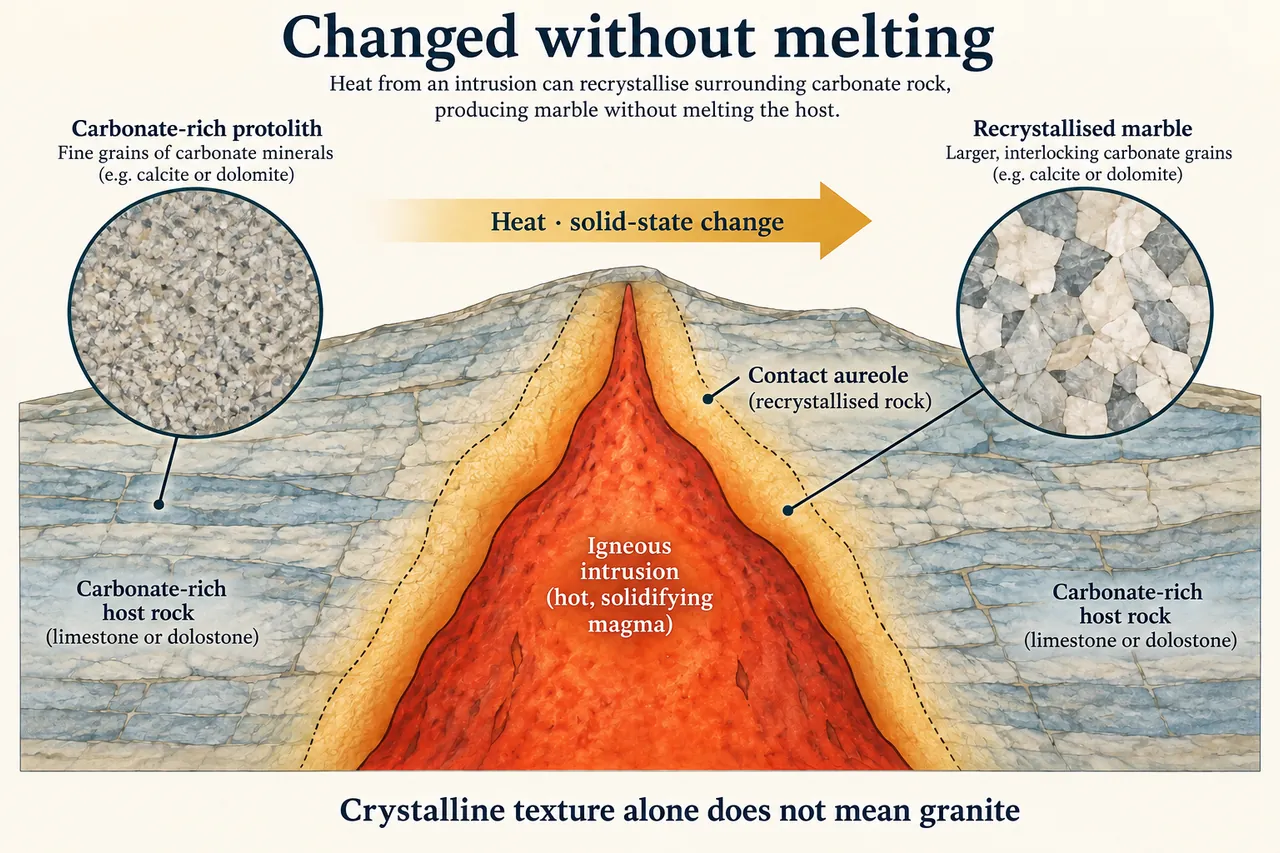
Image: illustration, not a documentary photograph. Numerical examples are stipulated; spatial sections and rock textures are schematic. · Original generated project artwork; no source textbook or examination-board figures reused.
A changed rock need not have melted
Metamorphism changes a pre-existing rock under new physical and chemical conditions without requiring wholesale melting. Minerals can recrystallise, react or become organised into a different fabric while the material remains solid. If material melts and subsequently solidifies, that component needs an igneous account. The boundary matters because a similar crystalline appearance can result from different histories.
A nearby hot intrusion can alter surrounding rocks in a contact aureole. The effect depends on more than distance from the intrusion: parent composition, temperature history and fluids constrain which minerals form. A carbonate-rich parent can recrystallise into marble, while a mud-rich parent can develop quite different minerals and fabrics. Identifying one process does not remove the need to identify the material undergoing it.
Directed stress and prolonged deformation can align minerals and produce fabrics during regional metamorphism. Pressure, temperature and stress should not be treated as identical causes. Pressure is a scalar measure, while directed stress and deformation help explain orientation. A contact-metamorphic example is therefore not automatically a model of every regional fabric, and an absence of strong foliation is not proof that no metamorphism occurred.
The OCR foundations treatment emphasises metamorphic change, and later petrology expands the evidence to index minerals, stability fields and deformation. A simple isochemical model may keep bulk composition fixed for an investigation, but fluid-mediated chemical transfer can change it in real systems. We will state such modelling assumptions rather than present bulk-composition invariance as universal. The same discipline applies to an overburden-pressure calculation: its result is one constrained quantity, not a complete diagnosis of a rock.
Evaluated model — The supplied setting and solid-state change support contact metamorphism. A nearby hot intrusion can raise the temperature of its surrounding rock, allowing existing minerals to recrystallise without the surrounding rock itself becoming molten. This is a mechanism that explains the observed change, rather than a name selected only because the sample looks crystalline. A carbonate-rich protolith can recrystallise into marble. Larger interlocking crystals are therefore compatible with a metamorphic history and are not exclusive to intrusive igneous rocks. Granite requires evidence of the appropriate mineral assemblage and igneous origin; the word crystalline does not supply either. Inferring granite from this texture alone would confuse an observation shared by several rock types with a unique diagnostic property.
The absence of melting evidence matters because metamorphism and melting are different processes. If a part of the rock melted and later crystallised, that component would require an igneous explanation. However, absence of visible melt features in one fictional image is not a universal proof that no melt ever existed anywhere nearby. The conclusion should stay within the supplied evidence. Additional mineral identification, spatial relations across the contact and evidence of a thermal gradient would strengthen the interpretation. Parent composition also constrains which minerals can form. Pressure, temperature, fluid interaction and time should not be treated as interchangeable causes or as a single numerical index of rock identity. This model supports a contact-metamorphic interpretation while leaving regional metamorphism, chemical transfer by fluids, thin-section diagnosis and actual specimen work for later teaching and assessment.
Unfamiliar transfer — Using stipulated density 2700 kg/m³, g 10 m/s² and depth 5000 m, compute overburden pressure. Does this identify a unique metamorphic facies? Reasoned response: p = rho g h = 135000000 Pa = 135 MPa under a simplified uniform-density model. It does not identify a facies without temperature, composition and appropriate evidence; lithostatic pressure is a later 6.2.1 scaffold, not full assessed closure here.
The contact aureole surrounds the intrusion, while the host’s inset changes by solid-state recrystallisation. Notice that heat reaches the host without a host-melting arrow. The paired textures illustrate one carbonate-rich pathway, not every metamorphic assemblage or a measured temperature map.
Worked example: A fictional carbonate-rich rock near an intrusion becomes a coarse interlocking crystalline rock, with no evidence of melting. Evaluate an interpretation of contact metamorphism and explain why that texture is not sufficient to label the rock granite.
The carbonate-rich host provides compositional evidence.
Heating next to an intrusion and no melting support contact metamorphism.
Interlocking crystalline texture can form by solid-state recrystallisation.
Granite identification would need appropriate igneous composition and history, not texture alone.
Answer: Contact metamorphism is supported. A carbonate-rich parent may recrystallise to marble; crystalline texture does not make it granite or provide a unique temperature.
Check your understanding: Using stipulated density 2700 kg/m³, g 10 m/s² and depth 5000 m, compute overburden pressure. Does this identify a unique metamorphic facies?
Answer: p = rho g h = 135000000 Pa = 135 MPa under a simplified uniform-density model. It does not identify a facies without temperature, composition and appropriate evidence; lithostatic pressure is a later 6.2.1 scaffold, not full assessed closure here.
Why: Accept equivalent valid reasoning that states assumptions and evaluates limitations; a correct value alone does not establish the geological inference or practical competence.