Read a sequence before assigning a date
By UK A Level Geology · independent study · myAudience
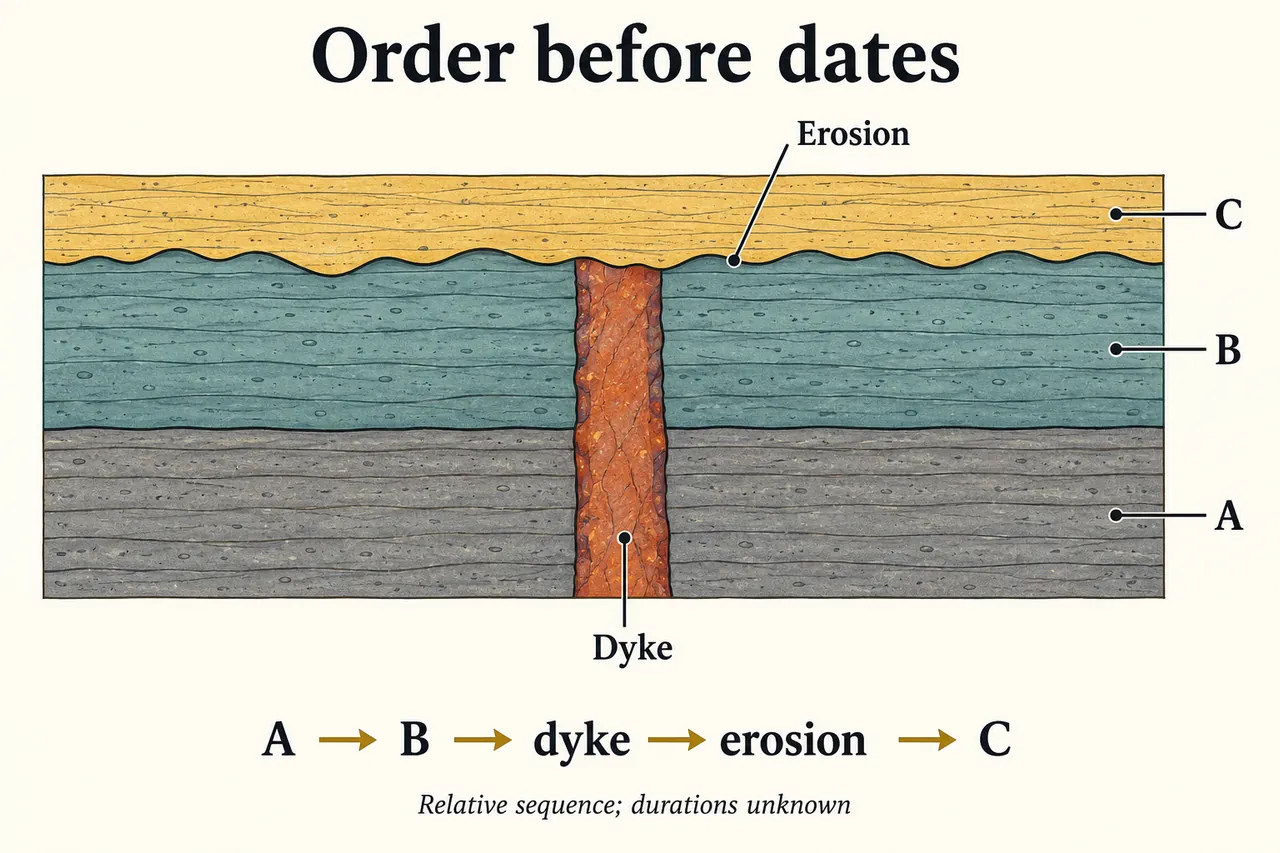
Image: illustration, not a documentary photograph. Numerical examples are stipulated; spatial sections and rock textures are schematic. · Original generated project artwork; no source textbook or examination-board figures reused.
Read a sequence before assigning a date
A geological section records relationships among events. Relative dating asks which came before which; numerical dating asks how much time has elapsed. A sequence can be well constrained even when its durations are unknown. We should keep those achievements separate: declining to attach invented dates does not make a carefully justified relative history uninformative.
In an undeformed, correctly oriented sedimentary sequence, a younger bed is deposited above an older one. That superposition rule cannot be applied blindly to every present-day vertical arrangement, because folding, overturning and faulting can change it. Original orientation and evidence of disturbance are part of the argument, not optional details added after a conclusion has already been selected.
A feature that cuts another rock is younger than the rock it cuts. The rule is useful for intrusions and faults, but requires an observed relationship. Extending a drawn dyke through a concealed contact is an interpretation, not the same evidence as a visible cut. Similarly, an erosional surface truncating a dyke demonstrates a later event, while a bed covering the surface must be later still.
An unconformity or erosional gap represents an incomplete record, not an instant that can be read directly from its drawn thickness. Rapid deposition, long pauses and later removal can produce different histories with superficially similar layer thicknesses. Numerical age constraints can improve the partial order, but a date from an intrusive mineral may date crystallisation rather than the deposition of neighbouring beds. Its meaning depends on what material and process the measurement actually records.
Evaluated model — The supplied undeformed orientation allows A to be placed before B by superposition. That inference depends on the stated setting: in a folded or overturned sequence, simply calling the physically lower bed older would not be adequate. The dyke is younger than both beds because it cuts them; it could not cut rock that did not yet exist. The erosional surface is younger than the part of the dyke that it truncates. C was deposited after that surface existed, because it covers the surface. Combining these relationships gives A, then B, then the dyke, then erosion, then C. This is a relative sequence of events, not a set of measured numerical ages. Some unobserved processes could have occurred between these events without contradicting the sequence.
Thickness does not reveal elapsed time by itself. A thick unit may accumulate quickly, a thin unit may take a long time, and an erosional gap may remove much of the record. Assigning a duration requires additional evidence, such as constrained deposition rates or independently dated horizons, with their assumptions and uncertainties made explicit. A suitable crystallisation date from the dyke could provide a numerical constraint on its formation and, through the cutting relationship, a younger bound for A and B. It would not automatically date their deposition exactly. Nor would it measure the duration of the later erosion. The strength of the interpretation comes from linking each conclusion to a specific observation and recognising which questions the outcrop does not answer.
Unfamiliar transfer — If the contact between the dyke and B is hidden, can the image alone prove that the dyke cuts B? Reasoned response: No. The visible cut through A constrains A, but a concealed contact with B leaves that relation unresolved unless independent evidence supplies it. A plausible drawn extrapolation must be labelled an interpretation.
Trace the dyke through A and B to its truncation at erosion; C covers the surface and is not cut. Those contacts justify the displayed order. A concealed continuation would change the evidence, and the distances or thicknesses in this schematic do not assign event durations.
Worked example: In a stipulated undeformed section A lies below B. A dyke cuts both; erosion truncates the dyke; C covers that surface. Explain the oldest-to-youngest sequence and evaluate whether thickness tells us how long each stage lasted.
Superposition in the stipulated undeformed section puts A before B.
The dyke cuts both, so it is younger than both.
Erosion truncates the dyke; C later covers that surface.
Thickness does not measure elapsed time or unconformity duration.
Answer: Oldest to youngest: A, B, dyke intrusion, erosion, C. These are relative constraints, not numerical ages or durations.
Check your understanding: If the contact between the dyke and B is hidden, can the image alone prove that the dyke cuts B?
Answer: No. The visible cut through A constrains A, but a concealed contact with B leaves that relation unresolved unless independent evidence supplies it. A plausible drawn extrapolation must be labelled an interpretation.
Why: Accept equivalent valid reasoning that states assumptions and evaluates limitations; a correct value alone does not establish the geological inference or practical competence.