A shared fossil does not prove identical environments
By UK A Level Geology · independent study · myAudience
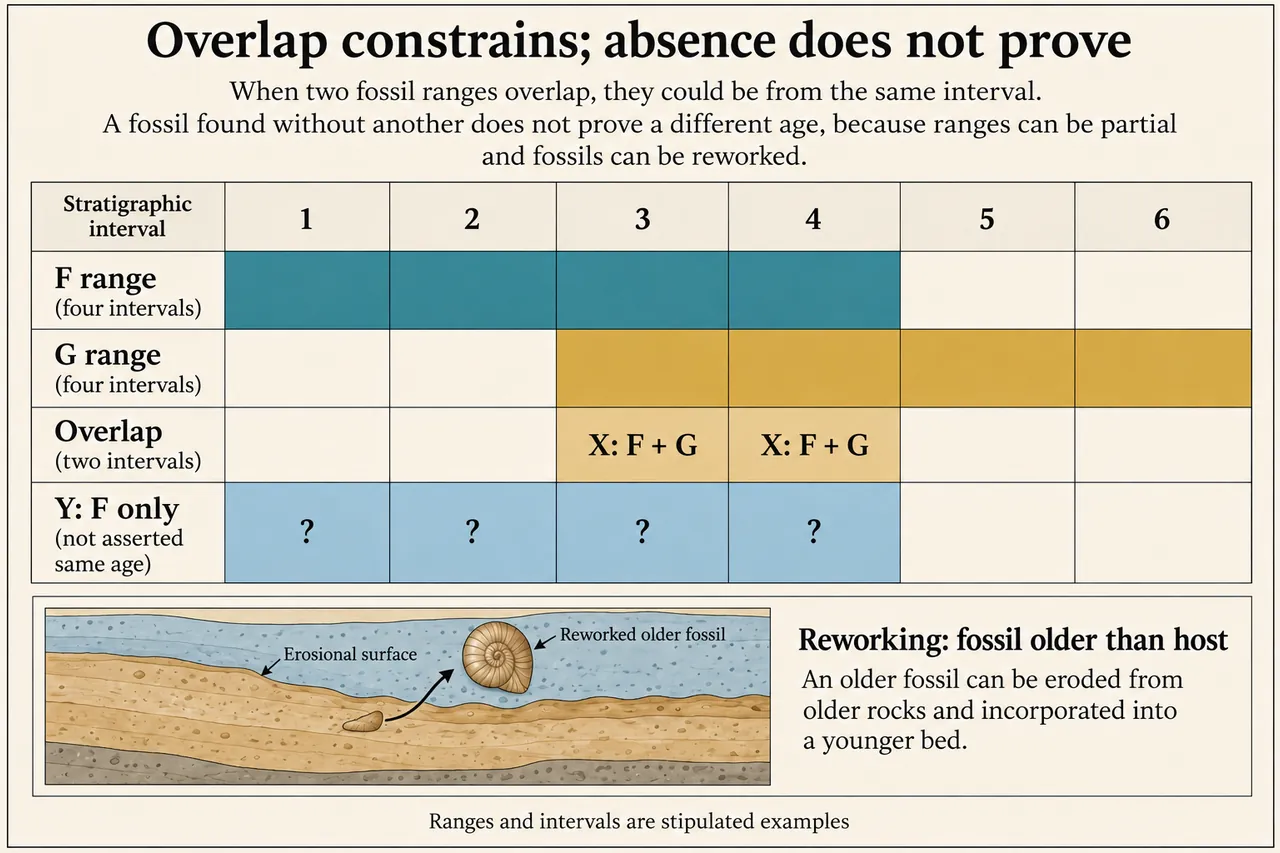
Image: illustration, not a documentary photograph. Numerical examples are stipulated; spatial sections and rock textures are schematic. · Original generated project artwork; no source textbook or examination-board figures reused.
A shared fossil does not prove identical environments
Fossils preserve evidence of organisms or their activities. Body fossils and trace fossils record different aspects of life, and preservation is selective. Soft parts, hard parts and traces do not all enter the record with equal probability. An assemblage is therefore a surviving sample shaped by ecology, deposition, alteration and discovery, rather than a complete census of every organism present.
A fossil range links identified occurrences to an interval in a stratigraphic framework. Combining overlapping ranges can constrain a deposit more tightly than either range alone, provided the fossils were deposited with it and the range information is suitable. The fictional intervals here teach that logic without assigning made-up ranges to real taxa. Named zone fossils and their morphology require separate source-supported study.
Correlation uses similarities and differences to relate separated records. Two beds with a shared fossil can be compatible in age without being exactly contemporaneous or environmentally identical. A species may live in several settings; some sedimentary environments may exclude it. Similar rock types can also form at different times. Age and facies are different inferences that should not be merged merely because one picture looks persuasive.
An absent fossil is especially difficult to interpret. Failure to find it may reflect its original absence, loss through poor preservation or limited sampling, rather than extinction. Reworking creates another complication: a fossil eroded from an older rock can enter a younger deposit. A robust interpretation combines identification, preservation and depositional evidence, and makes any contemporaneous-assemblage assumption explicit before narrowing a bed to an overlap interval.
Evaluated model — If the stipulated ranges are reliable and both fossils were deposited with bed X rather than reworked, the overlap constrains X to intervals 3–4. F alone allows intervals 1–4, whereas G alone allows 3–6. Their intersection is more informative than either range by itself. This is a logical consequence of the supplied ranges, not an age estimate obtained from an illustration. Bed Y contains F, but the information does not restrict Y to the overlap. It could fall anywhere in intervals 1–4 under the same assumptions. X and Y might therefore be contemporaneous, but an exact match is not established. Further identified fossils or suitable independently dated horizons could improve the comparison.
The absence of G in Y is also ambiguous. G may genuinely have been absent from that environment, may not have been preserved, or may not have been found in the available sample. A missing observation is not automatically evidence of extinction. This is why useful zone fossils are considered in terms of their ranges, distribution and recognisability, alongside the quality of the record. Finally, a fossil can be eroded from older rock and redeposited. A reworked F would constrain the fossil's origin rather than simply date its new host bed. Correlation should therefore combine evidence of preservation and deposition with fossil identity. The defensible conclusion is an interval constraint for X under explicit assumptions, while the exact correlation of Y remains unresolved; neither identical fossil content nor similar lithology proves identical environments.
Unfamiliar transfer — Bed Z has a reworked F above a well-established interval 5 horizon. Is the supplied 1–4 range inconsistent with Z being younger than 4? Reasoned response: No. The organism lived earlier, but its fossil can enter a younger deposit. Reworking breaks the simple contemporaneous-assemblage assumption. The younger horizon and reworking evidence distinguish fossil age from host deposition age.
Count the synthetic range columns: F covers 1–4, G covers 3–6, and their overlap is only 3–4. The separate reworking inset explains how a fossil can be older than its host. None of these columns represent a named taxon’s observed geological range.
Worked example: Fictional fossil F ranges intervals 1–4 and G ranges 3–6. Both occur in bed X. Bed Y contains only F. Evaluate the age constraint on X and the claim that Y must be exactly the same age.
F covers intervals 1–4; G covers 3–6.
Their intersection is intervals 3–4.
X containing both is constrained to that intersection if fossils are contemporaneous and ranges reliable.
F alone permits Y anywhere in 1–4; absence of G is not proof of a different or identical age.
Answer: X is consistent with intervals 3–4 under the stated assumptions. Y is not necessarily exactly the same age: its F-only assemblage provides a weaker constraint and preservation or reworking can alter inference.
Check your understanding: Bed Z has a reworked F above a well-established interval 5 horizon. Is the supplied 1–4 range inconsistent with Z being younger than 4?
Answer: No. The organism lived earlier, but its fossil can enter a younger deposit. Reworking breaks the simple contemporaneous-assemblage assumption. The younger horizon and reworking evidence distinguish fossil age from host deposition age.
Why: Accept equivalent valid reasoning that states assumptions and evaluates limitations; a correct value alone does not establish the geological inference or practical competence.