One Earth, two ways of dividing its interior
By UK A Level Geology · independent study · myAudience
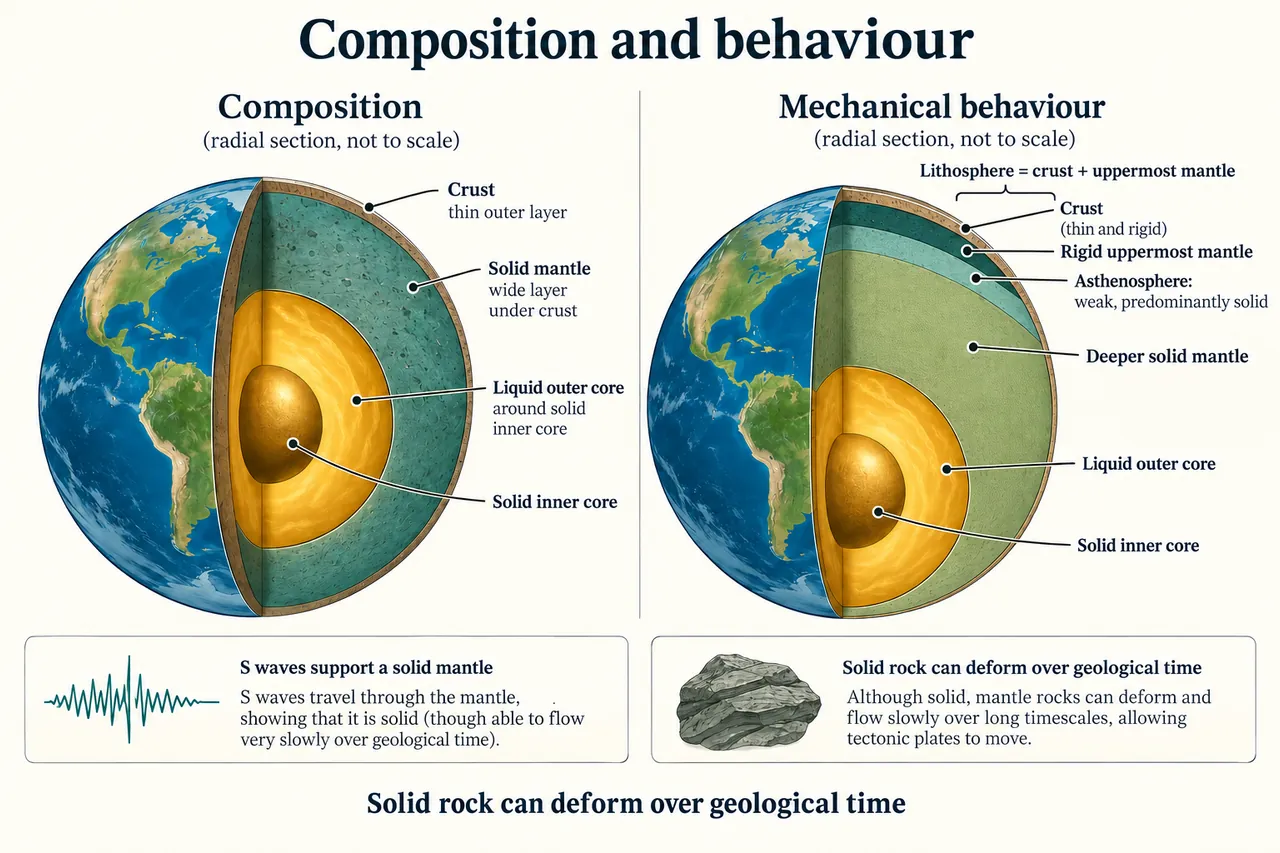
Image: illustration, not a documentary photograph. Numerical examples are stipulated; spatial sections and rock textures are schematic. · Original generated project artwork; no source textbook or examination-board figures reused.
One Earth, two ways of dividing its interior
The Earth’s interior is inferred from converging evidence rather than observed as a cut-open globe. Seismic transmission and refraction, gravitational and density constraints, exposed rocks and sampled materials each contribute to a model. A coloured section is a useful representation of that inference, but is neither a photograph nor a direct measurement of every boundary.
Crust, mantle and core primarily distinguish composition. Lithosphere and asthenosphere describe mechanical behaviour. The lithosphere includes the crust and mechanically strong uppermost mantle; treating it as only crust omits part of each plate. Aligning the two classifications on an illustration helps prevent the mistake of assuming that every compositional boundary is also the same mechanical boundary.
The mantle is predominantly solid, consistent with transmission of both P and S seismic waves. It can nevertheless deform slowly over geological time. A solid’s response during a short wave passage need not match its response under prolonged stress. Mechanically weak asthenosphere therefore does not mean an entirely liquid layer, and local partial melting does not make the whole mantle a global ocean of magma.
The liquid outer core provides a useful contrast. Direct S-wave transmission is absent through it, while P-wave paths are refracted. Together with other evidence, these observations support a different physical state from the solid mantle. Wave speeds depend on elastic properties as well as density; assigning a single speed to one simplified path is a stipulated calculation model, not a complete explanation of the real interior.
Evaluated model — The statement combines two mistaken classifications. Crust and mantle are principally compositional divisions: their materials differ. Lithosphere and asthenosphere describe mechanical behaviour. A lithospheric plate includes the crust and the mechanically strong uppermost mantle, so calling it only crust leaves out a substantial part of the moving structure. The mantle is predominantly solid. Its transmission of both P and S seismic waves is important evidence, because shear waves require a material capable of supporting shear on the relevant timescale. Yet solid rock can deform slowly over very long periods under suitable conditions. A material's behaviour during a brief wave passage need not be identical to its response to stress over geological time.
Consequently, mantle motion is not itself proof of a globally liquid mantle. The asthenosphere is mechanically weak relative to the lithosphere, but the word weak should not be replaced with liquid. Local partial melting can occur, and its presence does not make the entire mantle a molten reservoir. A simplified teaching diagram should distinguish those claims rather than colour every deeper layer as flowing lava. The liquid outer core provides a contrasting case. The absence of directly transmitted S waves through it, combined with P-wave refraction and other evidence, supports a different physical state from the solid mantle. No single observation determines every property of every layer. The most coherent explanation uses compositional labels for material divisions, mechanical labels for behaviour, and seismic observations as evidence within a model rather than as direct photographs of the interior.
Unfamiliar transfer — For a stipulated straight 60 km path at 6 km/s calculate P time. Can that constant-speed result determine a real deep Earth route? Reasoned response: 10 s. It is a supplied homogeneous straight-path model. A real route involves varying elastic properties/density and refraction, so the numerical answer cannot by itself reconstruct a deep boundary.
Compare the compositional panel with the mechanical bracket. Lithosphere spans crust plus uppermost mantle, while the asthenosphere remains predominantly solid despite being weaker. The section is not to scale; its colours do not depict a globally molten mantle.
Worked example: Evaluate the statement: “The mantle moves, so it must be liquid; plates are only crust.” Use the difference between compositional and mechanical classifications and the seismic evidence.
Compositional and mechanical layers answer different questions.
The lithosphere contains crust plus rigid uppermost mantle.
S-wave transmission is evidence for a solid mantle.
Predominantly solid material can deform over geological timescales.
Answer: Both assertions are misleading. Plates are lithosphere, not crust alone. Mantle deformation over long times does not imply that the entire mantle is liquid.
Check your understanding: For a stipulated straight 60 km path at 6 km/s calculate P time. Can that constant-speed result determine a real deep Earth route?
Answer: 10 s. It is a supplied homogeneous straight-path model. A real route involves varying elastic properties/density and refraction, so the numerical answer cannot by itself reconstruct a deep boundary.
Why: Accept equivalent valid reasoning that states assumptions and evaluates limitations; a correct value alone does not establish the geological inference or practical competence.