Use an arrival gap without pretending the model is the whole Earth
By UK A Level Geology · independent study · myAudience
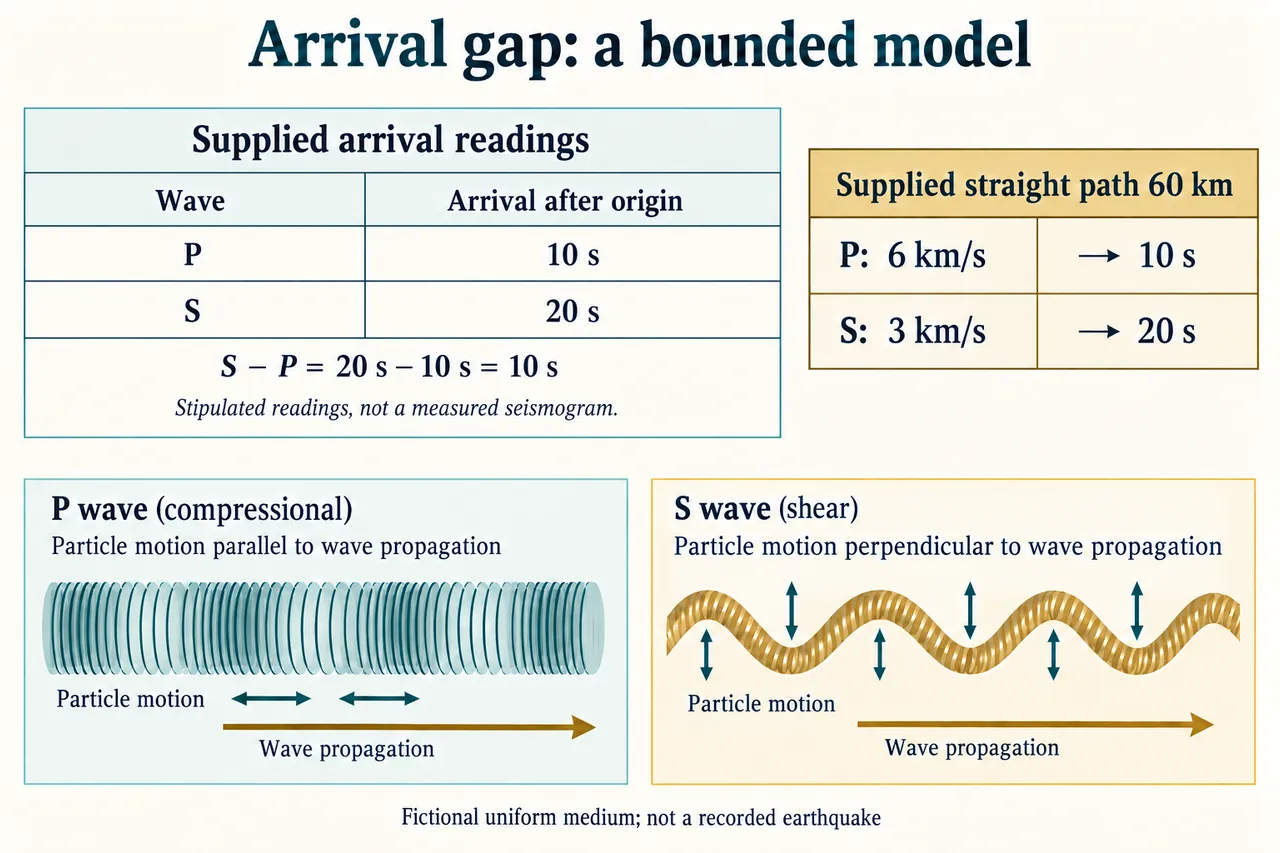
Image: illustration, not a documentary photograph. Numerical examples are stipulated; spatial sections and rock textures are schematic. · Original generated project artwork; no source textbook or examination-board figures reused.
Use an arrival gap without pretending the model is the whole Earth
P and S waves differ in how material moves as energy propagates. P motion is longitudinal: compressions and dilations occur parallel to propagation. S motion is transverse: displacement is perpendicular to propagation. A particle-motion arrow must therefore be distinguished from a wave-travel arrow; drawing both along the same direction for S waves would teach the wrong mechanism.
A seismogram records motion over time; it is not the earthquake itself. Picking an arrival means identifying an onset within a recorded signal, not simply finding its largest peak. The arrival gap can constrain distance through a travel-time model. We deliberately stipulate two constant speeds and one straight shared path here so that each algebraic assumption can be checked.
If path length is d, travel time is distance divided by speed. With P speed 6 km/s and S speed 3 km/s, the difference is d/3 minus d/6, or d/6 seconds when d is measured in kilometres. A ten-second gap then corresponds to 60 km. Substituting the answer back into both travel times checks the model rather than relying on an unexplained conversion factor.
A single station’s distance constraint does not specify direction or uniquely resolve a hypocentre. A flat-map circle is a limited geometric teaching approximation; real location combines multiple observations with appropriate Earth and depth models. Uncertainty in arrival picks, speeds and paths affects the result. The gap alone also does not give magnitude, expected damage or the timing of a future event, which require different evidence.
Evaluated model — For path length d, the P travel time is d/6 seconds and the S travel time is d/3 seconds when d is expressed in kilometres. The later S arrival therefore has a gap d/3 − d/6 = d/6 seconds. Setting that expression equal to the stipulated ten seconds gives d = 60 km. Substitution checks the result: P takes ten seconds, S takes twenty, and their difference is ten. The derivation is better than memorising a distance multiplier because it exposes the assumptions. Both waves have been assigned the same path and constant speeds. Actual wave speeds and paths depend on the Earth's structure, and a real location uses an appropriate travel-time model rather than treating these fictional values as universal constants.
One station provides a distance constraint within that model, not a unique direction. A simplified flat-map circle represents possible positions at that distance when depth and geometry have been deliberately excluded. Multiple stations can help resolve location, but a rendered intersection is not independent evidence that their observations or underlying model are correct. Real uncertainty and depth estimation need further treatment. The arrival gap also does not directly report earthquake magnitude, damage or the time of a future event. Those are separate questions requiring appropriate evidence. A convincing answer thus gives the checked 60 km result, explains the travel-time mechanism and limits the inference to the specified model. Recognising these boundaries is part of useful scientific reasoning, not a reason to abandon a transparent approximation.
Unfamiliar transfer — If the measured gap is 9–11 s with the same stipulated speeds, what distance interval follows? Does it include speed uncertainty? Reasoned response: 54–66 km by d = 6 × gap. This accounts only for the stipulated gap interval, not speed/model/path uncertainty. It does not predict another earthquake or guarantee a particular damage level.
Read the stipulated P arrival of 10 s and S arrival of 20 s, giving a 10 s gap. Compare the P particle arrows parallel to travel with S particle arrows perpendicular to travel. The arrival table gives a fictional teaching example, not a measured seismogram. The constant-speed path table is a bounded model, not a recorded earthquake.
Worked example: In a stipulated homogeneous model, P speed 6 km/s and S speed 3 km/s along the same path. The measured S–P gap is 10 s. Derive the distance and evaluate what one station can establish.
Use travel time t = d / v with the same stipulated path.
The gap is d/3 − d/6 = d/6 seconds when d is in kilometres.
A 10 s gap therefore gives d = 60 km; P time is 10 s and S time 20 s.
One station supplies a model-dependent distance, not a unique surface location or future-earthquake prediction.
Answer: The stipulated distance is 60 km. Real travel-time interpretation must consider depth, varying speeds and refraction; multiple stations and suitable models are needed for location.
Check your understanding: If the measured gap is 9–11 s with the same stipulated speeds, what distance interval follows? Does it include speed uncertainty?
Answer: 54–66 km by d = 6 × gap. This accounts only for the stipulated gap interval, not speed/model/path uncertainty. It does not predict another earthquake or guarantee a particular damage level.
Why: Accept equivalent valid reasoning that states assumptions and evaluates limitations; a correct value alone does not establish the geological inference or practical competence.