What does education do—and for whom?
By UK A Level Sociology · independent study · myAudience
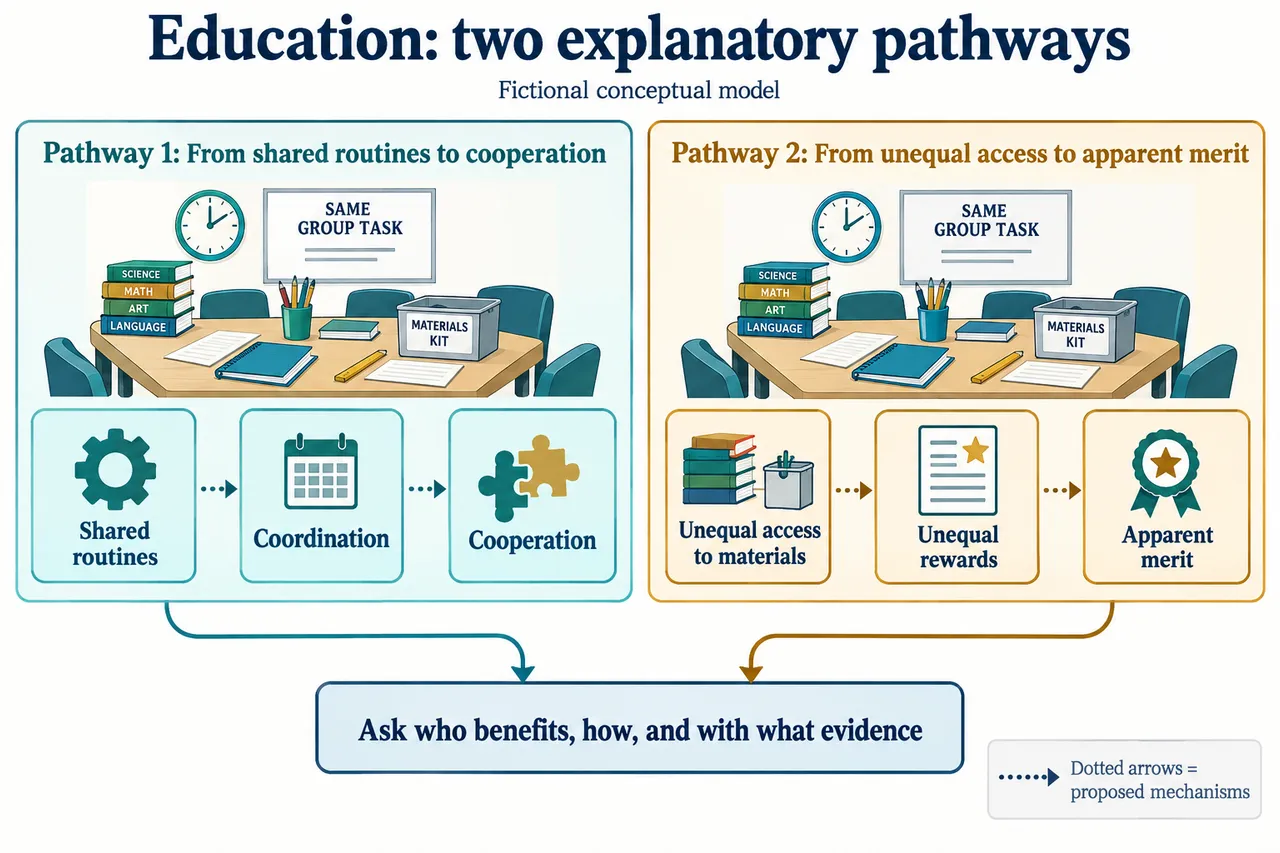
Original myAudience educational illustration. Image: illustration, not a documentary photograph. · myAudience educational illustration; no affiliation with any awarding body.
What does education do—and for whom?
A school is more than a collection of individual lessons. Timetables organise encounters, assessments define recognisable achievements, and qualifications help distribute later opportunities. Sociology asks how those arrangements connect to a wider society. Begin with the fictional school in this lesson: punctuality routines accompany vocational group work and prizes. Describing what the school intends is not yet explaining what its arrangements actually do. An intended benefit can fail to occur, and an unintended consequence can matter greatly.
A functionalist explanation examines contributions to an organised social system. Common expectations may make cooperation possible: students know when others will arrive, what a task requires and how contributions will be recognised. Training can develop capacities used in economic activity. This is a proposed connection between education and other institutions, rather than a claim that every existing practice is useful. An explanation needs evidence that the practice contributes to the stated outcome and consideration of who experiences that contribution.
A conflict explanation shifts attention to control and distribution. Whoever defines a valued accomplishment can influence who receives recognition. A presentation criterion that rewards costly materials might convert unequal access outside school into unequal rewards inside it. Qualifications could then make those unequal outcomes appear deserved. The key mechanism is not simply that some students win: it is that institutional judgements may conceal or reproduce unequal prior opportunities. Whether that happens in the fictional school remains a question for evidence.
Meritocracy names allocation through relevant achievement rather than inherited advantage. To evaluate such a claim, identify the achievement, its relevance and the opportunities to demonstrate it. Equal written rules do not guarantee equal practical access; equally, a difference in outcomes does not by itself prove an unfair assessment. A learner should distinguish a normative judgement that allocation ought to be fair from the empirical proposition that a particular procedure achieves fairness. Those propositions require different kinds of justification.
The two approaches can explain different features of the same institution. A routine may coordinate learning while distributing burdens unequally. Reliable transport makes punctuality easier, yet common starting times can still support group work. Analyse the mechanism at both levels instead of treating coordination and inequality as mutually exclusive slogans. Ask whether an alternative arrangement could retain cooperation while reducing avoidable disadvantages. That comparison sharpens the explanation without assuming that a proposed reform has already worked.
Evidence must correspond to the explanation. Task criteria and reward records can reveal the institutional rule and its outcomes, but not necessarily how students understood them. Accounts of obtaining materials and travelling to school can identify possible burdens, yet a few accounts cannot establish their prevalence. Connect these sources through a clear question: which opportunities, interpretations and rules could generate the observed distribution? A persuasive analysis examines conflicting observations rather than selecting only those that suit its preferred theory.
The evaluated model applies these ideas to the fictional school. Its conclusion is conditional because neither reward results nor transport histories have been supplied. Read its steps as an argument: reconstruct coordination, identify a possible reproduction mechanism, specify discriminating evidence, and judge what remains unresolved. A strong answer does not need to announce one theory as universally correct. It needs to show how a theoretical explanation could be supported, limited or revised by evidence.
The illustration gives the same group task two explanatory pathways. Dotted arrows represent proposed mechanisms, not measured effects; the material kit and clock are symbols rather than data. The transfer changes prizes while leaving aggregate completion unchanged. Different experiences of anxiety and recognition could still be important. State which outcome is being valued before declaring that a reform has no consequence, and investigate whether subgroup participation or task quality changed beneath the stable total.
Worked example: In a fictional school, punctuality routines accompany vocational group tasks and competitive prizes. Evaluate whether these arrangements should be explained mainly as useful coordination rather than reproduction of unequal power.
Useful coordination and unequal power are not mutually exclusive explanations. Punctuality can help a group start a shared task, while the authority to define acceptable punctuality may advantage students whose transport is reliable. The problem is therefore to identify mechanisms and evidence, rather than award the entire school to one theoretical camp.
A functionalist account would connect routines to cooperation. Participants learn that others rely on their contribution, and vocational tasks might develop skills used beyond school. Competitive prizes could allocate recognition to demonstrated accomplishment and motivate additional work. This explanation becomes stronger if assessment criteria are clear, relevant to the task and consistently applied, and if students with different backgrounds have comparable opportunities to meet them. Those conditions are empirical questions, not consequences of calling the institution functional.
A conflict account asks who controls the rules and who benefits. A prize judged partly through costly presentation materials could reward resources acquired outside school, even if its language celebrates individual effort. The punctuality rule could turn a transport disadvantage into an apparent personal failing. Repeated reward differences might then be represented as proof of deserved social position. This is a plausible reproduction mechanism, but the scenario supplies neither actual prize results nor students' transport histories. It cannot demonstrate that reproduction has occurred.
Evidence should follow these competing accounts. Compare criteria, actual task performance and rewards, alongside access to materials and journeys. Listen to students' interpretations rather than infer that everyone accepts authority in the same way. A pattern of unequal rewards needs examination of prior opportunities and possible institutional mediation; a pattern of cooperation does not establish that the distribution is just. Conversely, evidence of disadvantage would not show that coordination has no value.
The most defensible judgement is conditional. Some common routines are necessary for organised learning, but their operation can distribute burdens unequally. Evaluate a feasible alternative, such as providing materials and reviewing transport-related sanctions, to ask whether cooperation can be retained with fewer disadvantages. These are proposals for investigation, not evidence that a particular reform will work. The fictional case supports a combined explanation connecting institutional purpose, power and interpretation; it does not establish the superiority of either framework in every school.
Answer: The routines may coordinate punctual participation and vocational cooperation while prizes also distribute recognition through unequal opportunities. Which explanation deserves greater weight depends on evidence about access, reward criteria and who benefits; the described arrangements alone do not establish either useful coordination or reproduction as the dominant explanation.
Check your understanding: A fictional school removes prizes. Overall task completion remains unchanged, but students describe less anxiety and fewer opportunities for public recognition. Does unchanged completion prove the reform has no sociological consequence?
Answer: No. Completion is only one outcome. Changes in anxiety, recognition and who participates could matter even when the overall total is stable. The reports suggest mechanisms worth investigating, not a representative or causal finding by themselves. Compare subgroup participation, task quality and independently collected accounts before and after; consider simultaneous changes and whether students felt able to disagree. A defensible judgement must specify the valued outcomes and how they were measured.
Why: Keep the concept and denominator precise, show the inference, and distinguish supported descriptive results from unestablished causes or generalisations.