Labels, expectations and pupil responses
By UK A Level Sociology · independent study · myAudience
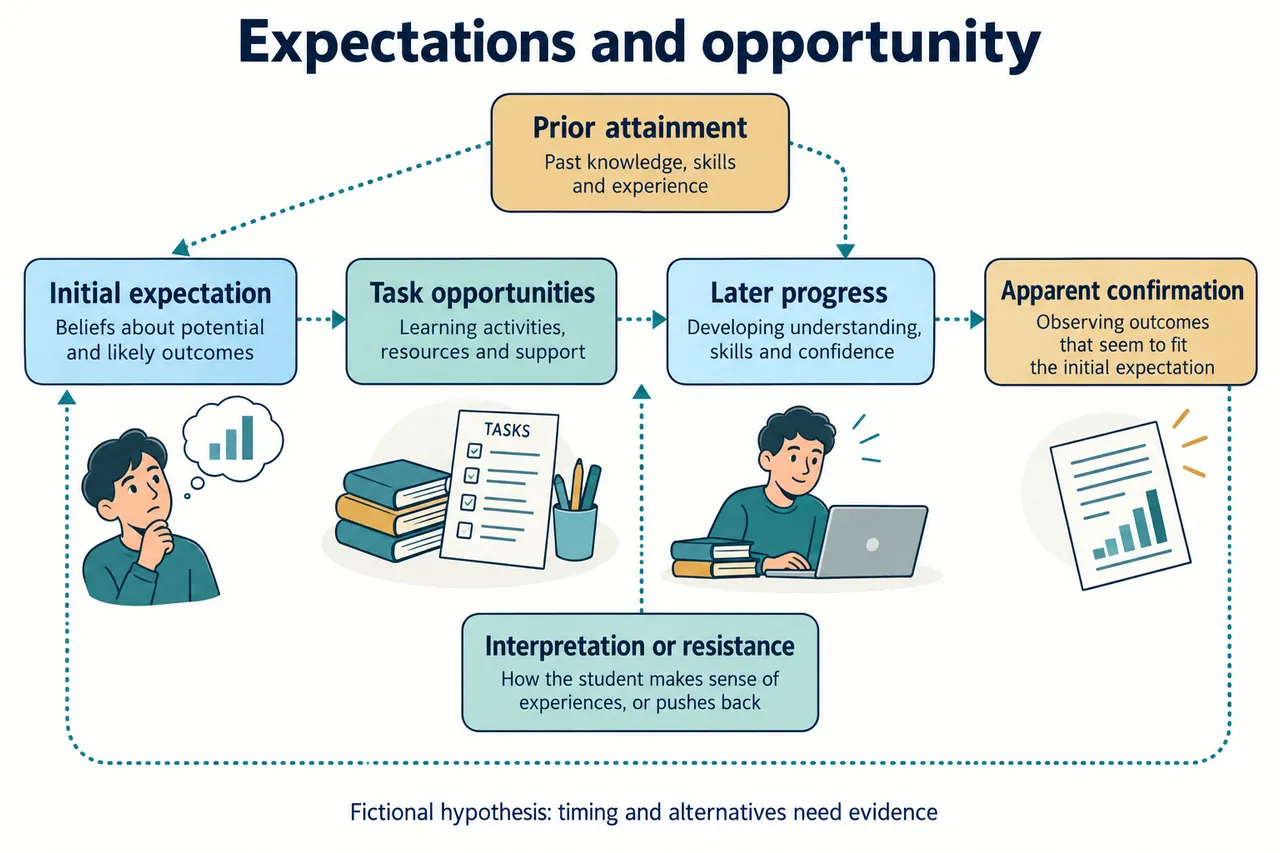
Original myAudience educational illustration. Image: illustration, not a documentary photograph. · myAudience educational illustration; no affiliation with any awarding body.
Labels, expectations and pupil responses
A label can be consequential when people act on it. In the fictional classroom, students described as promising later receive more difficult tasks and make greater progress. A self-fulfilling expectation would require a pathway from the initial definition through changed treatment to an outcome that appears to confirm it. Merely finding a label and a later difference does not establish that pathway. Establish what was known before the label, what treatment changed and when the outcome developed.
Task opportunities are one possible link. More demanding work might offer practice, feedback or access to knowledge that other students do not receive. Attention and patience could also be distributed differently. These processes can connect a seemingly small interaction to later institutional outcomes. Nevertheless, difficulty alone is not a benefit: a task can be unsuitable or unsupported. A sociological explanation identifies how the opportunity changes learning rather than assuming that every demanding task necessarily produces progress.
Interactionist analysis also examines meaning. Students might interpret recognition as encouragement, pressure, mistrust or a demand to perform an identity they dislike. They can accept, negotiate or resist expectations. That agency makes a deterministic label-to-outcome account inadequate. Researchers need evidence about both treatment and interpretation, since outward compliance may conceal disagreement. An observed classroom event can therefore have different meanings for different participants without all interpretations being equally supported by the available evidence.
Prior attainment is a crucial alternative in this example. Teachers might describe students as promising because earlier work already demonstrated progress. The same earlier attainment could influence task allocation and later performance. The apparent confirmation would then not originate wholly in the label. The task pathway might still matter, but the label could partly reflect information rather than create the entire difference. Distinguish a cause, an indicator and a consequence before writing a confident explanation.
Useful evidence would establish timing and compare plausible alternatives. What information informed the initial judgement? Were similarly prepared students offered different tasks? Did task access change before progress changed? Records can provide sequences, while observation reveals interactions and interviews investigate accounts of meaning. Each has limitations: record categories may conceal difficulty, observation can influence conduct, and interviews may produce retrospective explanations. Triangulation is an analysis of these differences, not a rule that three sources automatically prove a claim.
Ethics restrict what may be done to test an explanation. Deliberately assigning damaging labels to young people would not become acceptable because it might produce a clean comparison. Existing classroom decisions still require careful handling of consent, access and privacy when studied. This lesson supplies no permission to observe or classify classmates. It teaches how to evaluate a proposed explanation using fictional material, with professional ethical guidance relevant to any real study undertaken by appropriately accountable researchers.
The evaluated answer treats expectation as a promising mechanism while refusing to call it the established best explanation. Its judgement is earned through the prior-attainment alternative and the role of student interpretation. In the transfer, two students receive the same label but different tasks and support. An identical label does not imply identical opportunities or identical responses. A useful answer must specify the intervening process instead of predicting a fixed outcome from the word alone.
The dotted loop in the illustration is hypothetical. Prior attainment points toward both the initial expectation and later progress; the interpretation-or-resistance box marks a possible influence on the opportunity-to-progress pathway. The pictured document is symbolic, not evidence of measured improvement. Use the diagram to ask which link a source supports. A sequence that seems to confirm an expectation remains open to alternative explanations until timing, treatment and meaning have been investigated.
Worked example: In a fictional classroom, students described as promising later receive more difficult tasks and make greater progress. Evaluate whether a self-fulfilling expectation is the best explanation.
A self-fulfilling expectation would involve an initial definition influencing treatment, with that treatment contributing to an outcome that appears to confirm the definition. The fictional sequence is consistent with this possibility because promising students receive more demanding tasks before their later progress. Consistency is weaker than proof: the account must explain how the expectation changed opportunities and distinguish that process from other causes.
More difficult tasks might provide practice, feedback and access to knowledge not offered to other students. The label could also shape who receives patient explanations or opportunities to demonstrate understanding. If students interpret these interactions as evidence that they can succeed, their participation may change. Each link is contingent. A student might dislike the label, reject the expected identity or respond differently to an unsuitable task. Interactionist analysis should therefore examine meaning as well as externally recorded behaviour.
An important alternative is that earlier attainment influenced both the label and task allocation. Students who were already progressing might have received the description because teachers had noticed their performance. Later differences would then not originate entirely in expectations. The challenging tasks could still influence learning, but the initial description might be an accurate observation rather than the cause. Prior access to support or other school arrangements could influence the entire sequence.
Evidence should establish timing and compare plausible alternatives. Examine what teachers knew before assigning tasks, how similarly prepared students were treated, and what students actually experienced. Observation can reveal interactions but may change them and cannot directly recover private interpretations. Interviews can explore meanings but may contain retrospective explanations. Records can track progress but their categories may conceal differences in task difficulty. Combining these sources is useful only if contradictions are analysed rather than selected away.
On the information given, the expectation account is a promising mechanism, not an established best explanation. The sequence includes a potential treatment pathway, but earlier attainment and student agency remain unresolved. Research should not deliberately impose harmful labels to create cleaner evidence. A justified conclusion would identify which additional observations would strengthen or weaken the claim and acknowledge the limits of a single classroom. The point is to explain how identities and institutions interact, rather than assume that every unequal outcome is produced by labelling.
Answer: A self-fulfilling expectation is a plausible pathway if the label changes opportunities and those opportunities help produce later progress. The observed sequence does not establish it as the best explanation without testing timing, prior attainment and students’ interpretation or resistance.
Check your understanding: Two fictional teachers use the same positive label, but one changes feedback and tasks while the other changes nothing observable. Does the shared label predict identical outcomes?
Answer: No. The proposed mechanism depends on treatment and students' interpretation, not the label alone. Different feedback/task opportunities could produce different experiences; the absence of an observed change does not prove there was none. Investigate timing, earlier attainment and student meanings, and retain the possibility of no effect or resistance. A universal outcome prediction would exceed this conditional explanation.
Why: Keep the concept and denominator precise, show the inference, and distinguish supported descriptive results from unestablished causes or generalisations.