Interviewing in a school: access is not consent
By UK A Level Sociology · independent study · myAudience
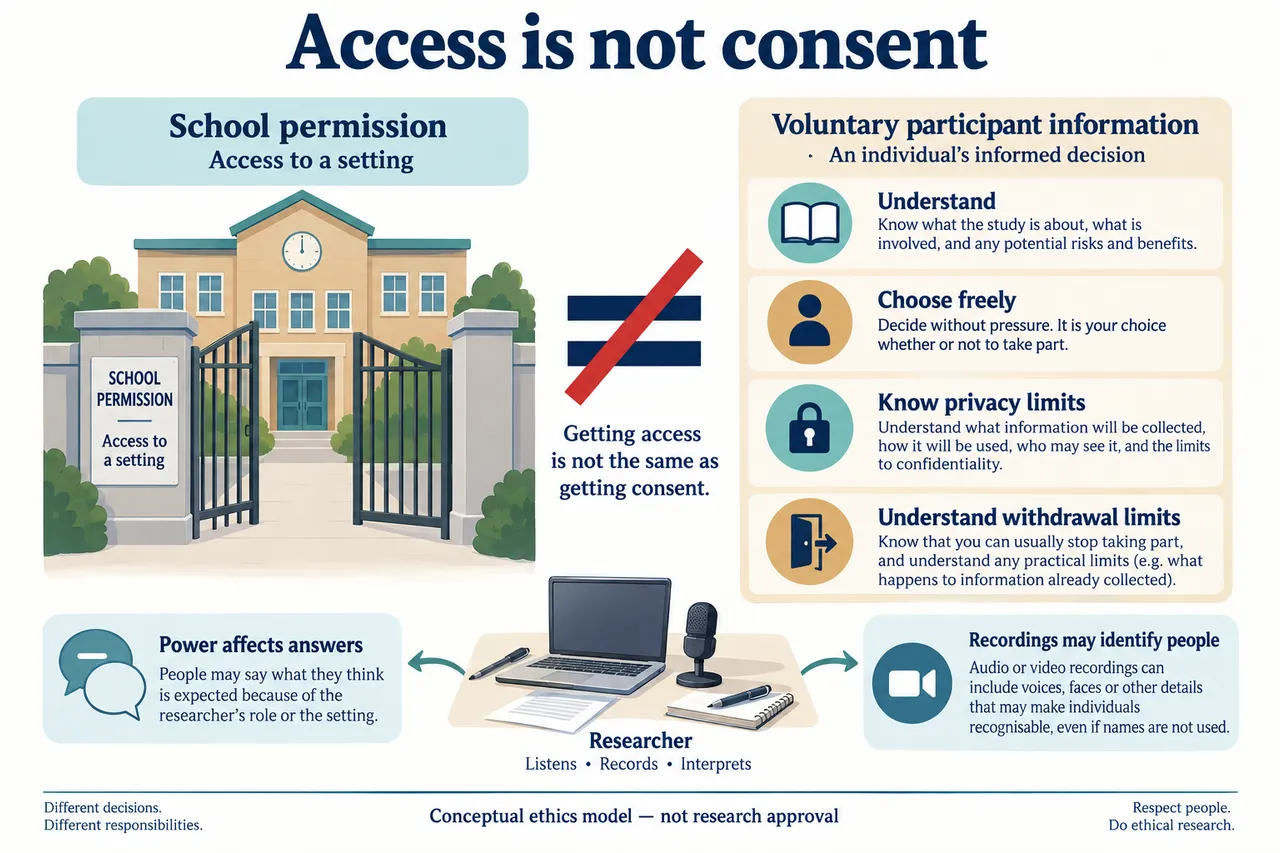
Original myAudience educational illustration. Image: illustration, not a documentary photograph. · myAudience educational illustration; no affiliation with any awarding body.
Interviewing in a school: access is not consent
Research access and participant consent are different decisions. A headteacher can permit entry to a setting without making every interview voluntary. In the fictional proposal, a teacher wants compulsory recorded interviews about trust in staff and promises to remove names. Students may still feel pressure because the interviewer influences their everyday school experience. The design therefore raises questions both about participants' rights and about whether the resulting accounts would credibly express their views.
An interview can investigate meanings, explanations and experiences that fixed categories may miss. A structured interview uses a consistent set of questions; a semistructured interview combines common prompts with scope to pursue an unexpected account. Less structure can reveal detail but also increases decisions about what to ask and how to interpret it. More structure does not remove deference or make an answer accurate. Evaluate the format against the research question and the relationship between interviewer and participant.
Power is a methodological issue because it can shape what people feel able to say. A student might give the answer they think a teacher expects, avoid criticism or refuse only when refusal seems safe. An independent researcher could reduce a particular dual-role pressure, but cannot eliminate every institutional influence. Access arrangements, recruitment and understandable information still need scrutiny. Consider whether the setting permits a genuine choice rather than assuming that a signed form settles the experience of consent.
Professional guidance treats ethical decision-making as ongoing. Participants need understandable information about purpose, participation and consequences; children and young people require appropriately attentive arrangements. Institutional access, responsible adults' roles, young people's assent and relevant consent conditions are matters to resolve in the actual setting. They are not universally identical rules that this lesson can complete. No learner is instructed to interview classmates, and this fictional exercise provides neither institutional approval nor safeguarding clearance.
Removing names does not guarantee anonymity. A recording may identify a voice, and a distinctive incident can identify someone in a report. Explain what information is collected, who can access it, how reporting is limited and what confidentiality cannot promise. Safeguarding disclosure may sometimes be necessary. A promise of absolute secrecy would therefore be misleading. Privacy protections need to address the actual material and context rather than rely on the single act of replacing a name with a code.
Withdrawal also needs precise explanation. A person may be able to stop an interview while later removal of fully anonymised or combined material has practical limits. Those limits should be explained beforehand rather than invented after a concern arises. Protecting participants does not require pretending that every action can be reversed indefinitely. The relevant BSA and BERA guidance supports reasoned, accountable judgements; it is not a checklist that grants permission for any study once its words are repeated.
The evaluated model reconstructs the proposed benefit of interviewing before explaining why compulsion and power undermine the original design. It proposes a qualified, voluntary alternative without claiming that the alternative has been approved. In the transfer, publicly visible discussion posts do not automatically become ethically unrestricted research material. Access, sensitivity, expectations, identification and reporting consequences still matter. Distinguish being technically able to read something from being justified in collecting and publishing a study of it.
The image uses separate columns for school permission and participant information, with a non-equivalence symbol between them. Its privacy and withdrawal boxes describe questions that require real answers, not a completed permission pathway. The researcher and recorder are conceptual symbols. Use the picture to identify a missing decision in a proposal, then explain how that omission could affect rights and evidence. The correct conclusion may be that a design must be reconsidered rather than carried out.
Worked example: A fictional teacher proposes compulsory recorded interviews about students' trust in staff, saying the headteacher has approved them and names will be removed. Evaluate this design and propose a justified alternative.
Headteacher permission can provide access to the setting, but it cannot make a compulsory interview a voluntary account of students' trust. The teacher controls important aspects of participants' everyday school experience, so students may believe that refusing or criticising staff could have consequences. This power relationship threatens both ethical participation and the credibility of the answers. Removing names after recording does not remove the pressure present during collection.
An interview can still be useful for this question. Trust concerns meanings and relationships that a fixed response category might miss. A semistructured format could ask common questions while allowing participants to explain an unexpected experience. However, flexibility requires careful interpretation, and statements cannot automatically estimate how common a view is throughout the school. A structured interview improves consistency of wording but does not eliminate deference to an authority figure or make sensitive answers accurate.
The design should therefore be reconsidered before anyone participates. An appropriately qualified independent researcher could reduce the teacher's dual-role pressure, with information understandable to students and a genuine option not to take part. Institutional review and applicable safeguarding and consent arrangements would need attention, including young people's assent and the role of responsible adults where relevant. These are requirements to resolve in a real setting, not steps that this fictional exercise has completed. No learner should be instructed to conduct the proposed interviews themselves.
Confidentiality also needs precise explanation. Recordings can identify voices, and distinctive experiences may identify a student even without a name. Data access, retention and reporting should be proportionate to the question. Participants should understand relevant limits, such as circumstances requiring safeguarding disclosure, rather than receive a promise of absolute secrecy. The right to withdraw should be explained honestly, including any practical limits after anonymised material has been combined or published.
The original compulsory design is unacceptable as a route to freely given trust accounts. A redesigned voluntary study may yield more credible evidence but would not eliminate all power or interpretation problems. The justified judgement balances the value of understanding school relationships against participants' rights and possible consequences. Professional ethical guidance supports ongoing deliberation rather than a permission checklist: approval, recording and pseudonyms cannot by themselves establish that research is ethical or that its conclusions are valid.
Answer: Compulsory recorded interviews by a teacher are not justified by headteacher permission or removal of names: power may constrain consent and answers, while voices and contextual details may remain identifiable. A justified alternative would use genuinely voluntary, clearly explained participation, an appropriately qualified independent researcher and agreed recording, privacy and withdrawal arrangements, subject to the relevant ethical review.
Check your understanding: A fictional school discussion board is visible without a login. May a learner copy identifiable critical posts into a research report simply because they are public?
Answer: No automatic permission follows from visibility. Consider intended audience, sensitivity, traceability, ownership, consent and potential harm; a searchable exact quotation may identify its author. Use a stipulated fictional extract for this lesson instead of collecting real posts. Real research needs appropriate ethical and institutional advice; paraphrasing or removing a username alone cannot guarantee anonymity.
Why: Keep the concept and denominator precise, show the inference, and distinguish supported descriptive results from unestablished causes or generalisations.