Observation: visible behaviour and invisible meanings
By UK A Level Sociology · independent study · myAudience
Original myAudience educational illustration. Image: illustration, not a documentary photograph. · myAudience educational illustration; no affiliation with any awarding body.
Observation: visible behaviour and invisible meanings
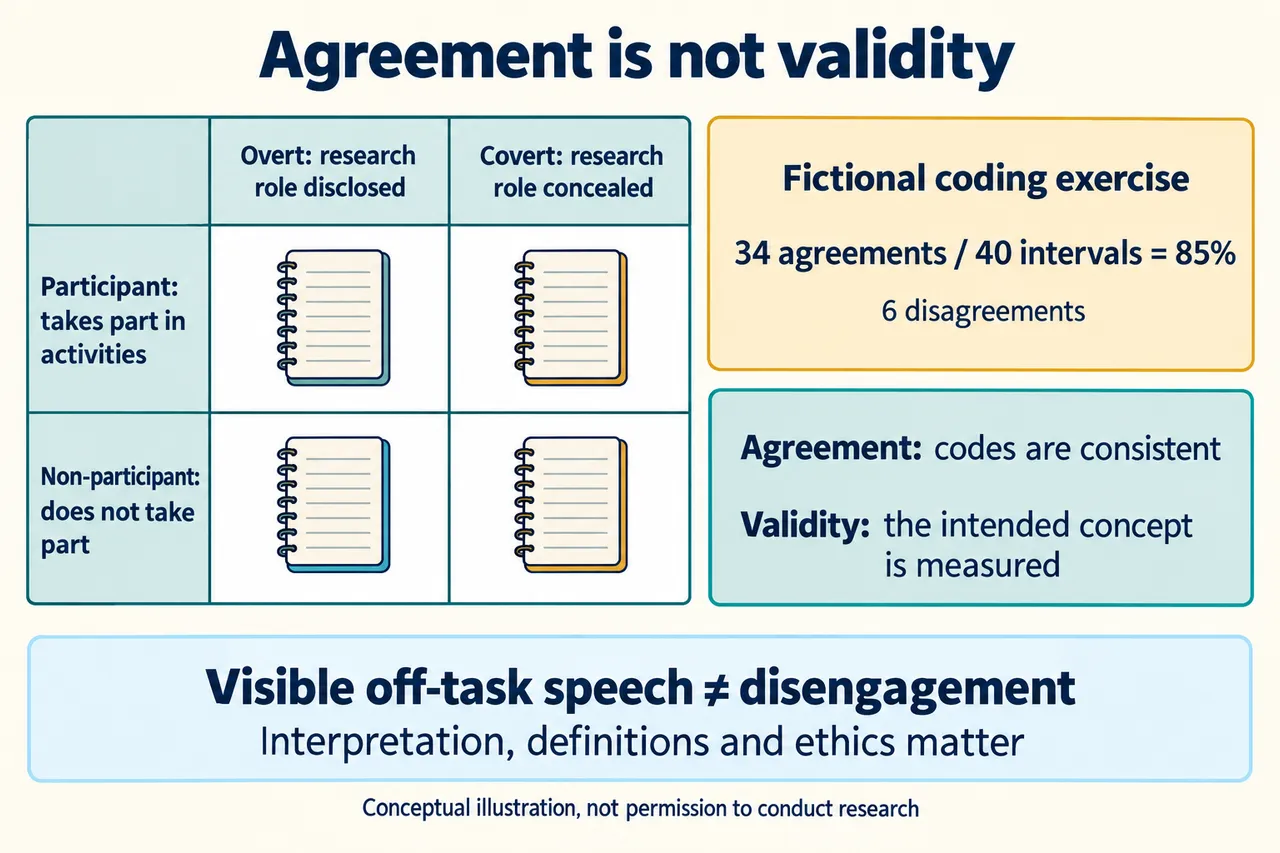
Observation can reveal routines and interactions that participants do not recall or describe in an interview. It cannot directly display private meanings. In the fictional coding exercise, two observers agree on 34 of 40 interval classifications for off-task speech. Their simple agreement is 85%, with six disagreements. That calculation describes consistency between their codes in this exercise. It does not establish that the category measures disengagement or characterise students' motivation beyond the observed setting.
Separate two independent classifications of observation. A participant observer takes part in activities in the setting; a nonparticipant observer does not take part in those activities. Overt observation discloses the research role, while covert observation conceals it. Covert does not mean that behaviour is invisible or that thoughts become observable. These distinctions concern the researcher's relationship and disclosure. They do not determine whether notes are structured, whether numerical codes are used or whether the resulting interpretation is valid.
Structured observation defines categories and recording rules beforehand. This can make comparisons clearer, but category design already involves choices about what counts. Fixed intervals may miss a short but important interaction, and the same visible action can have different meanings. Flexible notes can retain surrounding context but introduce other selection and interpretation decisions. A defensible method explains what it records, why that matters to the question and what events or meanings its procedure might omit.
Agreement is informative but limited. The observers may share a clear rule or share the same mistaken rule. The percentage also does not correct for agreement expected under a particular chance model or reveal whether disputes cluster in one difficult category. Examining the six disagreements may help refine definitions. Validity requires a further argument about the concept: why should off-task speech indicate disengagement rather than help-seeking, social support or uncertainty about instructions? Consistency alone cannot answer that question.
Reactivity is another possible influence: people may behave differently when they know they are being observed. Concealing the research role does not simply solve the methodological problem, because it introduces ethical issues about knowledge, consent and possible consequences. Participant roles can provide contextual understanding while also changing interactions and creating obligations. Nonparticipation may reduce one kind of involvement while limiting access to meaning. Evaluate those trade-offs rather than present one observation type as inherently superior.
The educational setting makes ethical care especially important. A study should not transform identifiable young people's actions into unsupported judgements about character. Access, participation arrangements, safeguarding, data minimisation and reporting consequences require accountable review in any real project. This lesson supplies no authorisation to conduct observation. It instead teaches how to critique fictional material and connect a visible category, a research relationship and an interpretation without treating them as a single unproblematic fact.
The evaluated model earns its conclusion by separating coding agreement from construct validity and explaining what further sources could contribute. The transfer changes the coding definition and the recorded count doubles. That does not show that disengagement doubled: the measurement rule has changed. Compare records produced with equivalent rules before discussing change over time, and inspect what the new category includes. A difference in counts can reflect a difference in operationalisation rather than a difference in the underlying social process.
The corrected illustration separates participant/nonparticipant roles from overt/covert disclosure. The notebook symbols are not countable evidence. The data card states 34/40 = 85% and six disagreements without a misleading unit strip. Its lower caption distinguishes visible speech from the broader construct. Use the two axes to explain how research roles differ without assuming that either arrangement reveals private meanings. Definitions and disclosure remain distinct from the question of whether the recorded behaviour measures the intended concept.
Worked example: In a fictional classroom exercise two observers agree on 34 of 40 interval codes for speaking off-task. Evaluate whether this proves they have measured student disengagement accurately.
Agreement on 34 of 40 codes is 85%, but this is an agreement percentage for a stated coding exercise, not proof that disengagement has been measured. The first question is what the code means. Speaking about something outside an assigned task may indicate distraction, a request for help, social support or an interpretation of an unclear instruction. Engagement is a broader construct than a single visible behaviour.
A structured observation can make the procedure explicit. Observers use common intervals and definitions, allowing disagreements to be examined. Repeated application of a clear rule may improve consistency and make comparisons possible. Yet the same shared misunderstanding could produce high agreement. The 85% figure also does not account for chance agreement or show which kinds of interval generated disputes. It should not be represented as a complete reliability coefficient or an estimate of all students' behaviour.
More interpretive observation could record surrounding interactions and changes in tasks, helping explain why a conversation occurred. A participant observer might gain insight into routines but face role conflicts and influence what happens. A nonparticipant observer may see less of participants' experience. Overt observation can change behaviour when people know they are being watched; covert observation does not simply solve the problem because it introduces serious ethical concerns. Neither arrangement provides direct access to private meanings without further evidence.
The educational context matters. A single lesson, teacher or task could be unusual, while fixed intervals might miss brief but important interactions. Compare carefully defined contexts and consider participants' accounts, without treating disagreement between sources as a nuisance. Data should avoid identifiable judgements about particular young people, and real observation requires appropriate permissions, voluntary participation arrangements and safeguarding review. The fictional exercise supplies none of that authorisation.
The justified conclusion is that the observers have achieved a particular level of coding agreement, with uncertainty about the construct they intended to measure. Investigating the six disagreements may improve the rule, but validation also requires considering alternative meanings and supporting evidence. A defensible report would describe visible coded events and the setting, not turn them into claims that certain students lack motivation. Observation can contribute to an explanation of classroom processes when its scope, categories and ethical limits remain explicit.
Answer: The observers agree on 85% of the interval codes, with six disagreements. This shows coding consistency under their rule, not that off-task speech validly measures disengagement; the construct, alternative meanings, disagreements and ethical context require separate scrutiny.
Check your understanding: With behaviour unchanged, a revised fictional rule counts whispering requests for help as off-task and the total doubles. What changed, and can disengagement be said to have doubled?
Answer: The operational definition changed. The recorded count is not comparable on its own with the previous measure, and the same behaviour has not demonstrated doubled disengagement. Recode a common set using both rules, explain disagreement and inspect whether the construct is appropriate. Distinguish a measurement change from a social change; no individual motivation can be inferred from the count alone.
Why: Keep the concept and denominator precise, show the inference, and distinguish supported descriptive results from unestablished causes or generalisations.