An entrepreneur chooses what not to do
By UK A Level Business · independent study · myAudience
Original myAudience educational illustration. Image: illustration, not a documentary photograph. · myAudience educational illustration; no affiliation with any awarding body.
An entrepreneur chooses what not to do
An entrepreneur brings resources together around an opportunity whose outcome is not certain. That opportunity might be a product, a service or a different way of serving customers. Rina’s fictional repair and hire options use the same initial £6,000, but solve different customer problems. Repair restores an item a customer owns; hire provides temporary access. Before comparing money, ask which problem exists, which customers experience it and what would make them choose this offer rather than an alternative. An idea does not become demand simply because its founder values it.
Founders can pursue income and wealth alongside independence, personal fulfilment, community service or innovation. These motives can complement or conflict with one another. Rina wants to preserve local repair skills and maintain a cash reserve. A large operation might employ more skilled repairers while tying up money in equipment and stock. The analysis must therefore state how success will be judged. Comparing two ventures only by immediate receipts silently chooses a financial objective and overlooks the possibility that the founder values a different outcome.
Risk-taking means committing resources where outcomes are not fully assured; it is not the same as ignoring evidence. Resilience can help a founder learn from a rejected offer or a faulty process, but repeated expenditure on an unsupported idea can consume the funds needed to adapt. Focus makes priorities clearer, while adaptability allows priorities or methods to change when evidence changes. Passion and innovation may encourage effort and experimentation. None supplies a fixed probability of success, and the case contains no measurement of Rina’s personal characteristics.
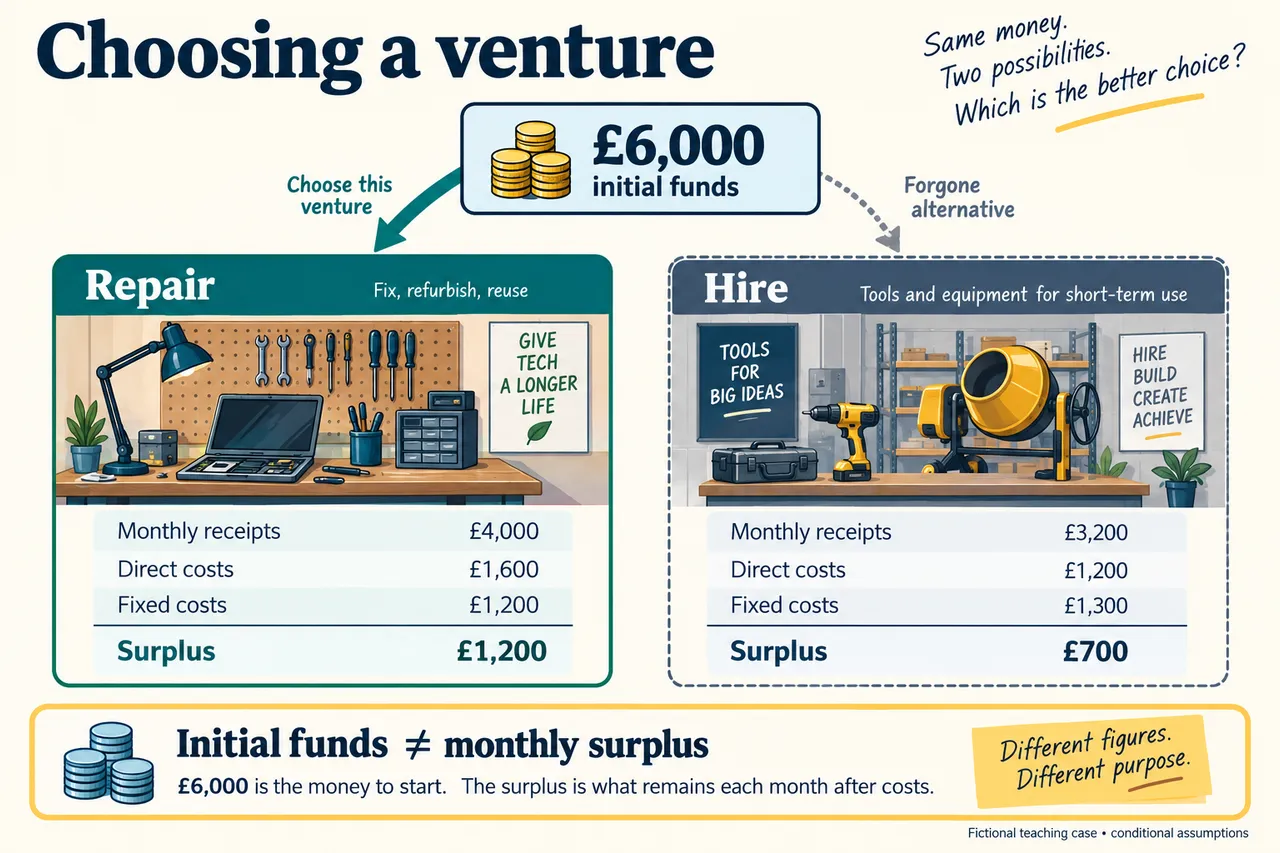
The money comparison needs a defined period. Repair’s 160 monthly jobs at £25 create £4,000 receipts. At £10 direct cash cost per job, £1,600 leaves with activity; the £1,200 monthly fixed cash cost does not change within the stipulated range. The remaining £1,200 is a cash surplus in this model. Hire’s 80 bookings create £3,200 receipts, £1,200 direct costs and £1,300 fixed costs, leaving £700. The initial £6,000 is a separate funding commitment. It is not paid anew each month or included twice in the operating comparison.
Opportunity cost identifies the next-best benefit forgone when a scarce resource is committed. If hire is Rina’s best feasible alternative, selecting repair sacrifices the possibility of hire’s forecast benefit. The £700 monthly surplus is consequently informative about the alternative, but is not an invoice charged to repair. Nor does the £500 difference alone capture every consequence. The ventures might require different working hours, expose equipment to different risks or deliver different community benefits. Specify the alternatives actually available before using opportunity cost as a meaningful decision concept.
A numerical forecast can be correct internally and still fail to predict events. Repair might be constrained by customers’ ability to pay, unavailable parts or the founder’s time diagnosing problems. At 120 jobs, its stipulated cash surplus falls to £600; at 100 jobs it is £300. Both are positive in this narrow calculation, but owner pay, tax and replacing equipment remain outside it. This sensitivity shows why a forecast should be tested rather than treated as a promise. It also identifies which assumptions most urgently need paid-demand and supplier evidence.
A trial can reduce the size of an irreversible commitment and create information, but is not automatically cheap or representative. Short-term equipment rental may have a higher unit cost; launch publicity may attract unusually curious first customers. A useful trial records completed paid jobs, time and direct costs, and states its review date and spending boundary. Compare what can be learned with the trial’s cost. Keeping a reserve is helpful only if the staged purchasing arrangement is genuinely available; the case’s initial full-funding requirement cannot simply be wished away.
Growth can change the founder’s role. Rina might initially diagnose faults, order parts and speak to every customer; later she may need to train repairers, schedule work and control quality through other people. Delegation can release time but requires clear expectations and suitable skills. The plate separates initial funds from monthly flows and marks hire as a forgone alternative, not a second payment. Its objects are illustrative symbols. Use the worked argument and the transfer to connect motives, constraints and evidence, rather than treating an attractive surplus or a determined founder as a guarantee.
Worked example: Fictional Rina has £6,000 available and can launch one of two local services. Repair has stipulated demand for 160 jobs per month, £25 received per job, £10 direct cash cost per job and £1,200 monthly fixed cash costs. Hire has 80 monthly bookings, £40 per booking, £15 direct cash cost per booking and £1,300 fixed cash costs. Each uses the whole initial £6,000; the monthly comparison excludes tax, depreciation and owner pay. Rina prioritises keeping repair skills in the community and preserving a cash reserve. These are conditional forecasts, not observations.
Rina should prefer the repair service for a carefully limited initial trial, rather than interpreting the larger forecast surplus as proof that it will succeed. Repair produces £4,000 monthly receipts from 160 jobs. Direct cash costs are £1,600; after £1,200 fixed costs, the stipulated monthly cash surplus is £1,200. Hire produces £3,200 receipts, incurs £1,200 direct costs and £1,300 fixed costs, leaving £700. Repair therefore offers £500 more monthly surplus under these assumptions, and directly supports Rina’s aim of retaining local repair skills.
The important chain is not simply that passion creates success. Existing repair expertise may reduce mistakes and help Rina explain value to customers. That could encourage repeat visits, supporting bookings and the cash needed to pay suppliers. However, the case gives no evidence about Rina’s service quality, competitor response or willingness to pay. Enthusiasm cannot establish that 160 jobs will materialise. Hiring may suit customers who want temporary access rather than ownership, but that preference also requires research.
Selecting repair means forgoing hire as the next-best available use of the same funds. Its forecast £700 monthly surplus describes a sacrificed possible benefit, not an additional cash invoice that repair must pay. Nor is the initial £6,000 a monthly operating cost. Keeping these periods separate matters because an attractive operating surplus does not demonstrate that starting stock and equipment can be financed without exhausting reserves.
Repair is vulnerable to demand shortfalls. At 120 jobs, receipts become £3,000 and direct costs £1,200, leaving £600 after fixed costs. The surplus remains positive in this narrow model, but is only half the central forecast. Owner remuneration, tax and equipment replacement could remove it. A booking trial and a capped purchase commitment would therefore be more informative than spending the full reserve immediately, if suppliers permit that structure.
My recommendation is conditional on verifying real paid demand and a workable parts supply. Rina should specify a review date and a reserve limit before launch. If repair bookings or the reliability of parts fall below an acceptable threshold, the alternative deserves reconsideration. This combines a commercial judgement with Rina’s non-financial purpose, rather than assuming that either profit alone or social purpose alone settles the decision.
Answer: A sustained original evaluated response: apply the stated case, verify the appropriate numerical endpoint, challenge assumptions, compare consequences and justify a conditional decision. No guaranteed business success or official mark/grade is asserted.
Check your understanding: If repair falls to 100 jobs while fixed cash costs remain £1,200, should the founder say resilience requires ignoring this result? Recalculate and distinguish a temporary trial from an indefinite loss-making commitment.
Answer: £2,500 receipts minus £1,000 direct costs minus £1,200 fixed costs leaves £300 in the stated cash model. That is not an accounting-profit or owner-income guarantee. Resilience could mean adapting opening times, parts purchasing or promotion after investigating the cause; it does not justify ignoring weak bookings indefinitely. A time-limited trial with a reserve boundary is defensible only if the extra information is worth its costs.
Why: Use the exact stipulated inputs, period, units and denominator; recalculate before judging. Distinguish supported conditional arithmetic from demand, causation, ethics or legal arrangements that the case does not establish.