A business plan becomes a testable decision
By UK A Level Business · independent study · myAudience
Original myAudience educational illustration. Image: illustration, not a documentary photograph. · myAudience educational illustration; no affiliation with any awarding body.
A business plan becomes a testable decision
A business plan connects an offer to the resources, activities and money needed to deliver it. A customer promise can fail if stock, staff or finance cannot support it. In fictional Northline, the campaign aims to increase paid orders, but fulfilment capacity becomes a limiting condition. The plan is useful when it makes those connections visible and gives people a basis for acting and revising decisions. It is not valuable merely because it contains a polished forecast or a long list of ambitions.
Separate three kinds of statement. The case’s current 100 monthly paid orders is a stipulated baseline. A forecast estimates what may happen under identified assumptions; a target states what the business wants to achieve. The desired 130 orders by month three therefore does not prove that customers will respond. Record what counts as an order: an enquiry, an unpaid reservation and a completed paid purchase are different outcomes. Using the same definition at the start and review date is necessary for a valid comparison.
This specification uses SMART as Specific, Measurable, Accountable, Realistic and Time-specific. Naming Maya identifies responsibility for the order objective, while a numerical quantity and deadline make it testable. Accountability must be accompanied by suitable information, authority and resources. If operations cannot expand or finance rejects the extra cost, blaming Maya alone would not make the plan coherent. The realistic element requires evidence about both customer demand and the organisation’s ability to meet it; a specific target can still be unrealistic.
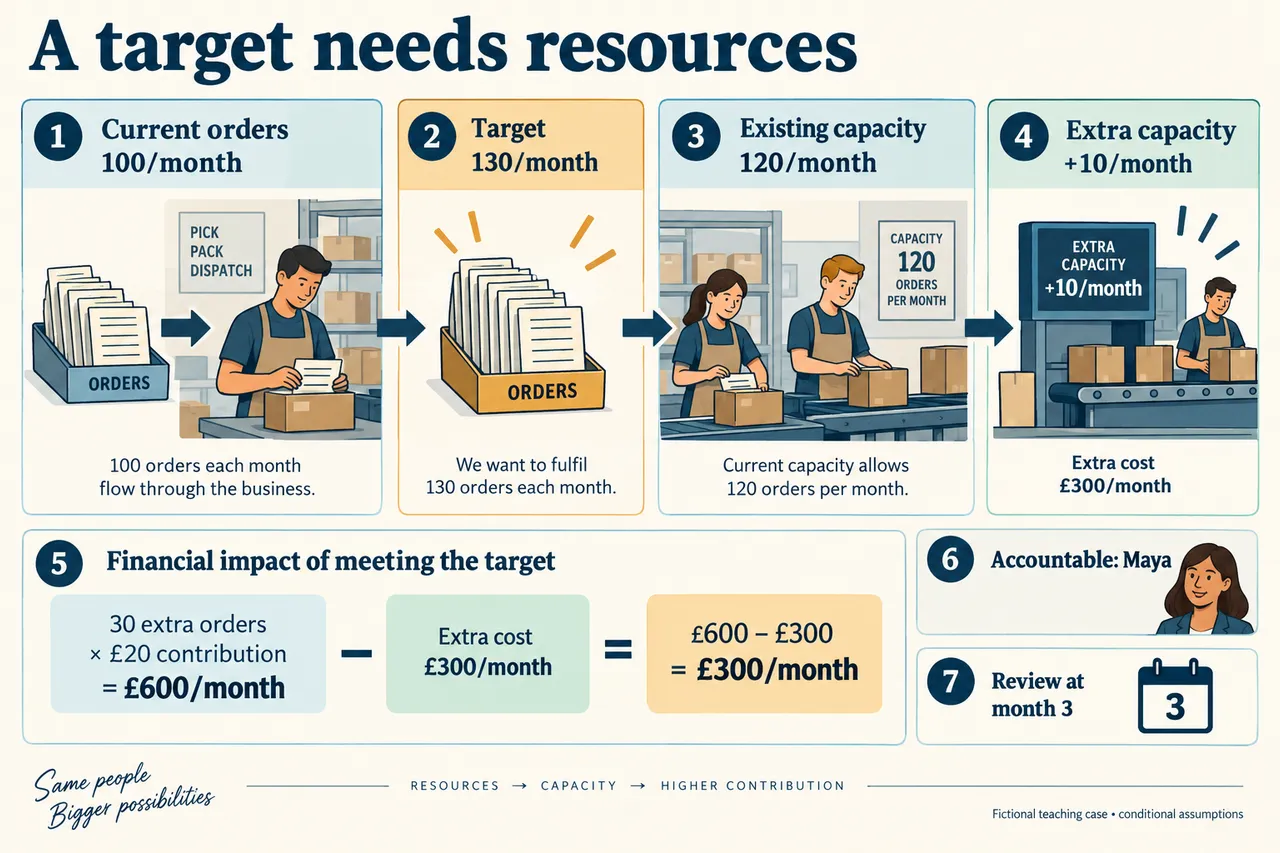
Northline can fulfil 120 monthly orders without overtime, only twenty above the baseline. Reaching 130 requires the stipulated extra capacity, costing £300 monthly. Thirty extra orders each contribute £20 before that capacity cost, producing £600. Deducting the £300 gives £300 additional monthly surplus in the case. Contribution is the amount available after the costs specified as variable; it is not automatically the final profit for the whole business. Here the extra capacity expenditure is explicitly outside that initial unit contribution, so it must be included once.
The campaign’s £2,400 launch expenditure belongs to a different timing question. If the extra £300 arrives every month, £2,400 divided by £300 is eight months of that increment after it begins. This is a deliberately simple recovery calculation, not a complete investment appraisal. It does not discount future flows, incorporate financing or establish how long demand lasts. If the extra sales take time to build, calendar recovery from launch is longer than eight months. A forecast must identify timing rather than adding unlike periods as if they were interchangeable.
Measuring a rise after a campaign does not by itself show that the campaign caused it. Seasonal demand, competitors’ decisions or a change in the offer can occur at the same time. Compare enquiry conversion, cancellations and completed paid orders with a consistent baseline and, where feasible, a suitable comparison group or period. No design makes every alternative explanation disappear automatically. The amount of evidence worth collecting depends partly on the expenditure at risk and how easily the decision can be reversed.
A staged plan may first use the existing spare capacity. Twenty additional orders would give £400 monthly contribution without the extra capacity cost, assuming the stated £20 remains valid. That yields a different recovery calculation and a different scale of market entry. The business should not therefore assume that its maximum order target is the most profitable or strategically suitable objective. Extra capacity might be useful later, while a smaller trial might miss a time-sensitive opportunity. Those possibilities require evidence and an explicit priority, not an automatic answer from a single division.
Reviewing a plan means deciding what to do with new evidence, not just reporting a missed number. Maya, operations and finance should know which threshold triggers a change in spending, capacity or the offer. Poor-quality fulfilment could reduce retention even where the order target is achieved. The plate links a target to demand evidence and resources, then separates the contribution and capacity calculations. The worked model judges those conditions together. A stronger plan can change in response to evidence while keeping its assumptions and responsibilities clear.
Worked example: Fictional Northline considers a £2,400 launch campaign. Its current verified monthly order rate is stipulated as 100; the plan aims for 130 paid orders per month by the end of month 3, led by Maya. Capacity is 120 orders monthly without overtime. Extra capacity to 130 costs £300 monthly. Unit contribution before that capacity cost is stipulated £20; campaign effects and persistence are unknown. All amounts are hypothetical, with no current market data.
Northline should revise the implementation plan before approving the full campaign, because its sales objective currently exceeds its operational capacity. A target of 130 paid monthly orders by the end of month three is specific, measurable and time-specific. Naming Maya supplies the accountable element used in this specification. Yet accountability does not make the target realistic: Northline can currently fulfil only 120 orders without overtime. Responsibility should therefore include access to information and a decision process for capacity, not merely blame if fulfilment fails.
If demand genuinely rises from 100 to 130 orders, the extra thirty orders provide £600 monthly contribution at the stipulated £20 each. Buying the additional capacity costs £300 per month, leaving £300 incremental monthly surplus before other changes. That figure is useful because the campaign can create operational costs as well as sales. Counting only the £600 would overstate the benefit. The £2,400 launch expenditure must also be recovered; at a constant £300 monthly increment, a simple recovery calculation is eight months after that increment starts, ignoring financing and timing differences.
However, the plan does not establish that the campaign causes thirty extra paid orders or that those customers remain. A target is a desired result, whereas a forecast is a conditional estimate of what may happen. Neither is evidence that the outcome has already occurred. If the campaign merely shifts orders forward from later months, the monthly improvement could vanish. Extra overtime could also affect delivery quality, increasing refunds and reducing the assumed contribution.
A staged campaign is therefore preferable if it can test demand without a disproportionate setup cost. Northline could initially aim for its existing spare capacity of twenty orders and compare completed paid orders, cancellations and customer response across the review period. This would not automatically identify causation, because seasonality and rival actions can change simultaneously. A comparison design and a consistent definition of an order would make the evidence more useful.
I would approve the larger campaign only after its expected duration and fulfilment arrangements are credible. Maya should report against a dated objective, but finance and operations must agree the associated resources. If the business instead values rapid market entry despite a longer recovery period, that objective could support a different decision; the plan must state it explicitly. The strongest feature of a business plan is this connection between aims, constraints and revision, not the appearance of certainty in its sales figures.
Answer: A sustained original evaluated response: apply the stated case, verify the appropriate numerical endpoint, challenge assumptions, compare consequences and justify a conditional decision. No guaranteed business success or official mark/grade is asserted.
Check your understanding: At only 120 monthly orders, with no extra capacity bought, calculate the incremental contribution. Explain why comparing its simple campaign recovery with the 130-order scenario does not alone select an objective.
Answer: Twenty extra orders ×£20 produce £400 monthly additional contribution. £2,400/£400 is six months of constant increments, whereas the 130-order scenario produces £300 after capacity cost and gives eight months. These are simplified conditional recovery calculations, not strategic investment approval. The extra capacity may have later uses and faster entry may matter, while demand persistence and service quality could differ. A decision needs the objective and the evidence behind each assumption.
Why: Use the exact stipulated inputs, period, units and denominator; recalculate before judging. Distinguish supported conditional arithmetic from demand, causation, ethics or legal arrangements that the case does not establish.