Ownership, control and liability are different questions
By UK A Level Business · independent study · myAudience
Original myAudience educational illustration. Image: illustration, not a documentary photograph. · myAudience educational illustration; no affiliation with any awarding body.
Ownership, control and liability are different questions
Ownership answers who has a claim on an organisation and, under its arrangements, who can influence decisions. Finance answers where the organisation obtains funds. Liability concerns responsibility for debts and other obligations. These questions are connected but not interchangeable. The fictional studio case deliberately stipulates equal ordinary-share voting rights while leaving contracts and tax details unspecified. It lets us examine dilution and finance without pretending to advise on real legal documents or assuming that every business using the same broad label has identical arrangements.
Current UK government guidance describes a sole trader as making the business decisions and being personally responsible for its debts. A limited company is legally separate from its owners, with general limited-liability protection and directors’ responsibilities. That protection does not remove the need to examine the actual contractual and personal obligations in a case. Keeping records, filing accounts and following rules for taking money out are relevant responsibilities. A structure’s administrative demands and funding opportunities should be compared alongside its general liability position; a business label is not a complete risk assessment.
A private limited company and a public limited company differ in how their ownership and funding arrangements can operate, but a plc is not simply any company whose work is visible to the public. Compare control, objectives, access to finance and profit distribution rather than assuming that a larger form is inherently superior. Worker, consumer and producer cooperatives organise participation around different member interests. Social enterprise describes a social or community purpose and can use different structures according to official UK guidance. Purpose, ownership and legal form need separate evidence, not a single interchangeable name.
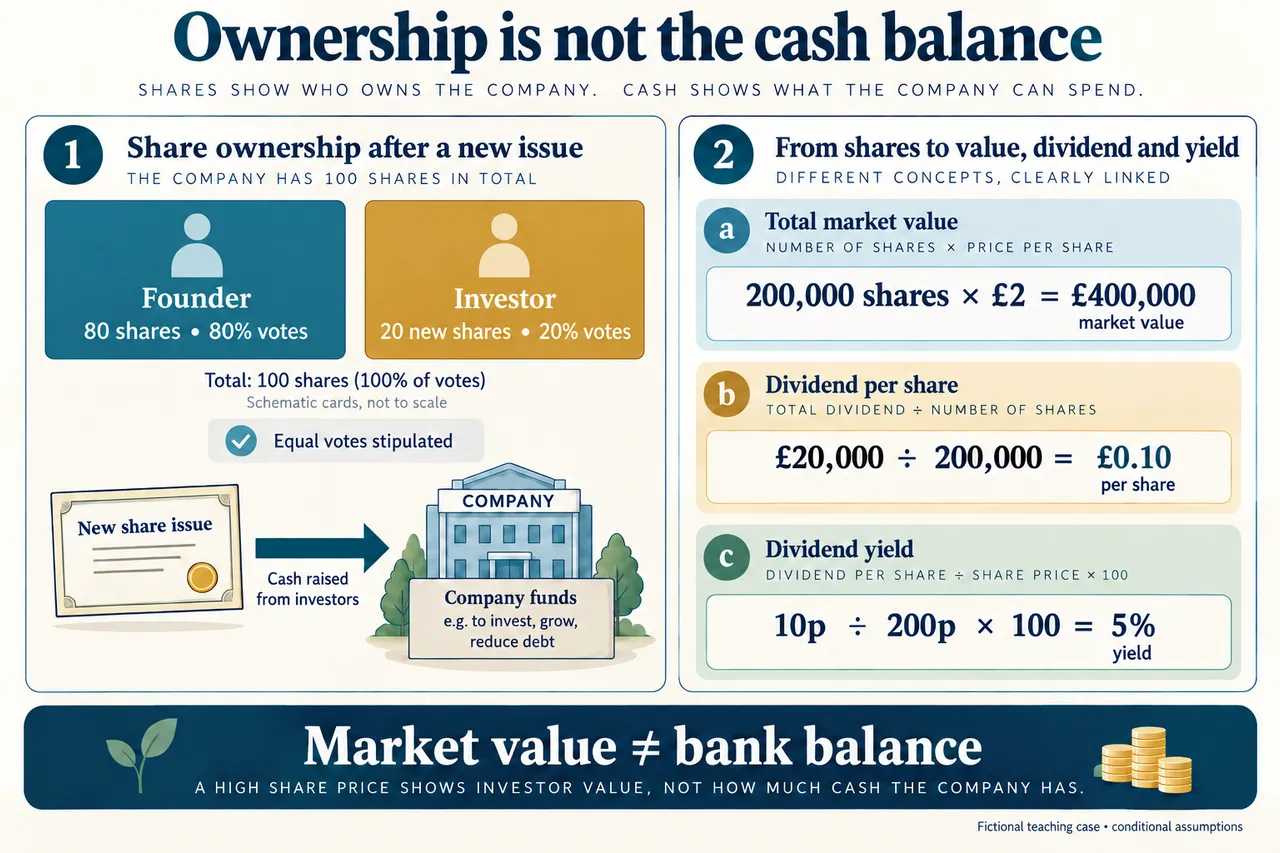
Ivo currently has eighty shares. Issuing twenty new shares of equal voting rights creates one hundred shares, giving Ivo eighty per cent and the investor twenty per cent. The founder’s percentage falls although the founder’s own share count remains eighty. This is dilution. A new issue can bring money into the organisation, whereas an investor buying an owner’s existing shares generally pays that seller. The case supplies no unusual share classes or voting agreement, so the simple calculation cannot establish every possible right or future control condition.
Shares can be bought for possible dividends, changes in value and influence over an organisation. These expectations are uncertain. A price can reflect revised expectations of future performance, wider conditions or changes in what buyers are willing to pay. Trading an existing share at a higher price does not itself deposit the valuation increase in the company’s bank account. Distinguishing the market’s price of claims from cash held by the organisation prevents a common mistake when a business’s quoted value rises without new capital being raised.
The separate listed-company illustration has 200,000 shares at £2, implying market capitalisation of £400,000. A total dividend of £20,000 gives £0.10, or ten pence, per share. Dividing ten pence by a 200-pence price and multiplying by one hundred gives a five per cent yield. Using £0.10 divided by £2 gives the same result. Mixing ten pence with a denominator of two pounds without converting units would give a hundredfold error. The yield describes the stipulated dividend and price, not a promise about next year.
Equity can support a venture whose receipts are uncertain because it does not have the same scheduled repayment structure as a loan. It can nevertheless change control and create expectations about returns and strategy. Retaining profits for equipment may conflict with distributing dividends. Conversely, preserving complete control may restrict the resources or expertise available to grow. Judge funding in relation to purpose, timing, conditions and the organisation’s ability to use it, rather than recommending the largest amount or most protective-sounding label in isolation.
The plate distinguishes voting ownership, a new issue entering company funds and a separate market valuation. Its separated owner cards are a schematic equal-vote model, explicitly not an area chart. The price-change transfer asks what changes in valuation and yield while the dividend stays constant. Neither the plate nor the model supplies investment advice, tax advice or a legal judgement about real documents. A justified answer identifies what the numerical arrangement establishes and what additional information is required before making a decision about ownership, finance and responsibility.
Worked example: Fictional studio founder Ivo has 80 ordinary shares, and an investor would purchase 20 new ordinary shares with equal voting rights. The case stipulates no other classes or agreements. A separate listed-company example has 200,000 ordinary shares at £2 each, total dividend £20,000, and no claim these are actual shares. Neither case supplies taxation, guarantees or legal-document details.
Ivo should consider the new-share investor if the studio genuinely needs external equity and can use the funds productively, but should not describe the decision as acquiring limited liability at no cost. UK official guidance distinguishes a sole trader’s personal responsibility for business debts from a limited company’s separate legal identity. That distinction matters for risk and administration. It does not establish that every personal exposure disappears: actual guarantees and directors’ responsibilities require their own analysis. This educational case is not legal advice about Ivo’s documents.
Under the stated equal-vote share arrangement, Ivo’s eighty shares out of one hundred after the issue give eighty per cent of the votes. The investor holds twenty per cent. Ivo has diluted ownership without necessarily losing ordinary voting control, but the model supplies no special voting rights, contractual vetoes or future funding terms. Saying that eighty per cent guarantees unrestricted decision-making would therefore reach beyond the case. If the investor instead bought existing shares from Ivo, the payment would normally go to the seller rather than provide the same new funding to the studio.
Equity may reduce dependence on scheduled loan repayments, which is helpful where studio cash receipts are uncertain. Nevertheless, the investor expects a return and may influence the organisation’s objectives. Dividend distribution competes with retaining funds for equipment or expansion. A sole trader might preserve simpler direct control, but remains personally responsible for debts under the general UK guidance. Choice of structure must therefore fit funding requirements, control preferences and responsibilities together.
The separate listed-company illustration helps distinguish three financial measures. Two hundred thousand shares at £2 imply market capitalisation of £400,000. A £20,000 total dividend gives ten pence per share. Dividing ten pence by a two-hundred-pence price gives a five per cent dividend yield. Market capitalisation is a market valuation, not the company’s bank balance, while that yield describes this stipulated dividend relative to price, not a guaranteed future return.
I would favour an equity discussion rather than an automatic commitment. Ivo should compare an investor’s expertise and conditions with alternative funding and the studio’s expected use of cash. An investor coveringthe venture may improve decisions, whereas conflicting return expectations can create pressure. Incorporation, finance and control are connected choices, but remain distinct questions; a recommendation needs evidence about all three.
Answer: A sustained original evaluated response: apply the stated case, verify the appropriate numerical endpoint, challenge assumptions, compare consequences and justify a conditional decision. No guaranteed business success or official mark/grade is asserted.
Check your understanding: If the listed share price becomes £2.50 and the dividend remains 10 p, recalculate market capitalisation and yield. Has the company necessarily received £100,000 extra cash?
Answer: Market capitalisation becomes 200,000×£2.50=£500,000. Yield becomes £0.10/£2.50×100=4 percent. A secondary-market price increase alone does not mean the company received the £100,000 valuation increase. New capital raising is a different transaction; future dividends and prices remain uncertain.
Why: Use the exact stipulated inputs, period, units and denominator; recalculate before judging. Distinguish supported conditional arithmetic from demand, causation, ethics or legal arrangements that the case does not establish.