A cheaper supplier can have a more expensive consequence
By UK A Level Business · independent study · myAudience
Original myAudience educational illustration. Image: illustration, not a documentary photograph. · myAudience educational illustration; no affiliation with any awarding body.
A cheaper supplier can have a more expensive consequence
Stakeholders are people or groups affected by an organisation’s activity or able to influence it. Employees and owners or shareholders are internal examples; customers, suppliers, other creditors, communities and government are external examples in this specification. Their interests can overlap without being identical. Customers may want a reliable affordable component, employees a manageable workload and owners a sustainable return. Naming groups is only a starting point. Analysis must explain how a particular decision changes their experience or influence.
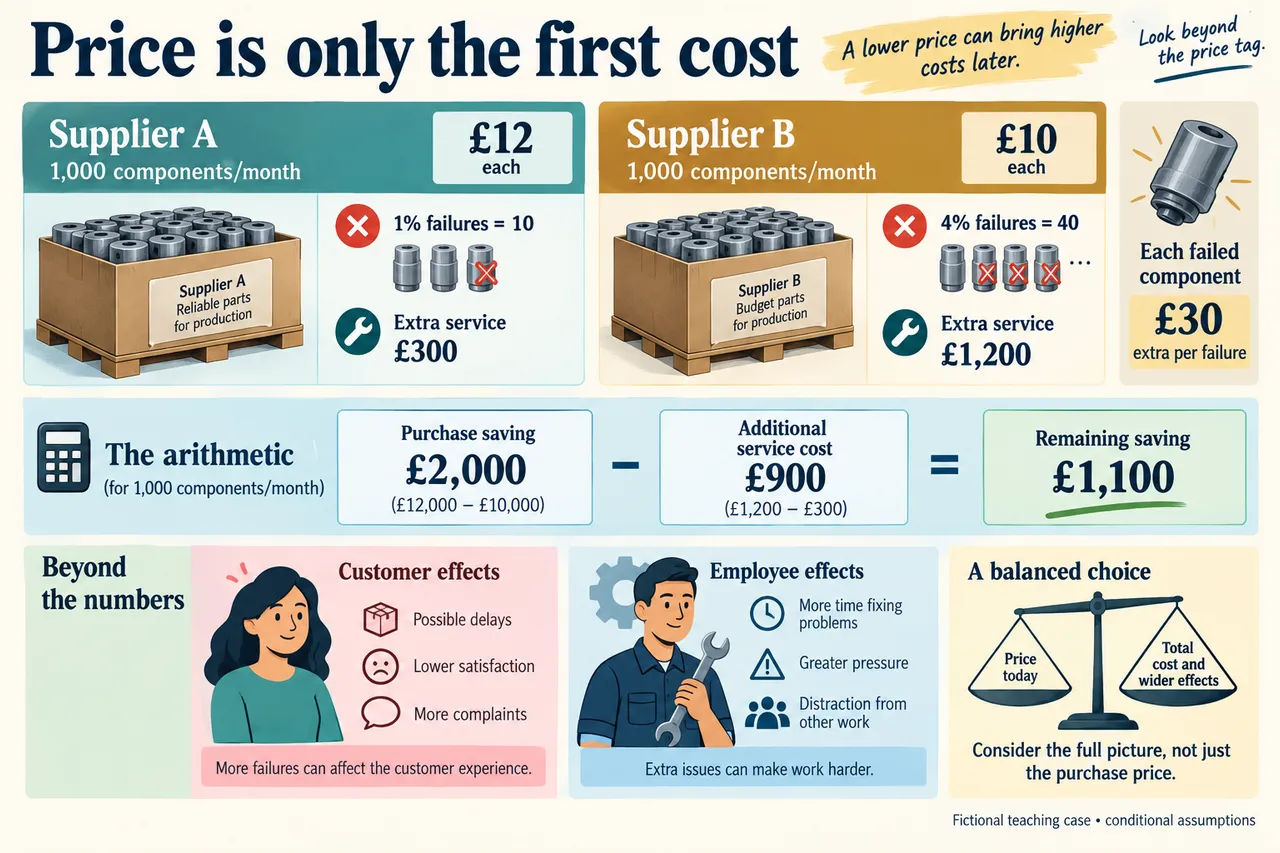
Fictional Elm’s supplier choice creates a clear first-round saving. One thousand components at £12 cost £12,000; the same volume at £10 costs £10,000. Switching to B therefore reduces purchase expenditure by £2,000. The quality forecast introduces another effect: one per cent failures with A means ten faulty components, whereas four per cent with B means forty. The case stipulates £30 additional replacement and service cash outlay per failure. These are conditional forecasts, not measured supplier results or a demonstrated causal relationship.
The additional service outlay is £300 with A and £1,200 with B. B therefore adds £900 to this part of the cost, reducing the £2,000 purchase saving to £1,100. Include each cost once. The original component purchase already appears in purchase expenditure; it should not be added again inside the stipulated £30 extra allowance. In a real investigation, the definition of a repair cost would need checking because a reported allowance might include different items. Accurate arithmetic depends on knowing what the numerator actually contains.
Money does not describe every consequence. Forty failures instead of ten could require more complaint handling, delay customers’ use of the product and interrupt employees’ other tasks. Those mechanisms could affect future sales, staff workload or trust even where the narrow combined cash calculation favours B. They are possible consequences to investigate, not facts established by the case. Specify the sequence: a fault creates a service need, service consumes time or causes delay, and those experiences may influence behaviour. A vague assertion that reputation matters is weaker than that causal account.
A supplier also has interests in stable orders, reliable payment and fair specification of responsibilities. Increasing the pressure on prices or extending payment terms may move risks rather than remove them. Other creditors need confidence in the business’s ability to pay, and a community may care about jobs or product reliability. Ethical responsibilities cannot be reduced to the forecast cash penalty of a reputation problem. The decision should consider whether treatment is defensible even where a consequence is difficult to price, while avoiding an unsupported claim that one group must always take priority.
The evidence behind failure rates may be unsuitable for a direct comparison. Products might differ in difficulty, the observation periods might differ, or one supplier may count a minor defect while another records only returns. Small samples and changes in inspection can also alter the apparent rate. Elm should request consistent definitions and examine comparable products and conditions. Stakeholder accounts can reveal experiences missed by cost records, while systematic records can show whether an account reflects a widespread pattern. Neither source is automatically complete or free of bias.
A limited trial with clear quality requirements is an alternative to switching every order immediately. It may let Elm observe service demands and work with B on the causes of defects. That approach has its own costs, including managing two sources and possibly buying at a less favourable trial price. The decision should compare those costs with the value of reducing uncertainty. If there is independently verified unacceptable treatment of workers or another serious responsibility issue, a successful cost trial would not settle that concern. Different evidence answers different parts of the judgement.
The worked model weighs the net saving against quality effects and evidence limits. Its transfer raises B’s failure rate to eight per cent: eighty failures produce £2,400 extra service outlay, so B is £100 more costly after allowing for A’s £300. The ethical question deliberately adds a separate hypothetical: even if cash costs were equal at another failure rate, customer disruption or treatment could still differ. The plate shows the central four-per-cent example and symbolic stakeholder consequences, not literal counts of people or a universal ethical verdict.
Worked example: Fictional Elm switches between supplier A at £12 per component and B at £10. Monthly volume is 1,000 components. In a stipulated forecast, A causes 1% and B 4% failures; each failed component requires £30 of replacement and service cash outlay in addition to the original purchase. No double counting of that original component is permitted. Supply conditions, labour practices and causation of rates need checking; the data are not real observations.
Elm should not make an immediate full switch solely on the component price, although supplier B remains a plausible option for a controlled trial. Buying one thousand components at £10 rather than £12 saves £2,000 per month before quality effects. In the stipulated forecast, A produces ten failures and B forty. At £30 additional cash outlay per failure, service costs are £300 and £1,200 respectively. B therefore still saves £1,100 in the narrow combined calculation: the £2,000 purchasing saving is reduced by £900 extra service outlay.
This arithmetic challenges the claim that cheaper inputs must reduce overall costs by the full price difference. It does not establish that B is the better supplier. Customers experience thirty extra failures per month in the forecast. Longer waits for replacements could reduce repeat purchases or trust, adding effects not quantified in the £30 allowance. Employees may spend more time handling complaints and repairing faults, reducing time available for other work. The financial and customer consequences are therefore connected through a specific mechanism, rather than through a vague assertion that quality matters.
Owners may favour the remaining £1,100 saving, especially where the business has thin margins, but their interest is not identical to immediate cost reduction. A deteriorating customer relationship can undermine future revenue. Conversely, automatically rejecting B could miss a genuine improvement if its failure rate can be reduced with better specifications or inspection. Suppliers also have interests in stable orders and reasonable terms; transferring excessive uncertainty to them may threaten reliability or create an ethical concern even where Elm temporarily gains.
The evidence deserves scrutiny. The stated failure percentages might concern different products, production periods or definitions of a fault. A small initial sample may not predict Elm’s experience. The £30 allowance must cover only the additional replacement and service cash costs stipulated, because adding the original purchased component again would double-count it. Even a correctly calculated forecast can be misleading if its inputs are not comparable.
I recommend a limited trial with agreed quality definitions and clear responsibilities for defects. Elm should monitor service time and customer outcomes alongside purchase expenditure, then revisit the choice. If B’s failure rate remains high or an independently established labour concern is unacceptable, the apparent cash saving would not justify the switch. This is a conditional stakeholder judgement that recognises both financial pressure and responsibilities beyond a single cost measure.
Answer: A sustained original evaluated response: apply the stated case, verify the appropriate numerical endpoint, challenge assumptions, compare consequences and justify a conditional decision. No guaranteed business success or official mark/grade is asserted.
Check your understanding: If B’s failure rate is instead 8%, calculate the saving after additional service outlays. Explain why a cash-only comparison would not settle ethics even if costs were equal at a different failure rate.
Answer: B produces 80 failures costing £2,400; A’s 10 cost £300. The extra £2,100 service outlay exceeds the £2,000 purchase saving, so B is £100 more costly in this model. A saving of exactly zero at another rate would still leave differences in customer disruption, working conditions and supplier responsibilities; cash equivalence is not ethical equivalence.
Why: Use the exact stipulated inputs, period, units and denominator; recalculate before judging. Distinguish supported conditional arithmetic from demand, causation, ethics or legal arrangements that the case does not establish.