Choose a target without turning a segment into a stereotype
By UK A Level Business · independent study · myAudience
Original myAudience educational illustration. Image: illustration, not a documentary photograph. · myAudience educational illustration; no affiliation with any awarding body.
Choose a target without turning a segment into a stereotype
A market segment is a group defined for a decision, not a label that reveals everything about its members. A repair business might group customers by the distance they can travel, the urgency of a fault, the equipment they use or the support they need. Each classification is useful only if it helps the business understand a relevant need. A demographic category can describe a population without explaining why someone would choose this particular service.
Demographic segmentation uses characteristics such as age or household circumstances; geographic segmentation describes location or access. Psychographic segmentation concerns interests, values or lifestyles, while behavioural segmentation concerns actions such as purchase frequency or benefits sought. These variables can overlap, and their measurement may be unreliable. The firm should not infer sensitive traits or assume that every person in a group shares the same preference. Ask what evidence supports the proposed connection to the offer.
Choosing a target combines attractiveness with capability. An apparently large market may be expensive to reach or already served by credible rivals. A smaller group may require a service the business can deliver particularly well, but its size and willingness to pay still need investigation. Compare competitors, access, service requirements, likely contribution and the resources needed to enter. A target is not attractive merely because its members have been described as affluent or enthusiastic.
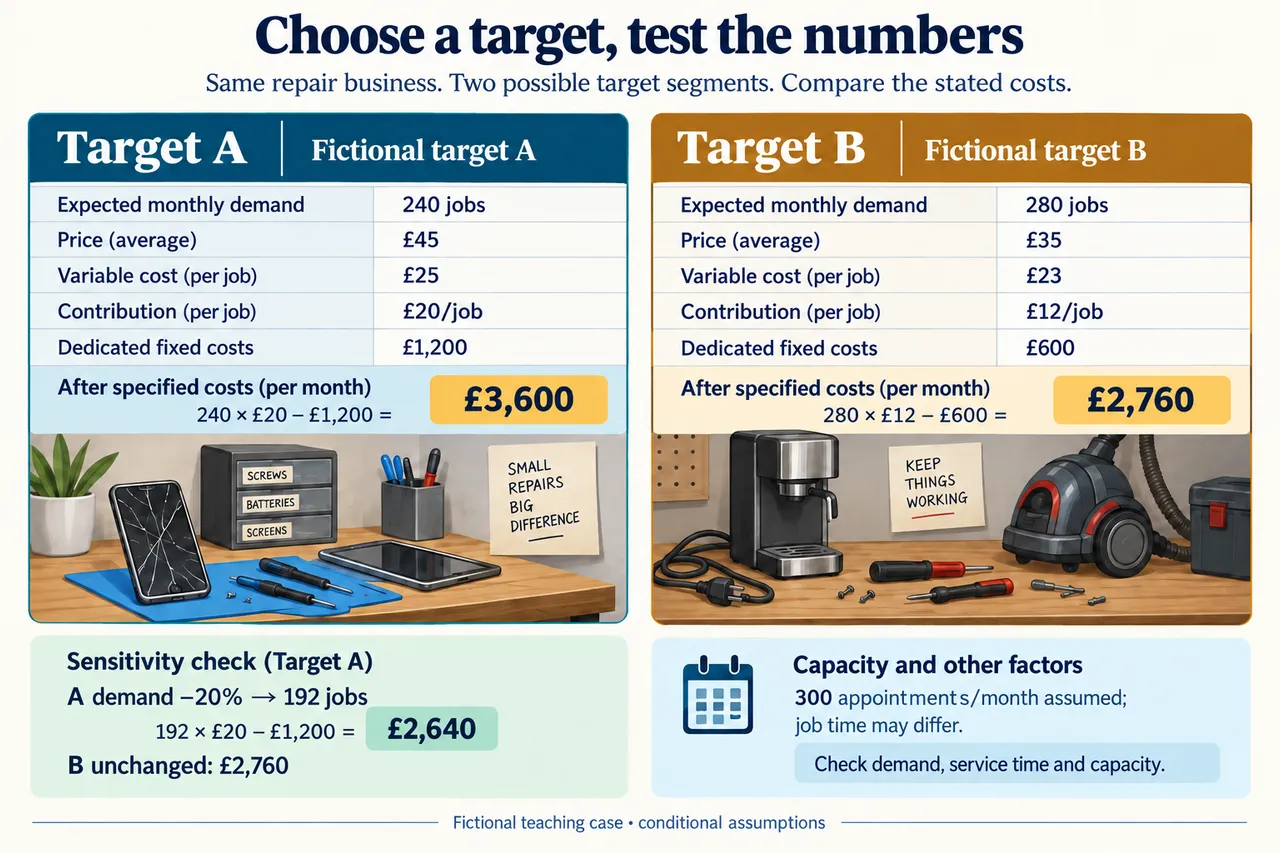
The fictional case makes the cost mechanism visible. A charges £45 and incurs £25 variable cost for each of 240 repairs: £20 unit contribution produces £4,800 before its £1,200 dedicated fixed cost, leaving £3,600. B charges £35 with £23 variable cost for 280 repairs: £12 contribution produces £3,360, leaving £2,760 after £600 dedicated fixed cost. These are conditional figures after specified costs, not complete accounting profit or guaranteed owner income.
A niche strategy concentrates on a relatively narrow set of needs, whereas mass marketing seeks a broader market. Neither guarantees a particular price or profitability. A niche may allow detailed expertise and relevant promotion, but can expose the firm to a small demand base or a specialist rival. Mass marketing can support scale, but requires enough demand, capacity and reliable delivery to justify its costs. The relevant question is whether the chosen scope fits the organisation and customers.
A coherent mix should make the promise deliverable. If A needs a diagnostic appointment and clear explanations, the product includes those service elements; the price must reflect their costs; the channel must allow booking and advice; promotion should describe what will actually be provided. A cheaper B service might require a simpler standard process. Changing only the advertisement while keeping an unsuitable service does not constitute meaningful adaptation. Customer access and fair treatment also belong in the decision.
Capacity requires a compatible unit. The stated 300 appointments per month does not establish that 240 specialist jobs and 280 simple jobs consume equal staff time. If A takes longer, its forecast could require more labour than the business possesses. Finance must consider cash timing, operations must examine equipment and queues, and people management must arrange skills. Sensible targeting therefore links marketing evidence to the functions that fulfil the promise instead of optimising contribution on paper alone.
The unfamiliar transfer reduces A demand by twenty percent to 192 jobs. Its £3,840 contribution leaves £2,640 after the dedicated fixed cost, £120 below B's unchanged £2,760. This supports a sensitivity question, not an automatic instruction to switch. Transition costs, reliability and the business's purpose may outweigh that small difference. The illustration's separated tables make the numerical comparison explicit; the people and service objects are symbolic rather than a counted or stereotyped customer sample.
Worked example: A fictional repair business has 300 monthly appointments. Target A forecasts 240 paid jobs at £45, £25 variable cost per job and £1,200 dedicated fixed cost. Target B forecasts 280 jobs at £35, £23 variable cost and £600 dedicated fixed cost. Demand and segment labels are stipulated, not population stereotypes.
The repair business should initially favour target A, provided it can verify the forecast demand and deliver the required service reliably. A supplies £10,800 revenue from 240 jobs at £45. Variable costs total £6,000, leaving £4,800 contribution. After £1,200 dedicated fixed costs, the stated contribution after those costs is £3,600. B generates £9,800 revenue, £6,440 variable costs and £3,360 contribution. Its £600 dedicated costs leave £2,760. A therefore provides £840 more under the central assumptions, despite serving fewer customers.
This is a conditional comparison rather than proof that the more expensive service is universally preferable. A may require appointments, specialist skills or a longer guarantee. Those requirements could make its apparent margin difficult to achieve, especially if the common capacity of 300 monthly appointments conceals different time requirements per job. B might suit a quicker standard repair. The business should test actual service times and customer willingness to pay rather than equating a demographic description with predictable behaviour.
A niche approach could concentrate scarce expertise and make promotion more relevant. However, dependence on a narrow group makes demand changes or new competitors particularly important. A mass-market approach might reach more potential customers, but low prices do not themselves create the scale needed to cover costs. The appropriate mix must fit the chosen needs: reliable booking, the repair actually promised, a defensible price and a channel through which customers can obtain advice. An attractive advertisement cannot substitute for those operational capabilities.
Sensitivity changes the recommendation. If A demand falls by twenty percent, 192 jobs produce £3,840 contribution and £2,640 after dedicated fixed costs. B's unchanged £2,760 then exceeds A by £120. Switching is not automatic: cancellation costs, retraining, reputation and the quality of the alternative forecast may exceed that small difference. Nor does the model establish whether all fixed costs disappear when a target is abandoned.
I would conduct a bounded paid-booking trial before committing to additional resources, using a common period and clearly defined service promises. The business should retain A only if its demand, costs and service time support the forecast advantage. This combines measurable commercial performance with evidence about customer needs; it avoids selecting a segment simply because its members are assumed to behave alike.
Answer: Target A leaves £3,600 after the specified dedicated costs, compared with £2,760 for B. A 20% fall in A demand reduces its figure to £2,640, leaving B £120 ahead if B demand is unchanged. Prefer A only conditionally: validate demand, job duration, capacity and other omitted costs before choosing.
Check your understanding: A demand falls 20% while B does not change. Recalculate and justify whether switching target follows automatically.
Answer: A has 192 jobs, giving £3,840 contribution and £2,640 after dedicated fixed cost. B gives £2,760, £120 higher. Switching costs, reliability, capacity and purpose still matter: the forecast difference is not proof of actual demand.
Why: Reconstruct the stated endpoint and consistent denominator. Explain the causal mechanism and compare the missing evidence before recommending action. Fictional arithmetic does not establish actual demand, permissions or ethical justification.