Marketing objectives must survive the capacity test
By UK A Level Business · independent study · myAudience
Original myAudience educational illustration. Image: illustration, not a documentary photograph. · myAudience educational illustration; no affiliation with any awarding body.
Marketing objectives must survive the capacity test
Marketing objectives clarify the result a business wants, but the chosen measure shapes behaviour. A team rewarded for clicks may optimise an attention-catching advertisement even when few visitors complete a purchase. A team judged only by sales may promise work that operations cannot fulfil. Start with the business purpose, identify a meaningful endpoint and specify the period and responsibility. This makes an objective open to investigation rather than an impressive but ambiguous percentage.
Lead generation, brand awareness, engagement, conversion, sales, share and retention measure different things. A qualified lead meets defined criteria; it is not yet necessarily an order. Conversion links a specified starting stage to a specified ending stage. Retention concerns an identified earlier cohort over a stated period. Market share additionally requires a defined market denominator. These measures can inform one another, but they cannot be exchanged merely because each can be reported as a percentage.
An objective needs resources and a review method. A new launch with little evidence may justify a bounded learning objective before a large sales commitment. An established service might emphasise retention or reliable fulfilment. The marketing budget limits experiments and communication, yet cutting it can also remove the information needed to allocate future resources. Treat the budget as a decision about opportunities and evidence, not simply a line that should always be reduced.
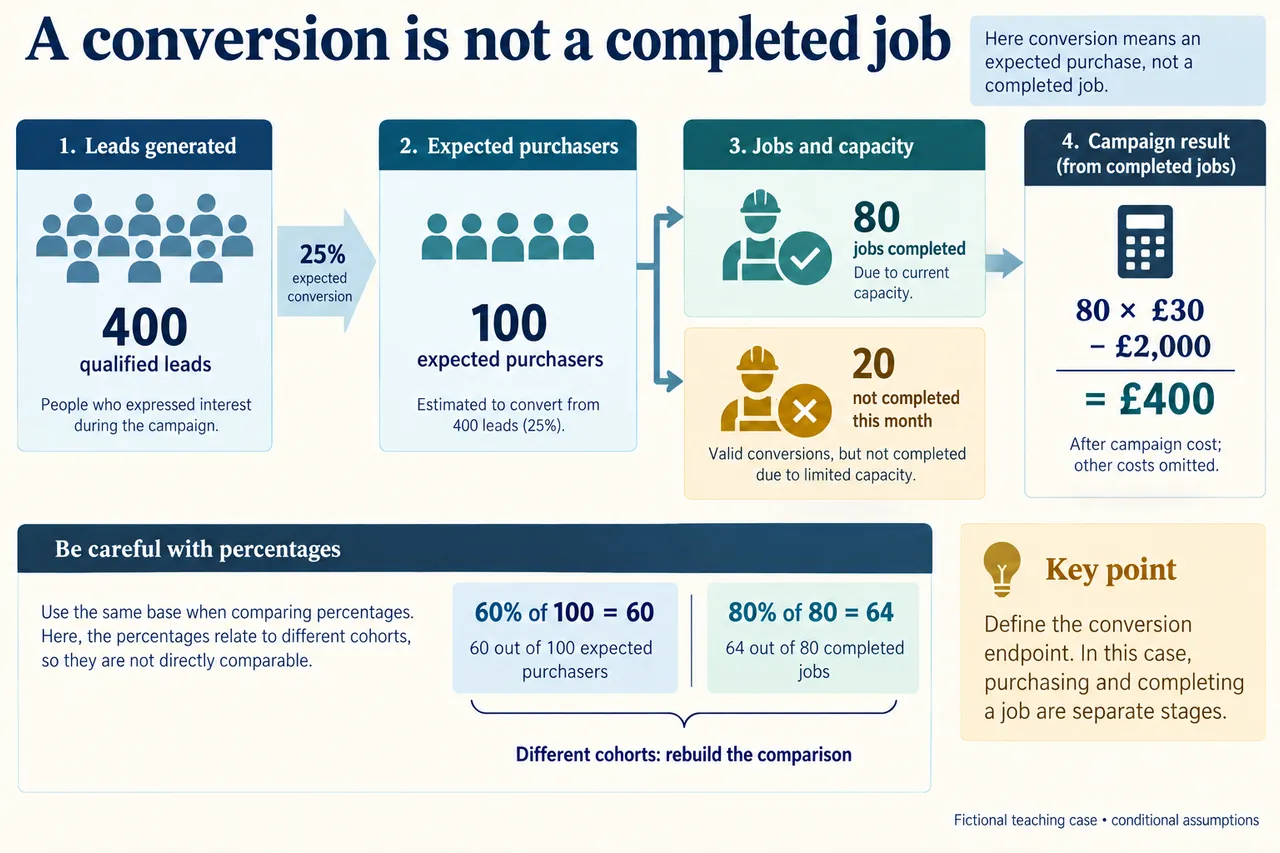
In the fictional funnel, 400 qualified leads at a stipulated 25% conversion rate give 100 expected purchasers. This month operations can complete only 80 new jobs. At £30 contribution per completed job, that produces £2,400; after the £2,000 campaign, £400 remains before omitted costs. Counting all 100 as fulfilled would give £1,000 and overstate this same-period calculation by £600. The uncompleted 20 need an explicit status rather than disappearing into a success figure.
Demand can change for different reasons. Seasonality concerns a recurring pattern within the year, whereas cyclical changes relate to wider fluctuations in economic activity. A temporary promotion, competitor disruption or a local event may instead create an irregular change. The distinction affects staffing, inventory and the mix: buying permanent capacity for a short spike may be costly, while ignoring sustained growth may lose customers. None of these patterns can be diagnosed from one attractive campaign result alone.
Marketing decisions connect to finance, people and operations. Cash may arrive before or after service costs; extra enquiries may require trained staff; the promised service may depend on inventory or appointment slots. A marketing manager can be accountable for the campaign without controlling all these resources. The objective should therefore include agreed responsibilities and a realistic fulfilment plan. Coordination reduces the risk that one department records a gain while another absorbs queues, complaints or unfunded commitments.
The retention transfer deliberately changes the base. Sixty percent of 100 expected purchasers gives 60 retained buyers. Eighty percent of the 80 completed purchasers gives 64. These percentages do not establish a clean improvement because they refer to different cohorts. Reconstruct the same customers, completion rule and follow-up period before comparing rates. The absolute difference of four people may be commercially relevant, but it cannot tell us whether the retention process caused it.
A defensible review would track fulfilled purchases, contribution, service quality and the fate of outstanding enquiries separately. If the aim is awareness or learning, disclose that rather than disguising it as current sales. The concept plate links leads, expected conversions and feasible completions, with a separate contribution calculation; its funnel is a schematic sequence, not measured customer behaviour. Use it to find the constraint and design a better test, not to assume the future rate will remain fixed.
Worked example: A fictional workshop has 400 qualified leads, expects 25% conversion to purchase and 60% annual retention among that expected cohort. Operations can fulfil 80 new jobs this month. The campaign costs £2,000 and each completed new job contributes £30. All rates are conditional.
The workshop should revise its campaign objective before treating the forecast as a success. Four hundred qualified leads at a stipulated twenty-five percent conversion rate produce one hundred expected purchasers. Operations can complete only eighty new jobs this month. At £30 contribution per completed job, those eighty generate £2,400; deducting the £2,000 campaign leaves £400 before any additional costs omitted from the case. Counting all one hundred as fulfilled would instead imply £1,000, overstating the same-period result by £600.
The immediate problem is coordination rather than necessarily poor advertising. A lead is someone meeting the firm's stated qualification criteria, not a paid customer. Conversion describes a transition between defined stages. The firm must decide whether purchase, booking or completion is its measured endpoint. Twenty purchasers might wait, cancel or move into the next period. Their money and costs cannot be assigned to this month merely to make the marketing figure attractive.
A useful objective would specify completed new jobs, the deadline and an accountable manager, while recognising service quality and the resource constraint. An awareness objective might still be justified for a longer-term launch, but it would need a different evaluation. Raising clicks, engagement or leads is not equivalent to meeting a sales objective. Likewise, the marketing budget is not just an expense to minimise: reducing it might save cash while weakening the evidence needed to choose a viable future offer.
Retention also needs a coherent cohort. The initial sixty-percent assumption applied to one hundred expected purchasers gives sixty retained buyers. Applying eighty percent to only eighty completed purchasers gives sixty-four. This is not sufficient evidence of a twenty-percentage-point improvement because the bases differ. The manager should identify the same customers, define a comparable repeat-purchase period and account for those who did not receive the first service. Four more retained people might reflect a stronger process or simply a changed denominator.
I recommend limiting the first campaign to a fulfilment plan that the workshop can support, while tracking the remaining enquiries separately. Finance must consider the timing of receipts; people management must arrange staffing; operations must protect the promised service. A higher marketing target could be justified after a credible capacity change. For now, a conditional £400 result with reliable service is a more defensible objective than an impressive funnel that includes jobs the business cannot yet complete.
Answer: The case gives 100 expected purchasers from 400 leads, but current capacity completes only 80 jobs. Those jobs leave £400 after the campaign cost; the other 20 are not completed this month. A 60% rate on a base of 100 and an 80% rate on a base of 80 describe different cohorts, so rebuild a common endpoint and denominator before comparing.
Check your understanding: If 80% retention applies only to the 80 completed purchasers, how many retained buyers are expected? Why cannot 60 and 64 alone establish a retention improvement?
Answer: 80 × 0.8 = 64 retained buyers. The earlier 60 came from 100 expected purchasers, including 20 not completed this month. Compare like-for-like cohorts, periods and completion rules; a changed denominator can create an apparent improvement.
Why: Reconstruct the stated endpoint and consistent denominator. Explain the causal mechanism and compare the missing evidence before recommending action. Fictional arithmetic does not establish actual demand, permissions or ethical justification.