A distribution route changes both margin and customer service
By UK A Level Business · independent study · myAudience
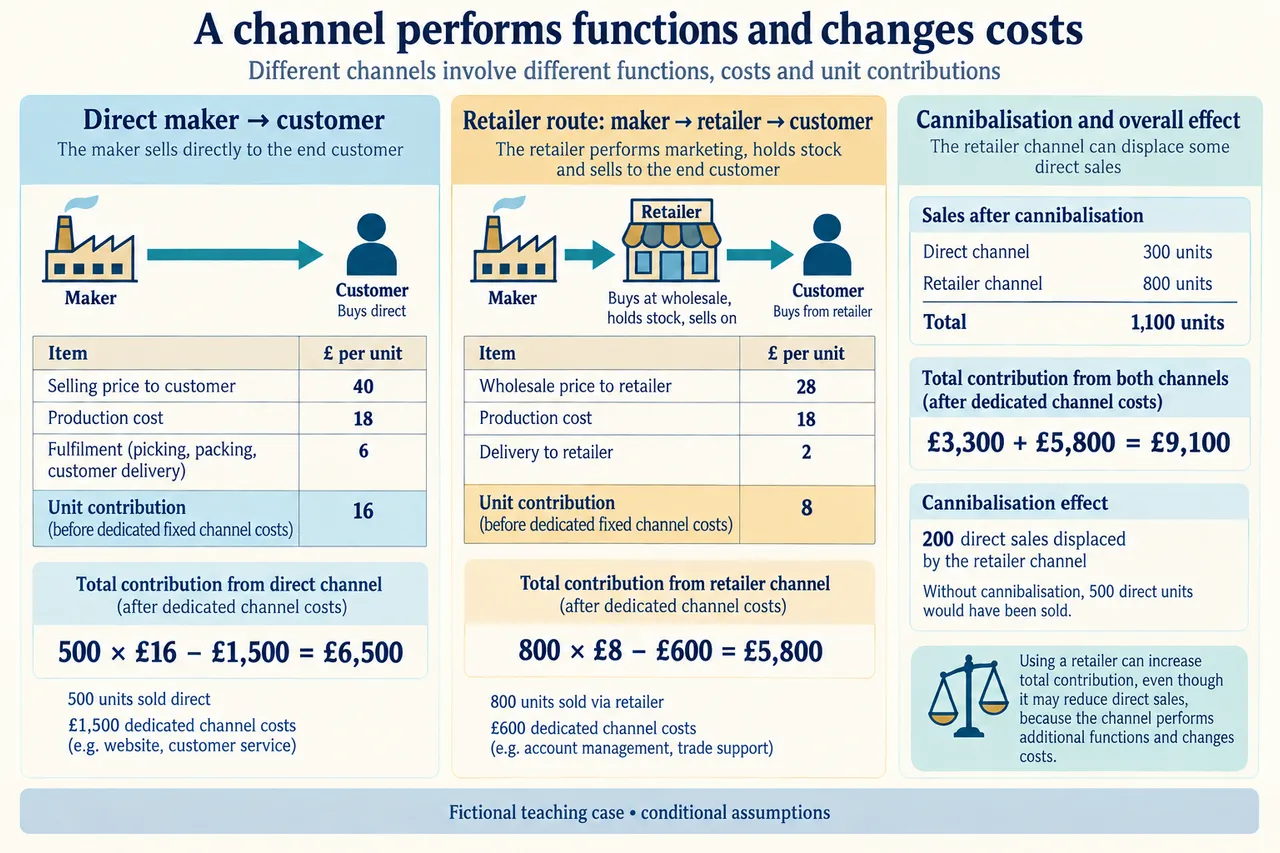
Original myAudience educational illustration. Image: illustration, not a documentary photograph. · myAudience educational illustration; no affiliation with any awarding body.
A distribution route changes both margin and customer service
A distribution channel describes how the offer reaches the customer and which organisations perform the required functions. Those functions can include finding buyers, holding stock, processing orders, offering advice, moving goods, taking payment and handling returns. A shorter chain is not automatically cheaper or better because the remaining business must still perform these tasks. Judge a route against customer needs and the organisation's capability to meet them.
Direct selling gives the maker a closer relationship with customers and more influence over presentation and service. E-commerce can widen access and provide ordering convenience, but it creates responsibilities for fulfilment, support, payment and returns. Website visits do not create a working distribution process. The maker needs a credible plan for completing orders and resolving problems, especially if the product requires advice or customers cannot easily inspect it before purchase.
Wholesalers and retailers can aggregate demand, provide locations, hold inventory and offer expertise or convenience. The maker usually receives a lower price than the final retail price because other organisations perform functions and seek a return. Assess whether their contribution justifies that difference. Intermediaries can also affect how products are explained or compared, and dependence on one buyer may create bargaining risk. These effects are contextual rather than universally favourable or harmful.
The fictional direct route sells 500 units at £40, with £18 production and £6 fulfilment costs per unit. Its £16 contribution gives £8,000 before £1,500 dedicated channel costs, leaving £6,500. The retailer route pays £28 for 800 units; £18 production and £2 delivery leave £8 contribution per unit. £6,400 less £600 dedicated costs leaves £5,800. These comparisons use consistent specified costs, not complete accounting profit or an assumption about payment timing.
Customer requirements may outweigh that initial £700 difference. A retailer may offer demonstrations, local collection or convenient opening hours. Direct selling may allow specialised advice or an unusual configuration. The maker should investigate which needs are actually important and how the price and service promise interact. A cheaper route that produces frequent returns or misunderstanding could weaken the proposition; a costly service customers do not value could also waste resources.
Multichannel distribution can offer more ways to buy, but it needs coordinated prices, stock, service and responsibility. A customer may discover the product through one route and purchase through another. Retailers may resist a maker undercutting their prices, while direct customers may expect the same guarantee or availability. These tensions can sometimes be managed, but additional routes should not be treated as independent sources of demand without examining displacement.
In the transfer, 200 retailer purchases replace direct sales. Direct output falls to 300, giving £4,800 contribution and £3,300 after its dedicated cost. The retailer still gives £5,800, so combined contribution after those costs is £9,100. Adding the original forecasts would give £12,300, overstating the result by £3,200: 200 displaced units times £16. This assumes both dedicated channel costs remain and does not establish capacity for the resulting 1,100 units.
The plate separates the two routes and their unit economics so that a learner can reconstruct rather than merely add the forecasts. Symbols are not counted orders. A recommendation should then test output capacity, payment terms, returns, customer service and control alongside the conditional calculation. The channel that maximises forecast volume may not maximise a defensible contribution or a sustainable customer relationship. Preserve the distinction between access, completed demand and the functions that make both possible.
Worked example: A fictional maker sells 500 direct units at £40, with £18 production and £6 fulfilment cost per unit plus £1,500 dedicated fixed channel cost. A retailer offers £28 wholesale for 800 units, with the same £18 production cost and £2 delivery per unit plus £600 dedicated fixed cost. Tax and payment timing are not specified.
The maker should not select the retailer merely because it offers a larger sales volume. Direct selling leaves £16 unit contribution after the £18 production cost and £6 fulfilment cost are deducted from the £40 selling price. Five hundred units therefore produce £8,000 contribution; £1,500 dedicated channel costs leave £6,500. The retailer route leaves £8 per unit from the £28 wholesale price after £18 production and £2 delivery costs. Eight hundred units produce £6,400 contribution; deducting £600 leaves £5,800.
The £700 direct-route advantage is conditional. Direct selling requires the maker to attract customers, handle enquiries and fulfil orders. The retailer may already offer access, advice and convenient locations. Its lower price partly reflects functions it performs and risks it accepts, rather than simply money lost to an unnecessary intermediary. Conversely, the maker may lose influence over how its product is displayed, explained or combined with competitors' products. Those differences should be examined against the customer's needs.
Multichannel distribution could expand access, but the two standalone forecasts cannot simply be added. If two hundred retailer purchases displace direct purchases, direct sales fall to three hundred. Those produce £4,800 contribution and £3,300 after the dedicated direct cost. Adding the retailer's £5,800 produces £9,100. The independent £12,300 total overstates the result by £3,200, the displaced two hundred direct units multiplied by £16 contribution. This assumes both channels' fixed costs remain payable.
The combined strategy could still exceed either route alone, but it creates practical questions. Can production supply 1,100 units rather than the independent 1,300-unit forecast? Which channel receives scarce stock? Will visible price differences confuse customers, and who handles returns? Payment timing could also create a working-capital need even if the contribution calculation is positive. The case does not establish the retailer's credit terms, return commitments or future order reliability.
I would test a coordinated two-channel offer with agreed customer promises and separate incremental measures, rather than assuming broader reach automatically creates more profit. If displaced direct sales or additional service costs are much larger than expected, direct-only selling may remain preferable. If the retailer provides genuinely additional demand at manageable cost, multichannel distribution could improve performance. The recommendation therefore rests on functions, customer experience and incremental economics, not volume alone.
Answer: Direct sales leave £6,500 after dedicated channel costs and the retailer route £5,800 on its separate forecast. Running both with 200 direct sales displaced leaves £9,100, not the independent sum £12,300. The retailer route can add £2,600 compared with direct alone under these assumptions, but distribution functions, capacity and cannibalisation must be tested.
Check your understanding: If 200 retailer purchases displace 200 direct purchases, calculate the combined result after both dedicated fixed channel costs. Explain why adding the independent forecasts would be wrong.
Answer: Direct: 300 × £16 − £1,500 = £3,300. Retailer: 800 × £8 − £600 = £5,800. Combined: £9,100. Adding independent forecasts gives £12,300 and overstates by 200 × £16 = £3,200. Capacity, payment timing, returns and brand control remain unresolved.
Why: Reconstruct the stated endpoint and consistent denominator. Explain the causal mechanism and compare the missing evidence before recommending action. Fictional arithmetic does not establish actual demand, permissions or ethical justification.