Promotion should earn a defensible response
By UK A Level Business · independent study · myAudience
Original myAudience educational illustration. Image: illustration, not a documentary photograph. · myAudience educational illustration; no affiliation with any awarding body.
Promotion should earn a defensible response
Promotion communicates an offer and tries to influence a response. The response could be awareness, an enquiry, trial, purchase or a continuing relationship. These aims have different costs and measures, so a business should specify what it wants before choosing a channel. A visually attractive campaign may fail if the offer is unclear, irrelevant or impossible to deliver. Promotion belongs to a coordinated mix rather than a separate contest for attention.
Advertising can reach many people with a consistent message, but reach is not proof that they noticed, understood or acted on it. Its value depends on the audience, timing, proposition and available resources. Compare the likely benefits with the cost and with alternative uses of the same budget. A low cost per impression can be unhelpful if the impressions concern people who have no reason to need the offer or cannot access it.
Sales promotions provide an additional reason to act, such as a limited offer, but their effects need incremental analysis. A discount may increase volume while reducing unit contribution; it may also bring forward future orders or replace purchases at the usual price. The business should distinguish new demand from changes in timing or mix. Short-term excitement is not a guarantee of lasting loyalty, and a deadline should not create a false impression about availability.
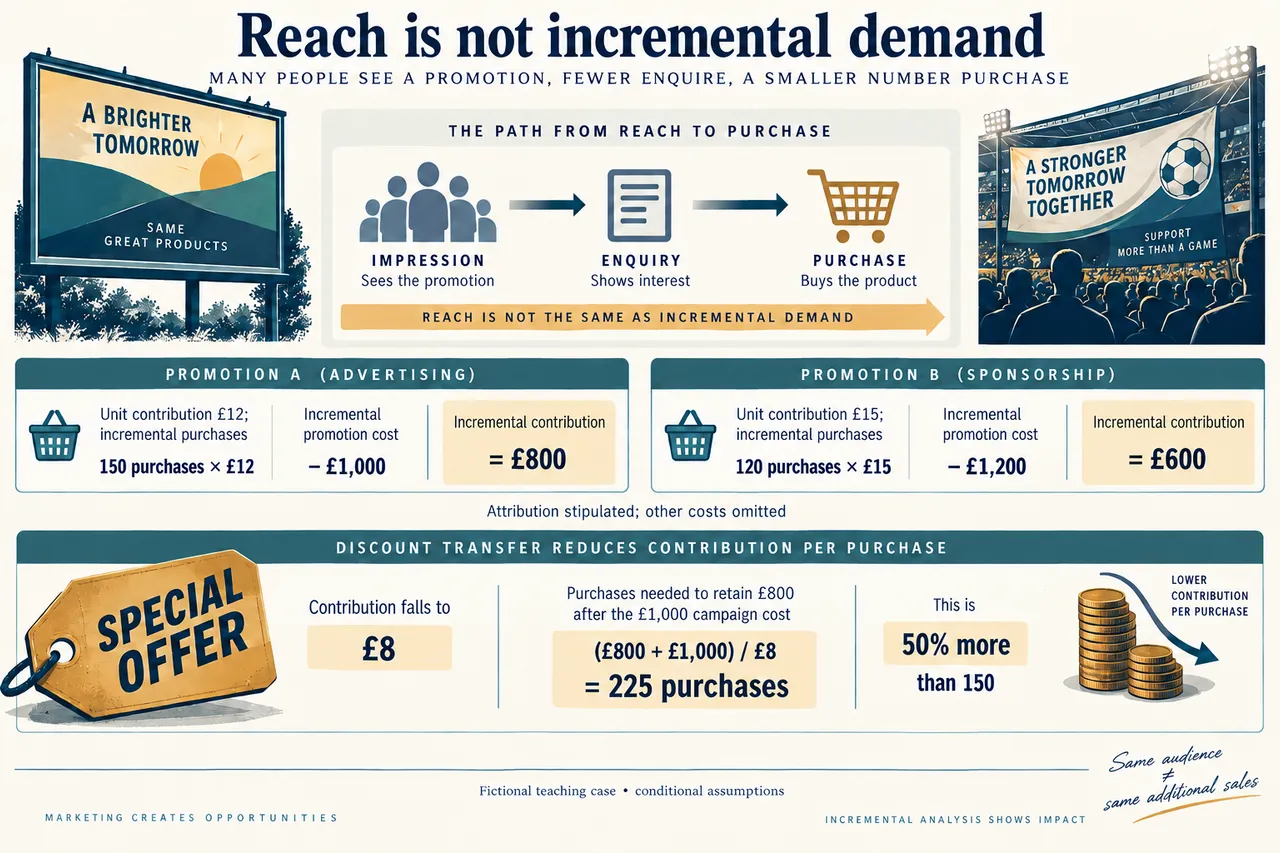
The fictional comparison stipulates attribution to make the arithmetic clear. A produces 150 new purchases at £12 contribution and costs £1,000: £1,800 less £1,000 leaves £800. B produces 120 at £15 and costs £1,200: the same £1,800 before promotion leaves £600. A is £200 ahead on this narrow measure. The result does not establish future repeat purchases, brand value or whether real attributed customers would otherwise have purchased anyway.
Sponsorship can associate a business with an event or activity and provide access to an audience, but the match and the resulting response need evidence. Social media and influencers can communicate through existing relationships, yet follower counts do not establish suitable customers or trustworthy claims. Clear identification and supportable statements matter. A firm should investigate actual audience fit rather than selecting a personality simply because their attention figures are large.
Personal selling and account management can help where customers need advice, configuration or a continuing service relationship. A salesperson can clarify requirements and arrange a feasible solution, but their time, training and incentives affect costs and behaviour. Brand loyalty may reflect useful past experience; it cannot be commanded by repetition. Own-label alternatives can also change the comparison customers make between price, quality, support and familiarity.
The transfer reduces A's contribution to £8 through a discount. At 150 purchases the result becomes £1,200 minus £1,000, or £200. To preserve the original £800, the campaign needs £1,800 contribution: 225 purchases, fifty percent more than 150. An increase in reach does not prove that threshold will be achieved. Calculate the endpoint first, then ask whether evidence supports the required demand and whether the extra orders can be fulfilled.
The plate's two panels separate purchases, unit contribution and campaign spending; its communication symbols are schematic rather than recorded audiences. Choose a mix using objectives, customer needs, resources and credible incremental evidence. A could be preferable on immediate contribution while B provides a defensible longer-term benefit, but that benefit must be investigated rather than invented. A reviewable recommendation states the conditions under which it would change and protects the promise made to customers.
Worked example: Fictional promotion A costs £1,000 and generates 150 stipulated incremental purchases at £12 contribution each. Sponsorship B costs £1,200 and generates 120 at £15 contribution. Attribution is stipulated; repeat purchases and brand outcomes remain unknown.
The business should initially favour promotion A on the narrow short-run contribution comparison, but should not present it as a proven superior promotional strategy. Its stipulated 150 new purchases contribute £1,800 at £12 each. Deducting the £1,000 promotion cost leaves £800. Sponsorship B contributes £1,800 from 120 purchases at £15 each; its £1,200 cost leaves £600. A therefore provides £200 more under the stated attribution and cost assumptions, even though both generate the same contribution before promotion costs.
The comparison depends on genuinely additional purchases. Advertising can reach people without changing their behaviour; sponsorship may strengthen associations without generating immediate sales. If the business counts customers who would have purchased anyway, the apparent return exaggerates the campaign's effect. A time-based rise in sales alone would not establish attribution because seasonality, competitors or availability may have changed. The case deliberately stipulates attribution so that the arithmetic can be examined; a real decision requires evidence for it.
A sales promotion also changes the financial mechanism if it reduces unit contribution. At £8 per purchase, 150 purchases generate only £1,200, leaving £200 after the same £1,000 cost. To retain the original £800, the promotion needs £1,800 contribution, or 225 purchases. That is fifty percent more than 150. Increased reach cannot establish that those purchases will occur, and some discounted orders may replace later or full-price orders rather than expand total demand.
The appropriate mix depends on the offer and relationship. Personal selling can clarify a complicated business purchase and an account manager can support repeat orders, although staff time is costly. Influencers and social channels may provide access to an audience, but audience fit and transparent identification matter. A brand can reduce uncertainty for customers who have experienced consistent quality; repeated promotion cannot create that quality by itself. Own-label competition could change whether a price-led or service-led position remains credible.
I recommend a bounded A trial with explicit incremental-sales measures and protection of the promised service. B could be preferable if credible evidence shows valuable longer-term relationships or audience access that the immediate case omits. The business should compare that evidence rather than inventing an unmeasured brand benefit to rescue a weak result. The strongest recommendation connects promotion to customer needs, contribution, capacity and a reviewable objective.
Answer: Attribution stipulated by the case gives £800 for promotion A and £600 for B after their specified campaign costs. Cutting unit contribution to £8 requires 225 purchases to retain A’s £800 result after the unchanged £1,000 campaign cost, 50% more than 150. That is a result-retention target, not break-even; reach alone cannot demonstrate the extra purchases.
Check your understanding: A discount reduces unit contribution to £8. What purchase volume retains the original £800 after campaign cost? Why would increased reach alone not establish that result?
Answer: (£800 + £1,000) / £8 = 225 purchases, 50% more than 150. More reach does not prove those incremental purchases. A discount may bring forward later orders or replace full-price sales; the required volume needs evidence.
Why: Reconstruct the stated endpoint and consistent denominator. Explain the causal mechanism and compare the missing evidence before recommending action. Fictional arithmetic does not establish actual demand, permissions or ethical justification.