Adapt the mix across markets without inventing national traits
By UK A Level Business · independent study · myAudience
Original myAudience educational illustration. Image: illustration, not a documentary photograph. · myAudience educational illustration; no affiliation with any awarding body.
Adapt the mix across markets without inventing national traits
International marketing concerns serving customers across different market contexts, not explaining them through national character. A firm may seek additional demand, a less dependent sales base or a new use for its capabilities. However, customers, competitors, channels and rules vary within as well as between countries. Start with the specific target and purchasing situation. A flag, broad cultural label or population figure does not establish that the organisation can deliver an attractive offer.
Market attractiveness includes relevant demand, competition, access, costs and the ability to fulfil promises. A large population may contain relatively few suitable customers; a smaller market may be accessible through a credible partner. Evidence should describe the actual product category and period. Researching a country's identity is not the same as investigating customer needs, willingness to pay or the capacity of a proposed distribution channel.
Standardisation can reduce duplicated design, communication and coordination costs. Adaptation may make an offer more useful, understandable or accessible. Neither is automatically preferable: a familiar domestic product can fit another context, while an expensive adaptation can fail to address a real need. Explain which element of the mix changes, why customers would value it and what the organisation must do differently. The choice may vary by element rather than require an entirely standardised or entirely adapted approach.
Product adaptation could concern packaging, language, configuration, support or a service process. A translated label does not fix a product customers cannot use or repair. Price also needs a consistent basis: currency, delivery, support costs and the customer comparison matter. The fictional calculations convert values to one currency under a stable-rate assumption. They do not establish future exchange rates or justify applying an observed elasticity from one market to another without evidence.
Place and promotion involve relationships as well as messages. A local channel might provide access or advice but introduce service responsibilities and costs. A promotional claim needs to be understandable and supported, and relevant local requirements need current authority. Avoid treating the apparent success of one translated campaign as proof that everyone in a country shares a preference. Local research can identify useful variations without turning them into a stereotype.
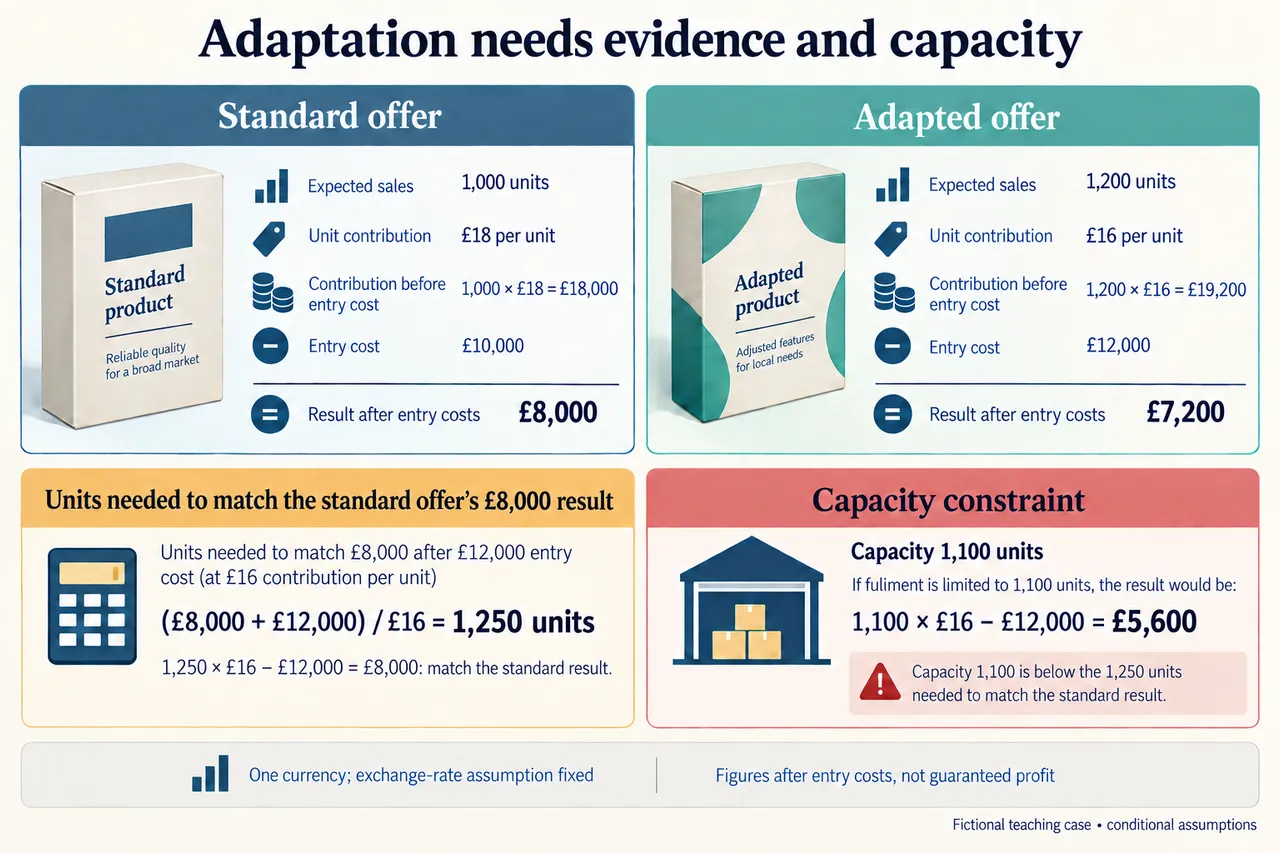
The standardised fictional offer expects 1,000 units at £18 contribution, leaving £8,000 after £10,000 entry cost. The adapted offer expects 1,200 at £16, leaving £7,200 after £12,000 entry cost. Adaptation must generate £20,000 contribution to match the £8,000 result, requiring 1,250 units. This threshold identifies the evidence needed, but it is conditional on the stated costs, feasible output and genuinely completed demand.
The transfer makes capacity decisive. A 1,300-unit adapted forecast looks promising, but the local operation can fulfil only 1,100. That yields £17,600 contribution and £5,600 after entry cost, not the result calculated from impossible sales. Finance must examine funding and payment timing, people management the necessary skills, and operations the supply constraint. A higher demand forecast cannot supply those resources on its own.
The illustration compares two abstract market offers and the explicit 1,250-unit threshold, without national flags or inferred customer traits. A sound recommendation could start with a staged local trial and revise the mix using actual feedback and resource evidence. Standardisation is stronger in the central numerical case; adaptation deserves reconsideration if its benefits can be delivered above the threshold at verified cost. This is conditional judgement, not a universal instruction about entering a country.
Worked example: A fictional launch compares a standardised offer: 1,000 units at £18 contribution and £10,000 entry cost; with an adapted offer: 1,200 at £16 contribution and £12,000 entry cost. All values use one currency and a stipulated stable exchange rate. Customer-fit hypotheses require local evidence.
The business should not assume that adaptation is automatically better because it appears more responsive to another market. The standardised offer forecasts one thousand units at £18 contribution, giving £18,000 before its £10,000 entry cost and £8,000 afterward. The adapted offer forecasts twelve hundred units at £16 contribution, giving £19,200 before £12,000 entry cost and £7,200 afterward. Despite the higher forecast quantity, adaptation produces £800 less under the stated assumptions.
Adaptation could still improve competitiveness if it addresses a demonstrated need. The product might require different support, packaging or service arrangements; the channel might need to provide advice or convenient access. Language should help customers understand the actual offer, not merely translate an unsuitable proposition. However, a country's identity is not evidence that its customers all want the same thing. The business needs local research about its specific target, alternatives, purchasing situation and operational constraints.
The financial threshold clarifies what further evidence matters. To match the standardised £8,000 result, adaptation must generate £20,000 contribution after allowing for its £12,000 entry cost. At £16 per unit, that requires 1,250 units. A forecast of 1,300 would appear to exceed the threshold, but the stated local capacity of 1,100 prevents fulfilment at that volume. At 1,100 units the result is £17,600 minus £12,000, or £5,600. Demand cannot be counted as completed sales beyond feasible supply.
Other functions can alter the comparison. Different delivery distances, customer service, training or inventory arrangements could change costs. Payment timing may create a funding need. The case converts all values to one currency under a stable exchange-rate assumption; it does not establish that future rates remain fixed. Likewise, local advertising, product and consumer requirements need current relevant authority, rather than a general assertion that one familiar domestic practice will work everywhere.
I recommend a staged local trial before committing to the adapted launch. Standardisation offers the stronger central result here, but the decision should remain conditional on credible customer fit and service evidence. If the adapted offer can sustainably exceed its threshold after real capacity costs, it deserves reconsideration. That conclusion distinguishes learning from stereotyping and connects the marketing mix to the resources needed to deliver it.
Answer: The standard offer leaves £8,000 after entry cost and the adapted offer £7,200 on the initial forecasts. At £16 contribution per unit, the adapted offer needs 1,250 units to match the standard result after its £12,000 entry cost. Capacity of 1,100 permits only £5,600, so adaptation is not yet justified by this financial model; test local needs and capacity rather than assume national preferences.
Check your understanding: The adapted forecast rises to 1,300 units, but local capacity is only 1,100. Recalculate the feasible outcome after entry cost. Does a country label explain the constraint or customer needs?
Answer: 1,100 × £16 − £12,000 = £5,600. Capacity data and local research provide evidence; a country label does not establish a preference. Investigate product fit, channels, language, service and operational constraints without national stereotypes.
Why: Reconstruct the stated endpoint and consistent denominator. Explain the causal mechanism and compare the missing evidence before recommending action. Fictional arithmetic does not establish actual demand, permissions or ethical justification.