Marketing ethics when a profitable claim misleads
By UK A Level Business · independent study · myAudience
Original myAudience educational illustration. Image: illustration, not a documentary photograph. · myAudience educational illustration; no affiliation with any awarding body.
Marketing ethics when a profitable claim misleads
Marketing ethics concerns how an offer affects people's ability to choose and how its benefits and harms are distributed. A decision may be profitable in the short run yet depend on an unclear price, unsupported product claim or pressure that prevents informed comparison. Begin with the actual proposition and evidence. It is not enough to call a strategy ethical because it attracts customers, or unethical merely because it earns money.
Product responsibilities include supportable descriptions of what the offer can do. An individual testimonial can be genuine without demonstrating a general capability. If an advertisement implies an objective performance claim, the evidence must address that claim rather than an easier substitute. Current CAP provisions discuss documentary substantiation. The educational principle is to connect the promise to suitable evidence, not to reproduce a protected source or predict a particular regulatory decision.
Promotion can mislead through omission or presentation as well as an explicitly false sentence. A headline may imply a result that its small-print qualification contradicts. Disclosing the limitation somewhere does not ensure that customers receive a clear overall impression. Examine what information is material to the decision and whether it is presented in a useful, timely way. The current code distinguishes qualification and substantiation; those distinctions help structure analysis without serving as complete legal advice.
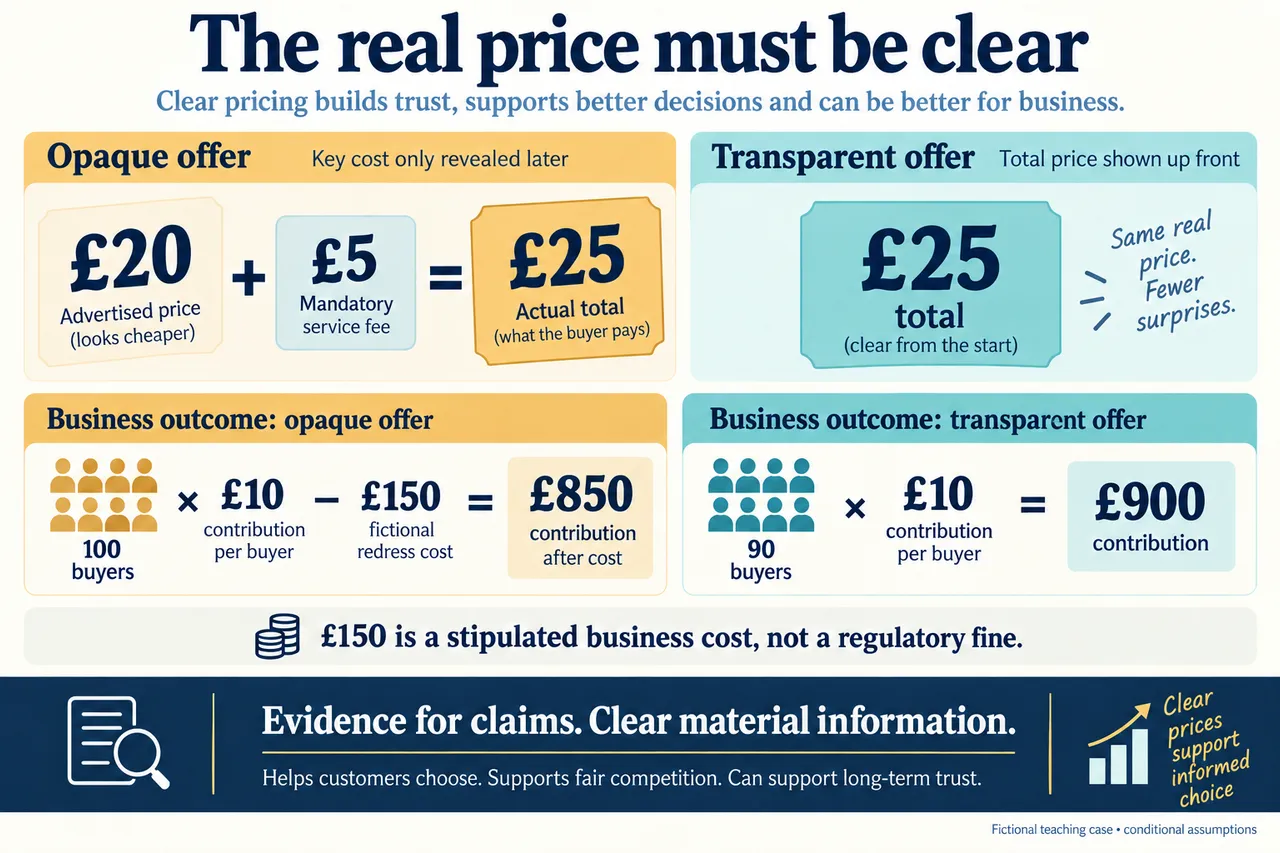
The fictional offer advertises £20 but requires another £5 service payment. Its actual purchase price is £25, not £20. A transparent alternative quotes £25 from the start. Mandatory charges differ from optional extras because the customer cannot obtain the stated offer without paying them. A manager should investigate the actual choice being offered rather than measure only how often people begin an order before discovering its full cost.
At 100 buyers and £15 variable cost, the opaque offer produces £2,500 revenue and £1,000 contribution. The transparent offer's 90 buyers produce £2,250 revenue and £900 contribution. The apparent £100 advantage is a stipulated short-run comparison, not proof that misleading presentation improves long-run performance. It omits complaint handling, repeat purchases, employee pressure and the value of a trustworthy comparison. Ethical assessment also asks about harm that does not appear as the firm's cash cost.
Subtracting the fictional £150 refund and administration cost leaves £850, £50 below the transparent £900. This is neither an actual fine nor a forecast of a legal consequence. Changing that assumption changes the calculation but not the need for truthful material information. Even if the cost were zero, a numerical gain would not demonstrate that hiding a charge or exaggerating a product capability was justified.
People differ in their time, information and ability to investigate an offer. A confusing process can impose greater burdens on those with fewer resources, while employees may be asked to defend promises they cannot fulfil. A fair analysis considers these mechanisms without profiling individuals or stereotyping a demographic group. It also distinguishes code requirements, broader ethical judgement and the organisation's stated values; agreement about one does not automatically settle all the others.
The plate separates the headline, mandatory fee, actual price and conditional contribution after redress. Its customers and offers are fictional, and the numbers do not describe a real ruling. Recommend a truthful, useful proposition and explain how its viability could be tested. If the honest offer is commercially weak, the organisation may need to change its product or costs. Reducing clarity is not a defensible substitute for creating value that customers can understand.
Worked example: A fictional offer advertises £20 but requires a £5 service fee; 100 buyers purchase. A transparent offer states £25 total and has 90 buyers. Variable cost is £15 per buyer in both cases. No legal penalty is assumed.
The business should use the transparent £25 offer rather than hide the mandatory £5 service fee behind a £20 headline. The misleading offer generates £2,500 revenue from one hundred buyers paying the actual £25. At £15 variable cost, contribution is £1,000. The transparent offer generates £2,250 from ninety buyers and £900 contribution. Before other consequences, the opaque presentation appears to produce £100 more, but that narrow result does not establish that it is an acceptable decision.
The important mechanism is informed choice. A customer evaluating the £20 headline may compare it with genuinely complete prices or commit time before discovering the charge. The fee is mandatory, so it belongs to the actual cost of purchasing rather than an optional extra. The business should not use an obscure qualification to contradict its main impression. Current CAP provisions distinguish material information, substantiation and clear qualifications; this educational case does not predict a particular ruling or legal penalty.
Product claims raise an additional issue. A customer testimonial may describe one person's experience without establishing a general performance promise. If the business implies a measurable capability, it needs appropriate evidence before making that claim. A more profitable advertisement does not turn an unsupported assertion into a justified one. Ethical evaluation should consider whether customers can understand limitations and make a meaningful decision, rather than treating complaint rates as the only sign of harm.
The stipulated £150 refund and administration cost also changes the cash comparison. Subtracting it from £1,000 leaves £850, which is £50 below the transparent offer's £900. This is a fictional business cost, not an assumed fine or an official estimate. Even if that cost were zero, a short-run £100 advantage would not settle the question. The model omits repeat purchases, trust, employee handling of complaints and the unequal impact on people with less time or information to investigate the offer.
I recommend publishing the complete price and a supportable description, then evaluating genuine demand for that proposition. The business may need to revise its product or costs if an honest offer attracts too few customers. It should not solve that problem by reducing clarity. A defensible judgement combines commercial sustainability with truthful value and fair treatment; the numerical comparison informs that judgement without replacing it.
Answer: Both offers cost the customer £25 once the mandatory £5 fee is included. The fictional opaque case leaves £850 after its stipulated £150 redress cost, while the transparent case leaves £900. Transparent pricing wins this narrow cash comparison and supports informed choice; the redress amount is not a regulatory fine, and ethical judgement still requires evidence, fair material information and effects on customers.
Check your understanding: The misleading offer incurs a stipulated £150 refund and administration cost. Compare its contribution with the transparent offer. Why would a larger short-run result still not justify unsupported product claims?
Answer: £1,000 − £150 = £850, £50 below the transparent £900. This cost is fictional, not an actual regulatory penalty. Even with no refund cost, hiding material fees and making unsubstantiated claims impairs informed choice. A cash ranking does not settle that responsibility.
Why: Reconstruct the stated endpoint and consistent denominator. Explain the causal mechanism and compare the missing evidence before recommending action. Fictional arithmetic does not establish actual demand, permissions or ethical justification.