Living carbon stores: uptake is not permanent removal
By UK A Level Environmental Science · independent study · myAudience
myAudience original educational concept illustration. Image: illustration, not a documentary photograph. · Original generated educational concept plate with retained actual prompts, receipts and rejected predecessors; no third-party logos or measured data.
Living carbon stores: uptake is not permanent removal
Carbon moves through living organisms and their surroundings without being created by photosynthesis or destroyed by respiration. Photosynthetic organisms incorporate carbon from carbon dioxide into organic compounds using an energy input. Respiration and decomposition can return carbon to the atmosphere. The processes redistribute atoms; their energy transformations must not be confused with a cycle in which energy is endlessly recycled.
A store is a quantity at a particular time, while a flux is a transfer over time. Tonnes of carbon in a soil are different from tonnes of carbon entering that soil per year. A positive uptake flux is not automatically a positive net storage change because outward transfers may also be large. Gross photosynthesis, net ecosystem exchange and durable storage answer related but different questions, so the chosen accounting boundary must be stated.
NASA’s 2011 carbon-cycle account distinguishes faster biological exchanges from much slower geological pathways. It is useful for mechanisms, but its historical numerical estimates are not current 2026 observations. Our two-box teaching model combines vegetation, litter and soil organic carbon into one store. It deliberately omits oceans, rock weathering and transfers outside the stated boundary, so it is not a complete global carbon-cycle reconstruction.
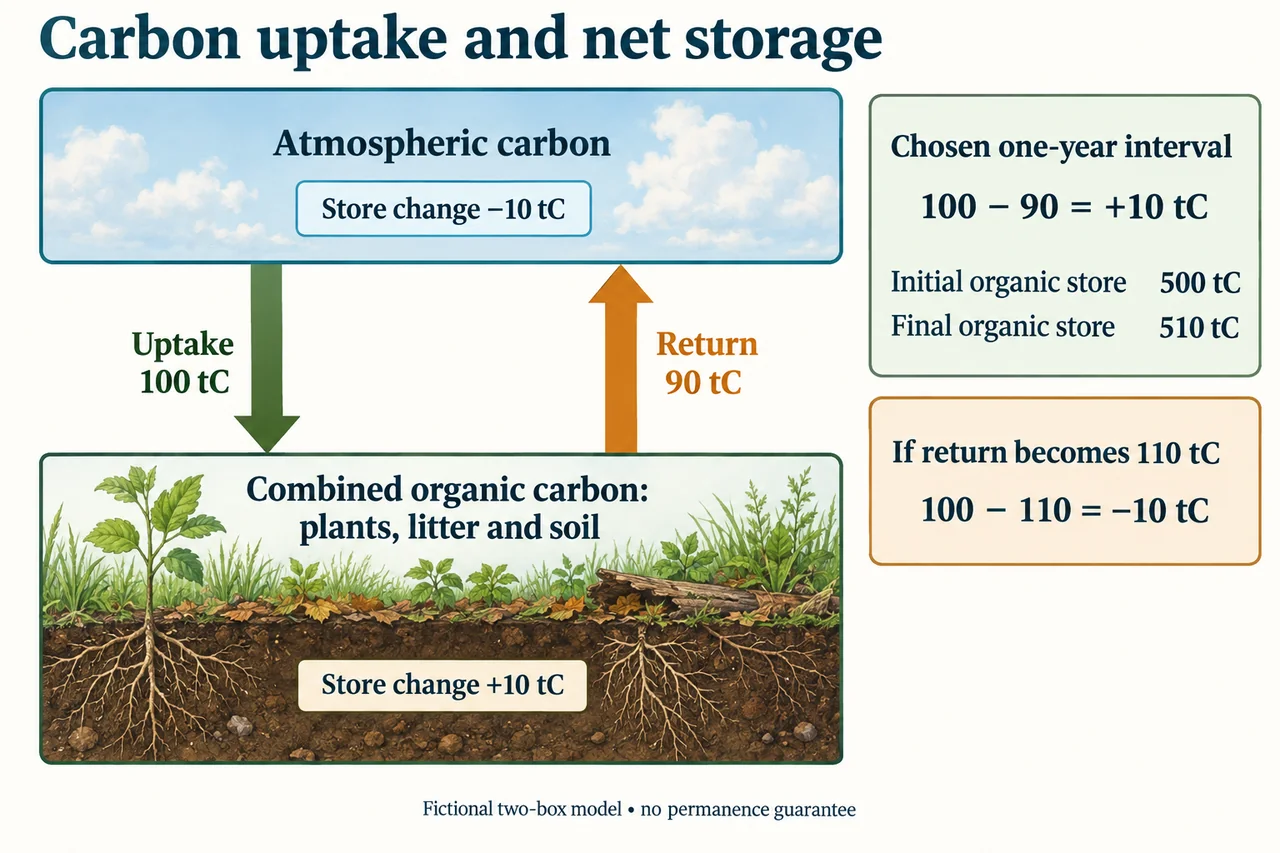
Choose an interval of one year. Carbon transfer from the atmosphere into the combined organic store is 100 tC, while combined respiration and decomposition return 90 tC. The organic store gains 10 tC and the atmospheric store loses 10 tC if these are the only exchanges between the two boxes. An initial organic store of 500 tC becomes 510 tC. The 100 tC uptake is a gross transfer, not the amount newly retained at the interval’s end.
Now choose another interval with the same 100 tC uptake but a further 20 tC of decomposition beyond the original 90. Outward carbon transfer is 110 tC, so the organic store changes by − 10 tC and the atmosphere by + 10 tC. Increased return can reverse the net result without removing photosynthesis. The comparison is conditional: the extra return is chosen, and no claim is made that all warming or land-use changes produce exactly this response.
Carbon accounting should preserve chemical units. A tonne of carbon is not a tonne of carbon dioxide. If all a chosen 10 tC transfer were represented as CO₂, the molecular-mass ratio 44/12 would give about 36.7 tonnes CO₂. This conversion does not supply a global-warming-equivalent factor for methane, account for non-carbon greenhouse gases or prove a life-cycle benefit. Those questions require separate species, time horizons and system boundaries.
The illustration labels both carbon boxes and shows the 100 tC inward transfer and 90 tC return in opposite directions for the same chosen year. Its + 10 and − 10 signs are store changes, not additional transfer arrows. The simplified plant and soil scene is a conceptual grouping, not a field site. Reading the arrows together explains why observing a large uptake arrow alone cannot demonstrate an equally large increase in stored carbon.
A storage claim needs evidence about persistence, disturbance and displaced activity. Carbon retained this year may return after decomposition, fire or land conversion; importing organic material can move a benefit from somewhere else rather than create an additional one. A responsible comparison also asks whose land, food security and livelihoods are affected. A net budget is an essential starting point, while long-term additionality and fair management require repeated measurements and a clearly defined counterfactual.
Worked example: A manager calls the chosen 100 tC annual uptake “100 tC of permanent removal”. Starting with 500 tC organic carbon and 90 tC annual return, evaluate that claim and a following interval with an additional 20 tC return.
I distinguish gross uptake from net retention before evaluating permanence. The first chosen annual interval transfers 100 tC inward and 90 tC outward across the boundary of the combined organic store. Net change is 100 − 90 = + 10 tC, so an initial 500 tC becomes 510 tC. In the two-box model the atmosphere changes by − 10 tC. Claiming 100 tC retained would ignore the 90 tC that returned during the same interval.
The following interval is an explicit counterfactual with uptake held at 100 tC and return increased to 110 tC. Net organic change is 100 − 110 = − 10 tC, so the store falls from 510 back to 500 tC. Over both intervals total inward transfer is 200 tC and total outward transfer is 200 tC. Net organic storage change is therefore zero, despite continued photosynthesis and large gross flows. The atmosphere correspondingly has no net change from these two-box exchanges.
This numerical example does not prove that every environmental project loses its stored carbon in the following year. The additional 20 tC return was chosen to test the logic of the permanence claim, not reported as measured disturbance data. Equally, the first + 10 tC result does not prove durable sequestration. Persistence requires a longer observation period and credible evidence about decomposition, disturbance, management and transfers beyond the boundary.
If a separate report expressed the first net transfer entirely as CO₂, 10 × 44/12 would be approximately 36.7 tonnes CO₂. The original gross 100 tC would correspond to 366.7 tonnes CO₂, but choosing that larger number would repeat the same accounting error. The conversion changes chemical mass units, not the definition of net retention. It also does not calculate methane’s climate effect or include energy used by the manager’s activities.
I reject both the gross 100 tC retention claim and its unsupported permanence qualifier. The defensible first-interval conclusion is a 10 tC organic-store gain under the stated transfers; the two-interval result is zero net retention under the stated counterfactual. A real decision would need independent repeated stock and flux measurements, an appropriate comparison without the intervention, leakage checks and evidence about who benefits or loses access to land. The model explains the accounting test without certifying a real offset or forecasting a particular ecosystem.
Answer: Only 10 tC is retained in the first chosen year; the following − 10 tC interval cancels that gain. Gross uptake does not establish either net 100 tC retention or permanence.
Check your understanding: In another closed two-box teaching interval, the organic store begins at 400 tC, receives 75 tC and returns 95 tC. Find both signed store changes and the final organic store. A report claims photosynthesis stopped because the organic store shrank; is that justified?
Answer: Organic change is 75 − 95 = − 20 tC and atmospheric change is + 20 tC. Organic storage ends at 380 tC. Photosynthesis did not stop in the declared model: the 75 tC uptake remains positive, but the 95 tC return exceeds it. This accounts only for the two specified boxes and interval.
Why: Use the declared boundaries, units, fictional values and assumptions; evaluate alternatives and specify missing evidence. These original practice tasks do not establish independent assessed mastery or first-hand practical completion.