Lesson 2: why diplomacy and supply could work together
By UK A Level History · independent study · myAudience
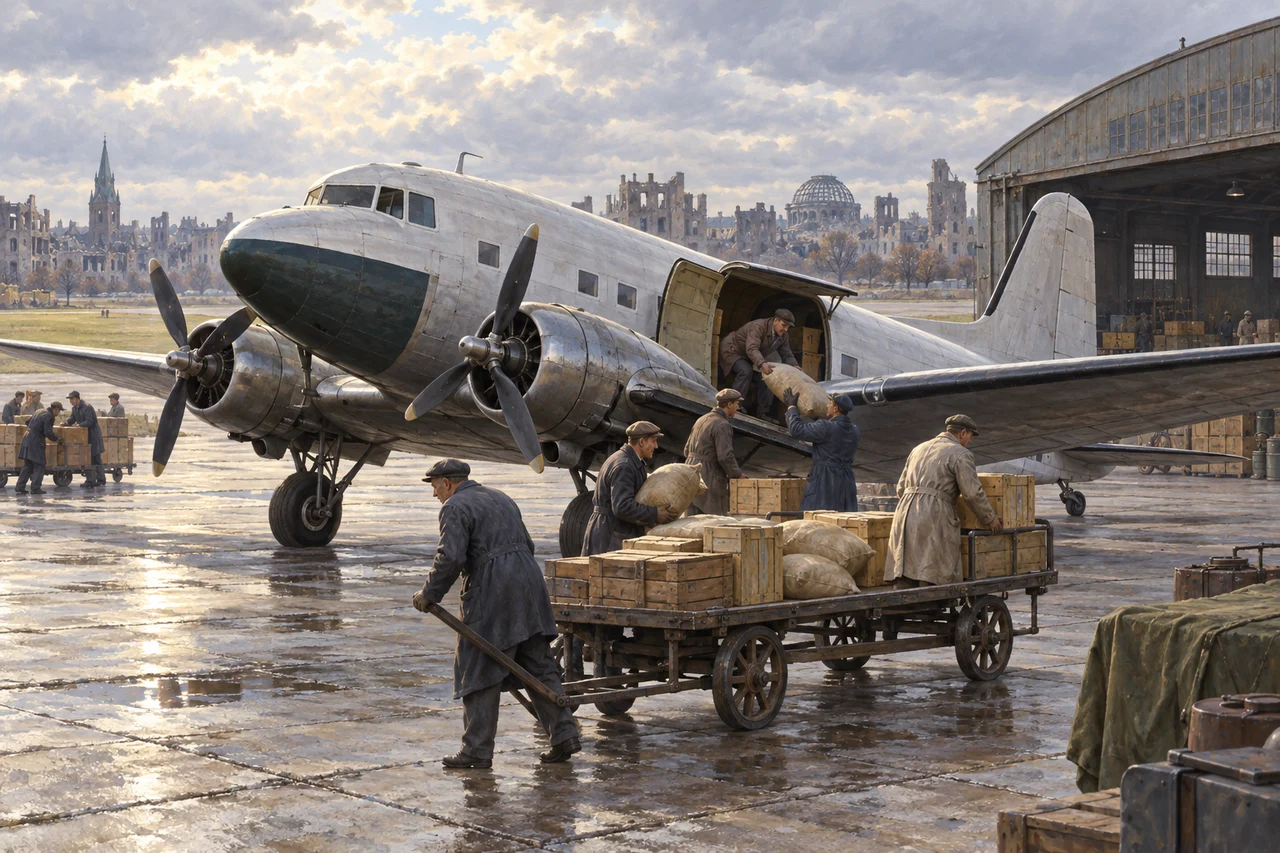
myAudience original historical teaching illustration. Image: illustration, not a documentary photograph. · Original generated supporting illustration; no noncommercial archival artwork included.
Lesson 2: why diplomacy and supply could work together
A crisis is not a list of events that automatically produces an outcome. Leaders choose between options under uncertainty, and each option changes the conditions for later choices. In Berlin, sustaining the population and maintaining an occupying presence could preserve bargaining time. Negotiation could seek removal of restrictions without accepting the other side's claim to authority. These activities could reinforce one another: continued supply reduced immediate pressure to leave, while diplomacy offered a way to end the confrontation.
Marshall's top-secret telegram to the US embassy in Britain on 20 July 1948 makes the immediate objective explicit: lifting the land blockade. It discusses a Soviet offer of food and recognises that, if implemented, it could reduce shortages while strengthening Soviet influence. A humanitarian effect and a political effect could coexist. The telegram records an assessment of an offer; it does not establish the amount actually delivered or prove what every Berliner thought about it.
The telegram weighs the risks of different diplomatic messages. A sharp written rejection might make the Soviet position less flexible by engaging prestige. A conciliatory note might appear weak and obscure what US officials considered the central issue. Marshall favoured exploring a direct oral approach before further steps. This is evidence of deliberate sequencing and concern about perception. It complicates an account in which Western policy was simply refusal to negotiate.
The document also mentions possible sanctions, retaliation and armed convoys if United Nations action failed. These were options under consideration, not proof that they were adopted. Their existence matters when evaluating a claim that the airlift was the only conceivable response. A historian can distinguish choices considered, choices implemented and outcomes achieved. Keeping those categories separate avoids turning the eventual policy into an inevitable decision visible from the start.
The 26 September record of meetings among the US, British and French foreign ministers reveals another part of the mechanism. They agreed to take the Berlin issue to the Security Council, while discussing when to release a communiqué and their final note. Marshall wanted to respond quickly to the Soviet public account; Bevin initially worried that a short immediate statement might look hasty. Agreement on broad policy therefore coexisted with debate about timing and presentation.
Those discussions are useful evidence of coordination, but the record is not a complete account from every participant. It was prepared by Bohlen and appears in the US documentary series. We can use it to identify recorded positions and the decision it reports, while remaining alert to selection, summary and perspective. French and British records would strengthen a comparison of how each government understood the same meetings. A single meeting record does not erase all disagreements across the alliance.
The airlift maintained a supply route during the blockade, but logistics must be connected to the political explanation rather than substituted for it. Aircraft, crews, loading, landing and maintenance had to sustain operations over time. The retired overview places the start of the blockade on 24 June 1948 and its lifting on 12 May 1949 in its opening chronology. Its later paragraph instead says 11 May; a separate Truman Library background account corroborates 12 May. That narrow internal inconsistency is retained in the source audit rather than silently reproduced.
Lifting the blockade and ending the airlift were not the same event. The Truman Library background notes that flights continued after the restrictions were removed. Continuing supply could provide stocks and resilience against renewed interruption. A full explanation of the outcome needs the 1949 negotiations, operational evidence, countermeasures and German political perspectives; those are not closed here. The bounded conclusion is that supply, diplomacy and public argument operated together, and their relationship can be investigated through evidence of decisions rather than a simple triumph narrative.
Worked example: Explain how continued supply and diplomacy could work together without treating considered armed convoys as adopted policy.
Marshall's top-secret telegram to the US embassy in Britain on 20 July 1948 makes the immediate objective explicit: lifting the land blockade. It discusses a Soviet offer of food and recognises that, if implemented, it could reduce shortages while strengthening Soviet influence. A humanitarian effect and a political effect could coexist. The telegram records an assessment of an offer; it does not establish the amount actually delivered or prove what every Berliner thought about it.
The document also mentions possible sanctions, retaliation and armed convoys if United Nations action failed. These were options under consideration, not proof that they were adopted. Their existence matters when evaluating a claim that the airlift was the only conceivable response. A historian can distinguish choices considered, choices implemented and outcomes achieved. Keeping those categories separate avoids turning the eventual policy into an inevitable decision visible from the start.
The airlift maintained a supply route during the blockade, but logistics must be connected to the political explanation rather than substituted for it. Aircraft, crews, loading, landing and maintenance had to sustain operations over time. The retired overview places the start of the blockade on 24 June 1948 and its lifting on 12 May 1949 in its opening chronology. Its later paragraph instead says 11 May; a separate Truman Library background account corroborates 12 May. That narrow internal inconsistency is retained in the source audit rather than silently reproduced.
Answer: The airlift maintained a supply route during the blockade, but logistics must be connected to the political explanation rather than substituted for it. Aircraft, crews, loading, landing and maintenance had to sustain operations over time. The retired overview places the start of the blockade on 24 June 1948 and its lifting on 12 May 1949 in its opening chronology. Its later paragraph instead says 11 May; a separate Truman Library background account corroborates 12 May. That narrow internal inconsistency is retained in the source audit rather than silently reproduced.
Check your understanding: Marshall mentions armed convoys. Does this prove Western governments used them to end the blockade?
Answer: no. His telegram records consideration of an option if other measures failed. Adoption and effect require further evidence. The distinction prevents a policy-planning source from becoming a false description of actual operations.
Why: Review the actual dated sources and their limits. Reading and these unmarked practice models do not establish mastery, a predicted grade, full route coverage or authenticated independent NEA.