Energy inside matter
By UK GCSE Physics · independent study · myAudience
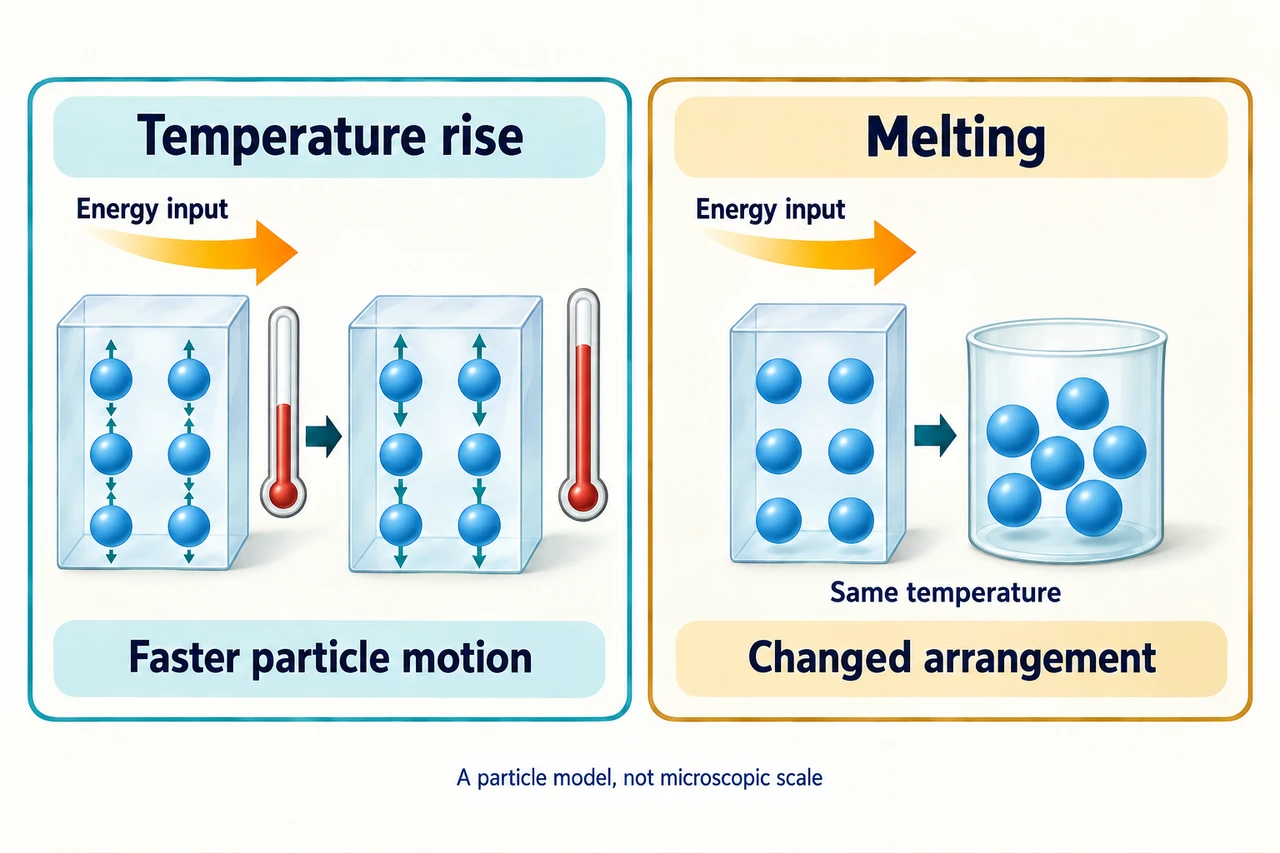
Image: illustration, not a documentary photograph. Symbols distinguish particle motion from arrangement; shapes are not molecular sizes or calibrated volumes. · Original AI-generated illustration; independently reviewed scientific teaching model.
Energy inside matter
A hot metal spoon and a melting ice cube can both receive energy, but their thermometers need not respond in the same way. To explain this, choose a system boundary around the material and ask what happens to its particles. Internal energy is the total kinetic and potential energy associated with the particles inside that system. It is not the kinetic energy of the spoon moving across a room, nor energy stored in the surroundings. Heating is a transfer across the boundary; internal energy is part of the account inside it.
Particles in a solid vibrate about positions; particles in liquids and gases can also move from place to place. Their kinetic energy comes from motion. Potential energy depends on their arrangement and interactions. When a solid warms without changing state, greater average particle motion explains a temperature increase. This does not mean every particle acquires the same speed, or that a particle swells into a larger particle. A thermometer describes a macroscopic temperature, not a complete map of all microscopic energies.
For a pure substance changing state at a fixed pressure, energy can alter particle arrangement while temperature remains constant. During melting, the regular solid arrangement is progressively replaced by a liquid arrangement. The internal-energy increase is associated with the phase change even though the thermometer has a plateau. Melting does not ordinarily break the chemical bonds within each molecule or create a new substance. The intact symbols in our illustration represent particles, not photographs of atoms or a scale model of a crystal.
Temperature and internal energy answer different questions. Temperature relates to average microscopic motion; total internal energy depends on how much material exists, what it is, its state and its temperature. A small and a large sample at the same temperature do not generally have equal total internal energy. Nor can a given energy addition determine a temperature rise without further information. The specific-heat equation describes one kind of change; a phase change requires a latent-heat account. First identify which physical process the evidence supports.
Energy conservation requires a boundary ledger. Electrical energy delivered by a heater may be shared between the intended material, the heater and insulation, and the surroundings. Calling all supplied energy an increase in the material’s internal energy is an additional assumption, not a definition. If the problem gives heat leaving the chosen system, subtract that outgoing transfer. A negative change means the system has lost internal energy, not that its absolute internal energy is negative. The sign belongs to the change.
Consider a sample receiving 600 J while 120 J is transferred from that sample to its surroundings. With no other transfers or mechanical changes, its internal energy increases by 480 J. That result is an energy change measured in joules. It does not, by itself, establish a temperature change measured in degrees Celsius. If the sample is a pure solid-liquid mixture at its melting point and fixed pressure, the extra energy can melt more material without raising the temperature. If it remains one phase, mass and specific heat are needed.
The illustration contrasts greater particle motion with a changed arrangement at an unchanged temperature. Its particle symbols and container shapes are explanatory conventions: they do not establish molecular size, density or a numerical volume change. To test an explanation, identify the system, describe the observed state, calculate net transfer and then explain whether energy predominantly changes motion or arrangement in the stated model. A thermometer plateau is evidence to investigate a phase change; it is not proof that every mixture or real experiment behaves ideally.
Worked example: A sample receives 600 J and transfers 120 J to its surroundings. It remains at its melting point while solid disappears. Determine its internal-energy change and explain the temperature.
Boundary: sample only; other transfers excluded.
Net energy=600−120=480 J, an increase in internal energy.
At fixed pressure a pure sample changes arrangement during melting. Temperature can remain constant while the liquid fraction increases.
No mass or latent heat is supplied, so the melted mass cannot be computed.
Answer: Internal energy increases 480 J; no temperature rise follows from the melting account.
Check your understanding: An unfamiliar sample receives 1200 J and loses 200 J. A student claims it must warm by 10°C. Evaluate the claim and state missing information.
Answer: The change is 1200−200=1000 J if these are the only transfers. A 10°C rise is not determined: mass, material-specific heat and confirmation that no state change occurs are needed. If a pure two-phase sample changes state at fixed pressure, temperature may stay constant. If an apparatus also stores energy inside the larger experimental boundary, isolate the sample contribution before using its specific heat.
Why: Apply the explicit system boundary, units and model limits stated above. This original supplied transfer is not a recorded practical or completed assessment.