Energy changes during melting and boiling
By UK GCSE Physics · independent study · myAudience
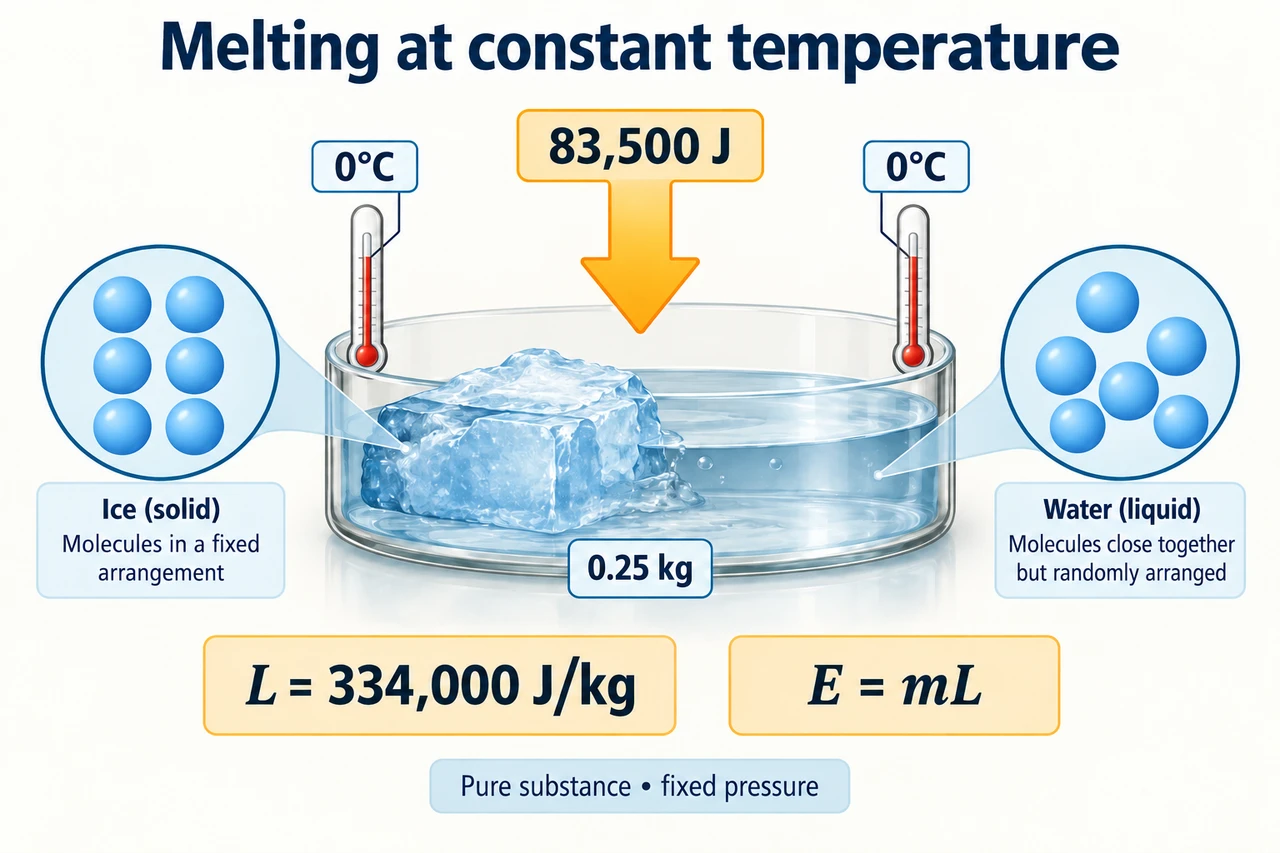
Image: illustration, not a documentary photograph. Equal thermometers represent pure ice melting at fixed pressure; intact symbols are explanatory particles rather than chemical bonds or microscope data. · Original AI-generated illustration; independently reviewed scientific teaching model.
Energy changes during melting and boiling
At a pure substance’s melting or boiling temperature, energy can be transferred without a temperature rise while the phase change proceeds at fixed pressure. This energy is called latent heat because a thermometer alone does not reveal the transfer. Specific latent heat L is the energy needed to change the state of one kilogram without changing its temperature, measured in J/kg. The equation E=m L uses the mass that actually changes state. It is not the entire container mass when only some of its contents change state.
Specific latent heat of fusion refers to melting; vaporisation refers to liquid becoming gas. The reverse changes release energy: freezing and condensation can transfer energy from the material to its surroundings. The microscopic account concerns a different arrangement and separation of particles and their interactions. It does not mean the molecules are chemically destroyed. During boiling, gas particles occupy a much more separated arrangement; during melting, particles remain relatively close. The symbols in our art deliberately remain intact.
The plateau model has boundaries. A pure sample at fixed pressure may coexist in two phases while temperature remains approximately constant. Mixtures can melt over a range, pressure can alter a transition temperature, and poor thermometer contact can distort a measured graph. Energy needed to warm a solid to its melting point is a separate specific-heat stage; energy needed to melt it is a latent-heat stage. Do not insert a zero temperature change into E=m c ΔT and conclude that melting requires zero energy.
For an original illustrative account, use 0.25 kg of ice at its melting point with supplied fusion value 334000 J/kg. The required energy is 0.25×334000=83500 J. A 100 W heater operating for 1000 s supplies 100000 J. If 16500 J is transferred elsewhere and no other term is present,83500 J remains for the ice. This is exactly sufficient to complete melting in the stated ideal account. While ice and liquid coexist at fixed atmospheric pressure, the temperature is 0°C; the energy changes the phase fraction.
The instant melting completes, the account changes. Continued net energy can now warm the liquid, requiring its mass and liquid specific heat. Boiling later requires its own transition and vaporisation value; the fusion value cannot be reused for that process. Conversely, a partial-melting problem uses m_changed = E/L and compares that with the initial solid mass. If the computed mass exceeds the amount available, the model has reached a boundary: divide the energy into successive phases rather than predicting more melted material than exists.
Energy released on a reverse transition has the same magnitude mL under matched ideal conditions, but its direction is outward. For example,0.020 kg condensing with L=2260000 J/kg releases 45200 J. This is an energy-transfer statement, not a temperature estimate for a room or a burn model. To determine what warms, the receiving system and subsequent transfer would have to be specified. The relatively large latent-energy account also explains why phase changes can dominate an energy budget despite a steady temperature.
The image uses equal 0°C thermometer readings and intact particle symbols to show an energy input changing arrangement. Its spheres are neither water’s detailed molecular geometry nor a true microscopic scale. Separate image observation from the calculation: identify the substance and pressure assumption, distinguish fusion from vaporisation, determine net energy available, calculate changed mass or required energy and check whether the phase change finishes. These checks prevent a familiar formula from being used beyond its physical stage.
Worked example: Does 100 W for 1000 s melt 0.25 kg ice initially at its melting point if 16500 J is lost?
Input 100×1000=100000 J.
Available 100000−16500=83500 J.
Required 0.25×334000=83500 J.
All 0.25 kg melts; no energy remains in this account to warm liquid above its melting point.
Answer: Exactly complete melting in the ideal stated account; the phase-change temperature remains 0°C.
Check your understanding: A fictional material of mass 0.20 kg is at its melting point. Its fusion value is 50000 J/kg;8000 J is available. Find what changes and what remains.
Answer: Melted mass=8000/50000=0.16 kg. Remaining solid=0.20−0.16=0.04 kg. The phases still coexist, so temperature stays at the melting point under the pure-substance fixed-pressure model. Melting the entire 0.20 kg needs 10000 J, 2000 J more than supplied. The supplied 8000 J is net energy available for this transition, not merely a heater’s rated input.
Why: Apply the explicit system boundary, units and model limits stated above. This original supplied transfer is not a recorded practical or completed assessment.