Random motion and pressure at fixed volume
By UK GCSE Physics · independent study · myAudience
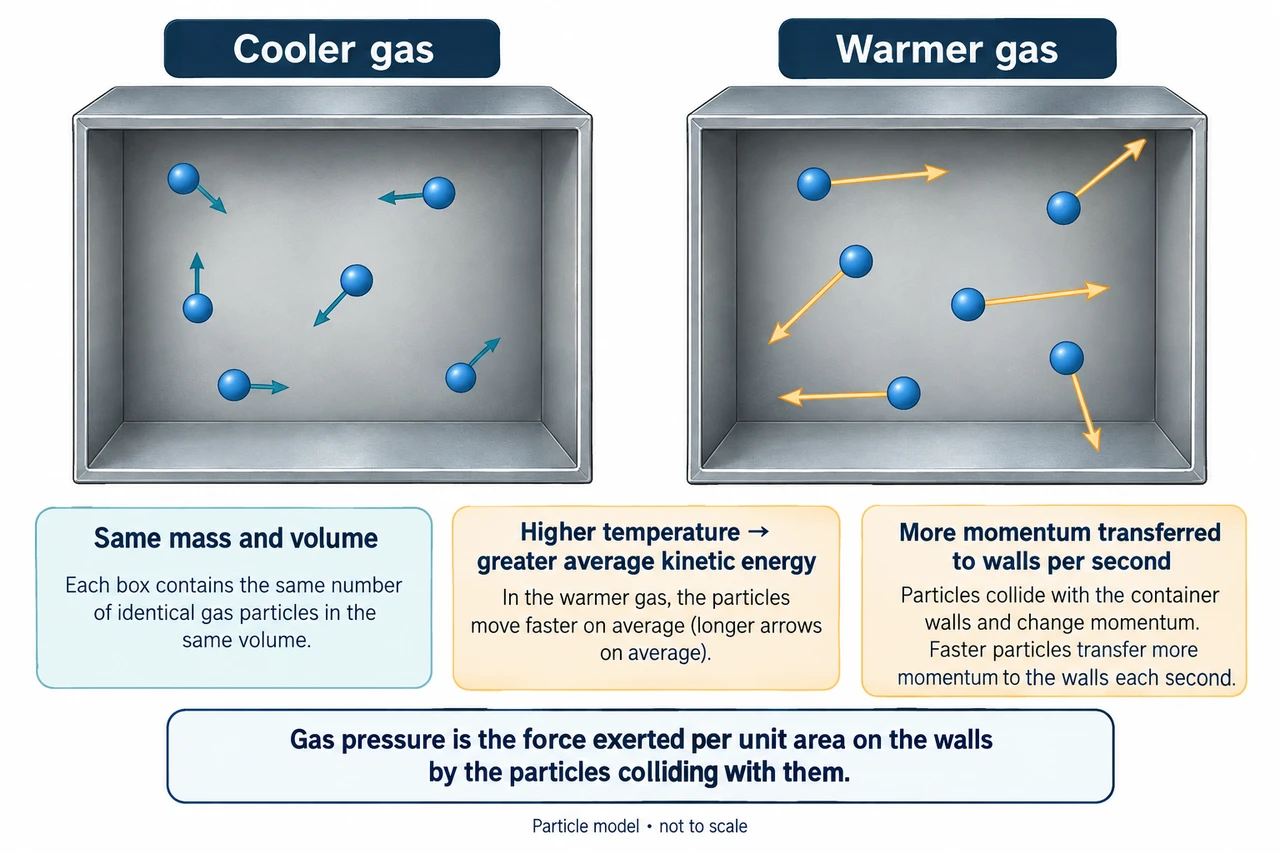
Image: illustration, not a documentary photograph. Six representative symbols per equal-volume model; arrow lengths suggest average motion, not calibrated speeds or actual collision paths. · Original AI-generated illustration; independently reviewed scientific teaching model.
Random motion and pressure at fixed volume
A stationary gas can exert pressure even when its particles have no overall drift in one direction. Its molecules move randomly and collide with the container walls. At each collision, the component of momentum normal to the wall changes; the wall receives an opposing transfer. Summed over many impacts, this produces a force. Pressure is the force per unit area, p=F/A. It is not the average direction of particle motion, so random motions cancelling in bulk do not cancel the pressure.
For a gas of fixed mass in a rigid container, increasing temperature increases average particle kinetic energy. Particles therefore move faster on average, though individual speeds vary. Faster movement leads to more frequent impacts and a greater change in normal momentum per impact, explaining increased pressure when volume remains fixed. The words fixed mass and fixed volume are essential. If the container expands, or gas can enter or escape, the same temperature change need not produce the predicted pressure change.
Pressure acts on every wall, not only the lid. A small drawing showing a few particles is a representative model of a very large population; it is not a collision count for a real vessel. The arrows indicate possible instantaneous directions and relative speeds. They do not show permanent paths, because collisions continually change directions. Opposite arrows can describe no net bulk flow while all walls still experience impacts. This is why a sealed gas can be macroscopically at rest yet sustain a measurable pressure.
Optional separate-physics calculation crosslink (the related topic): Distinguish pressure from total force. A pressure of 120000 Pa acting uniformly on a 0.0020 m² wall area corresponds to F=pA=240 N. On a second 0.0050 m² area at the same pressure the force is 600 N. These are fictional supplied values, not a prediction of an actual container’s strength. Increasing area increases total force for a given pressure; it does not mean the gas particles in that region have a greater temperature. Units help: a pascal is one newton per square metre.
The GCSE particle-model requirement asks for a qualitative temperature-pressure explanation at constant volume. Do not double a Celsius reading and claim pressure doubles. The zero of Celsius is not zero microscopic kinetic energy. Where absolute temperature is introduced in a later model, its kelvin conversion uses the exact 273.15 offset recorded by NIST; this lesson does not require an ideal-gas proportional calculation. The observations here support a directional explanation under controlled conditions, not a numerical pressure from temperature alone.
A careful comparison keeps gas type, mass and volume constant and distinguishes external pressure from the pressure inside. If a flexible bag expands when warmed, the wall can move and the volume changes, so the rigid-container argument is incomplete. If an outlet is open, mass may change. A pressure reading can also reflect a changed temperature after work is done on the gas. These examples are interpretations of supplied observations, not instructions to heat a sealed vessel or create a pressure hazard.
The original illustration uses six symbols in each equal-sized box and longer arrows on average in the warmer case. Count equality communicates the model’s unchanged mass; arrows are not calibrated velocity measurements. To answer an unfamiliar comparison, identify what is controlled, describe the change in average motion and explain the effect of impacts on each unit area of wall. If a required control is missing, state that limitation. Simply saying particles expand, or that they all move upward, would miss the mechanism.
Worked example: A gas has supplied pressure 120000 Pa. Find force on 0.0020 m² and 0.0050 m² wall patches and explain why the pressures are equal.
F1=120000×0.0020=240 N.
F2=120000×0.0050=600 N.
BothF/A values equal 120000 Pa; the larger patch receives more total momentum transfer because it has greater area.
No temperature was calculated from these forces; pressure is supplied.
Answer: 240 N and 600 N, both at 120000 Pa.
Check your understanding: Two samples begin at the same temperature. One is warmed in a rigid sealed vessel; the other is warmed in a flexible bag which expands. May the same pressure increase be claimed?
Answer: No. In the rigid sealed model mass and volume remain fixed, greater average kinetic energy leads to a higher pressure. The expanding bag changes volume, so reduced collision frequency per unit area can offset the temperature effect; its pressure depends on the expansion and surrounding conditions. Neither model permits Celsius doubling as a pressure-doubling rule. No sealed-heating procedure is being recommended.
Why: Apply the explicit system boundary, units and model limits stated above. This original supplied transfer is not a recorded practical or completed assessment.