Changing volume at a controlled temperature
By UK GCSE Physics · independent study · myAudience
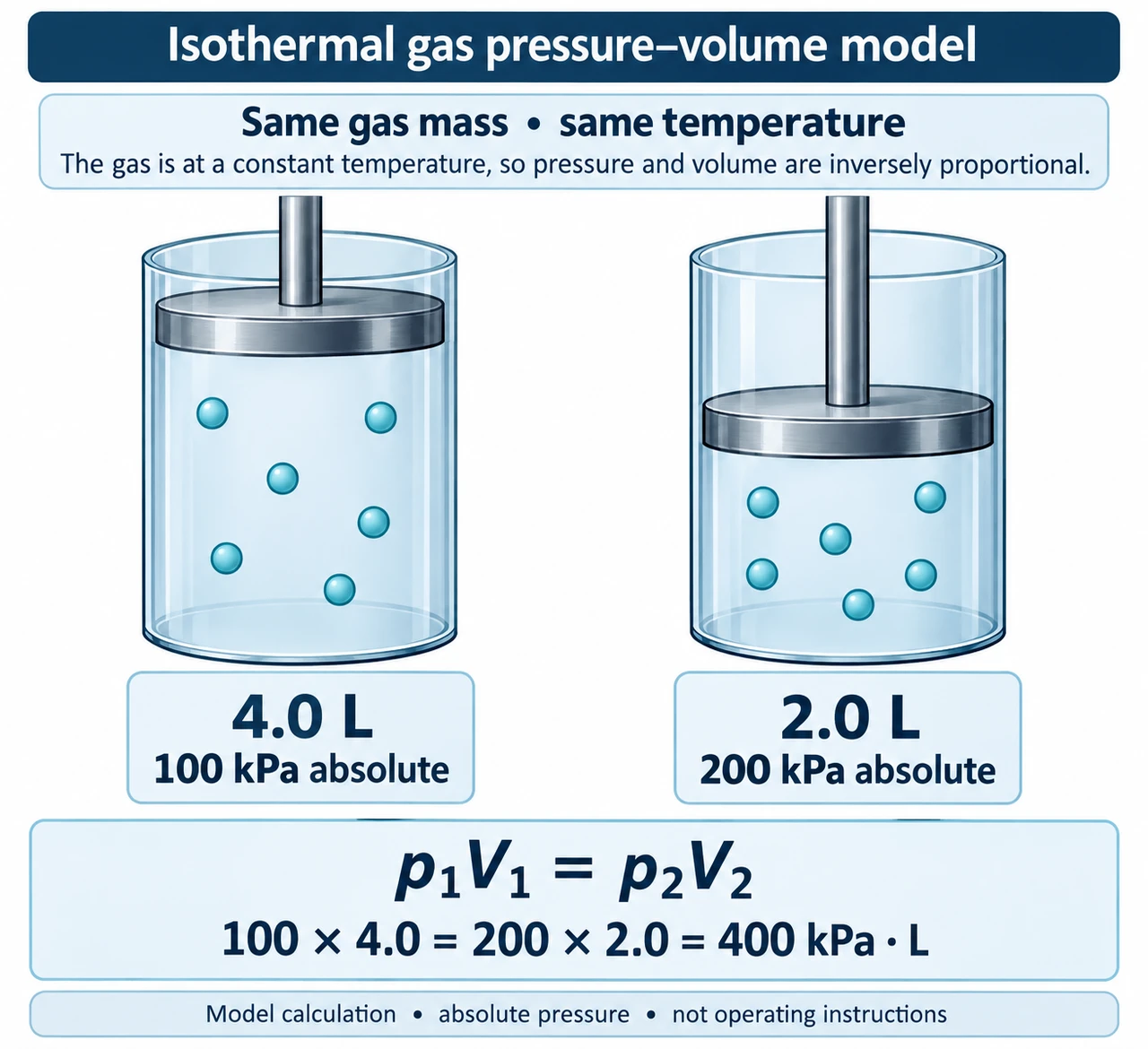
Image: illustration, not a documentary photograph. Isothermal fixed-mass model; cylinder drawing is not a calibrated volume ruler. Printed values define the numerical comparison. · Original AI-generated illustration; independently reviewed scientific teaching model.
Changing volume at a controlled temperature
For a fixed mass of gas held at a constant temperature, the pressure-volume model is pV=constant. This is a separate-physics requirement and an approximation with stated conditions. Pressure is inversely proportional to volume: halving volume doubles pressure, while doubling volume halves pressure. The relationship does not say pressure and volume rise together. A statement about one variable is meaningful only when the mass and temperature are controlled; a leak or temperature change removes the basis for using the same constant.
At a particle level, reducing the volume at the same temperature does not increase the average kinetic energy in this ideal account. The same population has less space, and wall collisions transfer momentum more frequently per unit wall area. Maintaining constant temperature during compression generally requires heat exchange with the surroundings; a rapid compression need not be isothermal. Thus a piston picture cannot prove the temperature condition. The condition is supplied by the problem or supported by adequate experimental evidence.
Use absolute pressure for this proportional model. A gauge can report pressure relative to its surroundings rather than relative to vacuum. If surrounding absolute pressure were 100 kPa and a gauge read 50 kPa above it, gas absolute pressure would be 150 kPa. A gauge reading of zero does not mean there are no molecules or no pressure. These are supplied illustrative values, not a calibration instruction. Substituting relative gauge pressures directly into p1V1=p2V2 can give an incorrect result.
In the original model, gas at 100 kPa absolute occupies 4.0 L. Reducing its volume to 2.0 L at the same temperature and fixed mass gives p2=(100×4.0)/2.0=200 kPa absolute. Both products are 400 kPa·L. Consistent kilopascal and litre units cancel in the ratio, so converting is not required for that comparison. If a pascal-metre-cubed product is requested,100 kPa=100000 Pa and 4.0 L=0.0040 m³, giving 400 Pa·m³.
A pressure-volume product has the dimensions of energy because Pa·m³ equals N·m. That dimensional equality does not make the 400 Pa·m³ result the work of this compression. Work depends on the pressure during the whole volume change, not merely one product at an endpoint. At GCSE here, use the constant to relate the two supplied states, and do not invent a work value. The higher-tier compression lesson addresses energy transfer using a separate energy account.
Before using the equation, list initial and final states and identify the missing variable. Rearrange symbolically first: p2=p1V1/V2 or V2=p1V1/p2. Check the direction afterwards. If the volume becomes smaller, constant-temperature pressure should become larger. Check that quantities have compatible units; treating millilitres as litres on one side changes the answer by a factor of 1000. A formula yielding a plausible-looking number is not enough if the conditions or units are incompatible.
The illustration is a conceptual cylinder comparison, with numerical volumes and absolute pressures supplied explicitly. Its decorative geometry is not a ruler for volume. The same six symbols indicate fixed mass, not a literal number of molecules. A heated or leaking real cylinder might have a different final pressure, and the image does not establish that it was compressed slowly enough to remain at constant temperature. These limitations make the relation testable rather than turning every piston sketch into an unconditional rule.
Worked example: Relate 100 kPa absolute and 4.0 L to 2.0 L at fixed mass and temperature, then express the constant in SI units.
p2=100×4.0/2.0=200 kPa absolute.
pV=400 kPa·L at both endpoints.
100000 Pa×0.0040 m³=400 Pa·m³.
This endpoint product is not, by itself, compression work.
Answer: 200 kPa absolute; constant 400 Pa·m³.
Check your understanding: Gas starts at 150 kPa absolute and 3.0 L. At the same temperature and mass it ends at 90 kPa absolute. Find volume; explain whether a warm leaking cylinder can use the same result.
Answer: V2=150×3.0/90=5.0 L. Expansion is consistent with lower pressure. A cylinder that warms and leaks changes both temperature and mass, so the fixed-mass isothermal relation does not determine its final volume;5.0 L cannot be asserted. A gauge reading must first be converted to absolute pressure using supplied surrounding pressure.
Why: Apply the explicit system boundary, units and model limits stated above. This original supplied transfer is not a recorded practical or completed assessment.