Compression work and internal energy
By UK GCSE Physics · independent study · myAudience
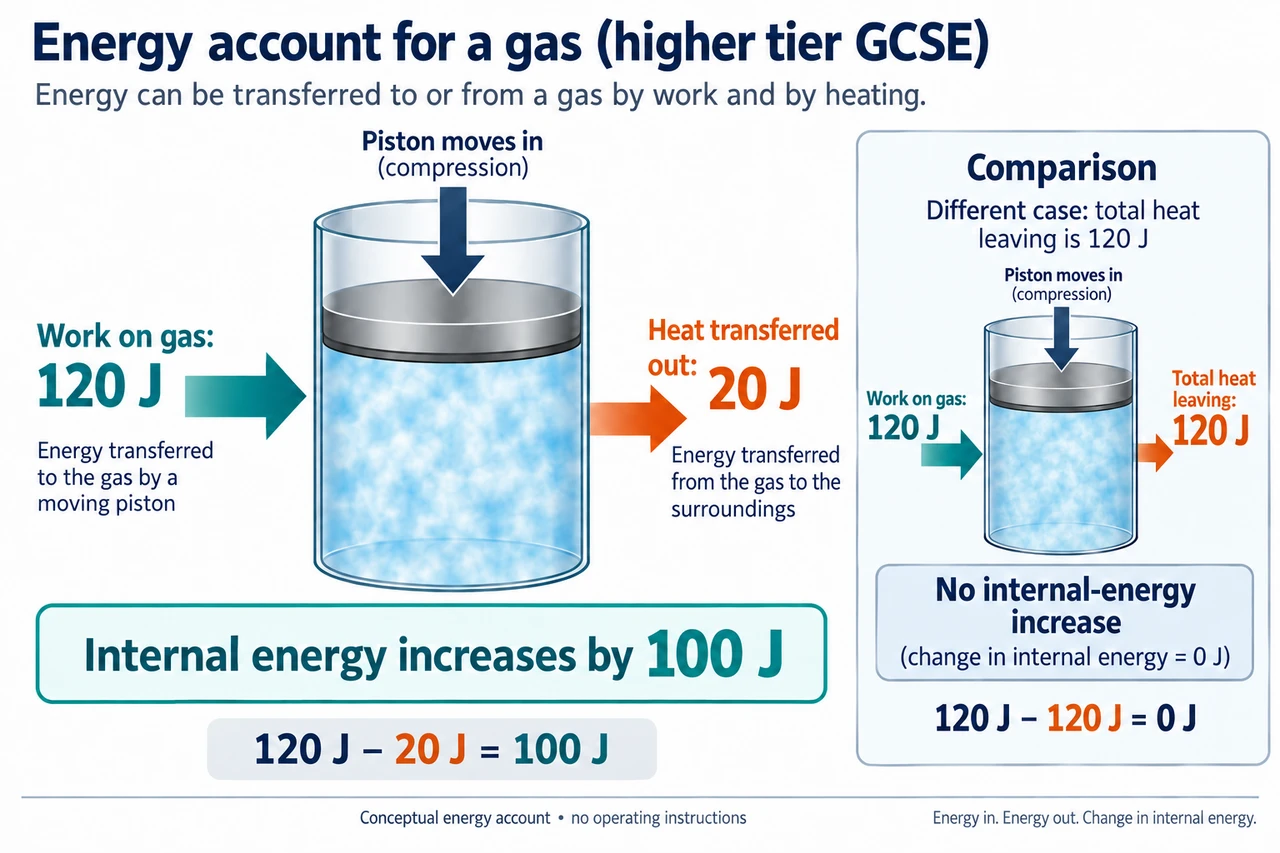
Image: illustration, not a documentary photograph. Separate conceptual energy accounts; no calibrated pressure, temperature or equipment operating method is shown. · Original AI-generated illustration; independently reviewed scientific teaching model.
Compression work and internal energy
This higher-tier separate-physics lesson connects work done on a gas with its internal energy. Work is an energy transfer when a force acts through a displacement. A piston moving inward can do work on the gas. The gas can also transfer energy to its surroundings by heating. Choose the gas as the system and account for both routes. Compression does not, by itself, establish a temperature rise: the result depends on how much energy also crosses the boundary by heating.
In the simplified energy ledger, ΔU=work done on the gas+heat transferred into the gas, with outward heat assigned a negative sign. Writing input minus output is often clearer when the quantities are supplied as positive magnitudes. For example,120 J of work in and 20 J of heat out produce ΔU=120−20=100 J. This is a change, not the total internal energy. It says nothing about a Celsius temperature unless the gas amount and a suitable thermal model are also provided.
The particle explanation is that a moving boundary can transfer energy to particles during collisions, increasing their average kinetic energy if that transferred energy remains in the gas. Greater average kinetic energy corresponds to a higher temperature in the model. Energy leaving through the walls can reduce or cancel the increase. The energy account takes priority over a shortcut such as every compression heats the gas. All particles still have a spread of speeds rather than one shared velocity.
Compare a second process with 120 J work in and 120 J total heat out. Net internal-energy change is zero. For a fixed amount of an ideal gas whose internal energy depends on temperature, this describes an isothermal comparison. The 120 J is the entire outward heat transfer in that second case, not 120 J added to the first case’s 20 J. These are distinct fictional processes. Their purpose is to show that identical work inputs can produce different internal-energy changes when heat transfer differs.
Compression can even accompany a decrease in internal energy. If 80 J of work is done on a gas while 100 J is transferred out by heating, ΔU=−20 J. The negative sign means the internal energy falls despite positive mechanical input. This is not a claim that internal energy becomes less than zero. Conversely, rapid compression with little heat loss can leave more of the work input inside the gas. The illustrations do not specify an actual compression rate or a safe operating procedure.
A pressure-volume relation and a work account are not interchangeable. The constant pV for a fixed mass at constant temperature relates endpoints; it is not generally the work done over the process. Pressure can vary throughout a volume change. If a question supplies the mechanical work directly, use it rather than multiplying one arbitrary endpoint pressure by a volume. If it does not supply enough information for work, say so. The full mathematical treatment of variable-pressure work goes beyond this GCSE leaf.
The original diagram shows energy entering and leaving the conceptual gas boundary, with a separate zero-change comparison. Piston arrows are explanatory and should not be treated as instructions for pressurising equipment. In an unfamiliar problem, mark the system, name each transfer, assign directions, add the energy changes and describe the particle consequence within the stated model. A correct numerical sign and a justified temperature inference are separate tasks. Neither a dramatic render nor the word compression supplies missing measurements.
Worked example: Compare 120 J work input with 20 J outward heat, and a separate 120 J outward-heat case.
First ΔU = 120−20=100 J increase.
Second ΔU = 120−120=0 J.
No absolute temperature or temperature rise is determined numerically.
For a fixed-mass ideal gas, the second zero ΔU case has no temperature change; the first increases average kinetic energy under that model.
Answer: 100 J increase, then 0 J in the separate comparison.
Check your understanding: An unfamiliar compressed gas receives 80 J of mechanical work but releases 100 J by heating. A student says compression proves it warmed. Evaluate.
Answer: ΔU=80−100=−20 J: internal energy decreases. For the fixed-mass ideal-gas model, temperature therefore falls, so compression alone does not prove warming. The statement concerns a change, not negative total energy. If phase change or a non-ideal system is involved, the temperature inference needs additional material information; the energy balance still requires all transfers to be included.
Why: Apply the explicit system boundary, units and model limits stated above. This original supplied transfer is not a recorded practical or completed assessment.