Enthalpy signs and one-mole definitions
By UK A Level Chemistry · independent study · myAudience
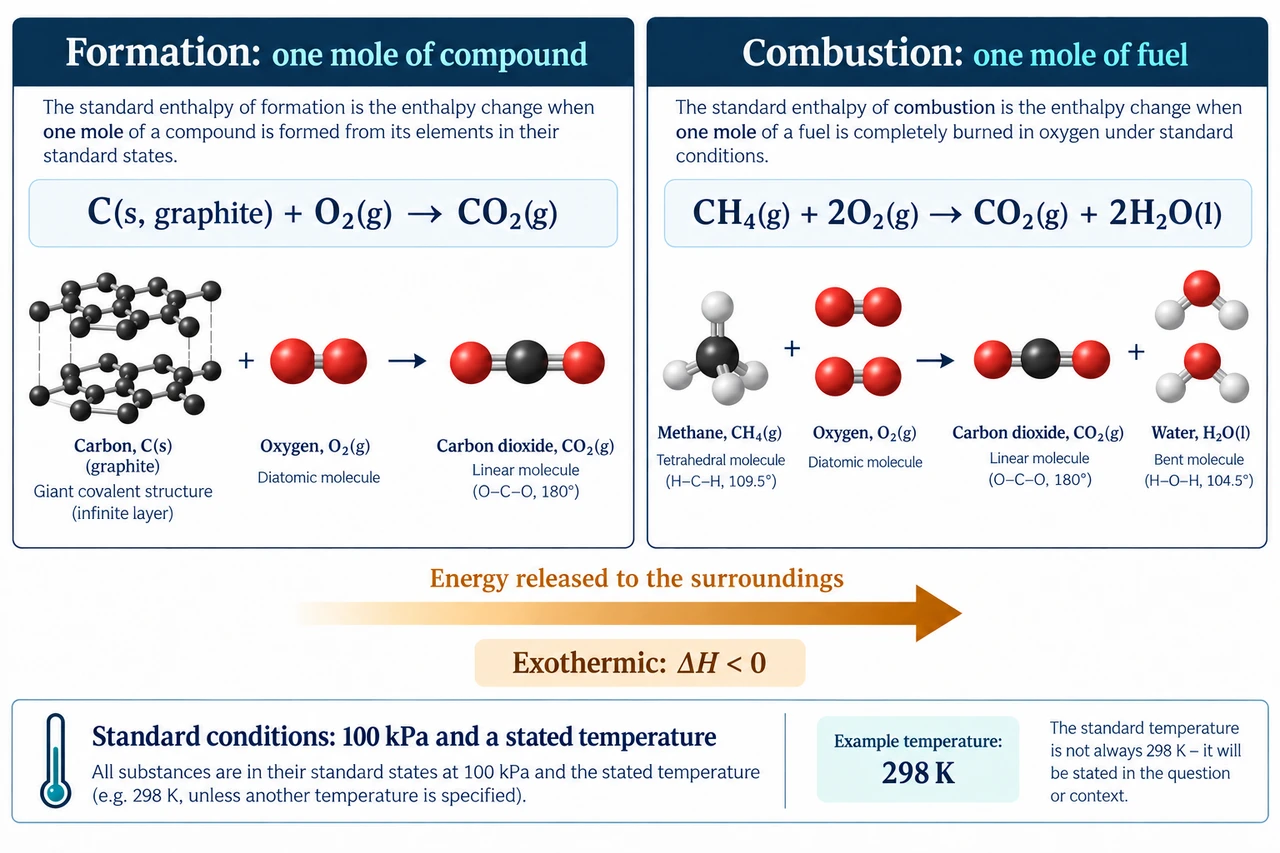
Image: illustration, not a documentary photograph. Equations define reference amounts and physical states; molecular models identify species and the graphite fragment is not a calibrated atom count. · Original AI-generated illustration; independently reviewed scientific teaching model.
Enthalpy signs and one-mole definitions
A reaction can warm its surroundings even though the reacting system loses energy. This distinction fixes the sign of an enthalpy change. At constant pressure, heat transferred from the reaction to its surroundings gives a negative reaction enthalpy change: the reaction is exothermic. Heat entering the reacting system gives a positive change: the reaction is endothermic. The sign describes the system named by the chemical equation, rather than simply whether a thermometer reading rises. Begin every energy explanation by identifying that system and its surroundings.
Enthalpy is a state quantity: its change depends on the specified initial and final states. For the constant-pressure conditions in this course, the reaction heat account connects to ΔH. A value belongs to a balanced equation with physical states and an amount convention. Reversing the equation reverses the sign; multiplying every coefficient multiplies the enthalpy change. The units kJ mol⁻¹ require the accompanying mole definition. They do not mean that any one mole of any substance in the equation releases the quoted amount.
Standard conditions specify a pressure of 100 kPa and a stated temperature. A table might state 298 K, but standard does not mean that temperature is always 298 K. The physical states and standard forms matter as well. Carbon as graphite is not interchangeable with diamond in a formation definition, and liquid water is not interchangeable with water vapour in a combustion account. Changing an endpoint requires an additional energy term. A small state symbol therefore changes the meaning of a numerical result, not merely its typography.
Standard enthalpy of formation refers to forming one mole of a compound from its constituent elements in their standard states under the specified conditions. For carbon dioxide at a suitable stated temperature, C(s, graphite)+O₂(g)→CO₂(g) has the one-mole compound convention. An equation making two moles of CO₂ must be divided by two to express its standard formation enthalpy. Fractional coefficients can be appropriate when needed to make exactly one mole of the compound; they represent amounts, not fractions of a physical molecule.
Standard enthalpy of combustion refers to completely burning one mole of a substance in oxygen under the specified standard conditions. For methane, CH₄(g)+2O₂(g)→CO₂(g)+2H₂O(l) states a one-mole fuel account with liquid-water products. The formation and combustion definitions choose different reference amounts even when a particular equation can satisfy both. Incomplete combustion or a different water state requires a different reaction account. The definition is not permission to substitute a fuel’s advertised heating value without checking its stated basis.
Use an original supplied model to separate equation scaling from factual data tables. Suppose a reaction equation has ΔH=−80.0 kJ per mole of reaction as written. Carrying out twice that extent gives −160 kJ; reversing one equivalent extent gives +80.0 kJ. The reaction system loses 160 kJ in the first case, while the surroundings can gain that amount in an ideal closed energy account. This model does not identify a real reaction or prove its rate, mechanism or safety. Those require separate chemical evidence.
The illustration contrasts one mole of compound formed with one mole of fuel combusted. Its molecular shapes identify chemical species; the written equation supplies the amount and state conventions. A graphite fragment is not a count of one atom or a finite isolated molecule. To evaluate an unfamiliar enthalpy definition, check the process, amount convention, elemental forms, physical states, pressure and temperature before checking the sign. This prevents a correct-looking number from concealing a different reaction, and prepares the endpoint discipline needed for Hess cycles.
Worked example: A supplied equation has ΔH=−80.0 kJ per mole of reaction as written. Find changes for twice the forward extent and half the reverse extent.
The written equation defines the reference extent; no arbitrary reactant mole is substituted.
Twice forward: 2×(−80.0)=−160 kJ.
One reverse extent: +80.0 kJ.
Half reverse extent: 0.5×80.0=+40.0 kJ.
Forward is exothermic; reverse is endothermic in this account.
Answer: −160 kJ forward twice, +40.0 kJ reverse half.
Check your understanding: A student labels 2H₂(g)+O₂(g)→2H₂O(l) with a supplied ΔH=−572 kJ as the standard formation enthalpy of water. Repair the reference amount and explain what cannot be changed silently.
Answer: The equation forms two moles of water, so divide it and its supplied enthalpy by two: H₂(g)+0.5O₂(g)→H₂O(l), ΔfH°=−286 kJ mol⁻¹ under the stated standard conditions. Liquid water must remain liquid; using H₂O(g) requires a different endpoint account. The pressure must be 100 kPa and temperature explicitly supplied; the one-mole definition does not itself establish 298 K. These are supplied illustrative numbers, not a quoted measurement.
Why: Use the stated equation, conservation account, units and representation limits. Supplied illustrative reasoning is not observed practical performance, completed formal assessment or evidence of mastery.