Calorimetry with a reaction boundary
By UK A Level Chemistry · independent study · myAudience
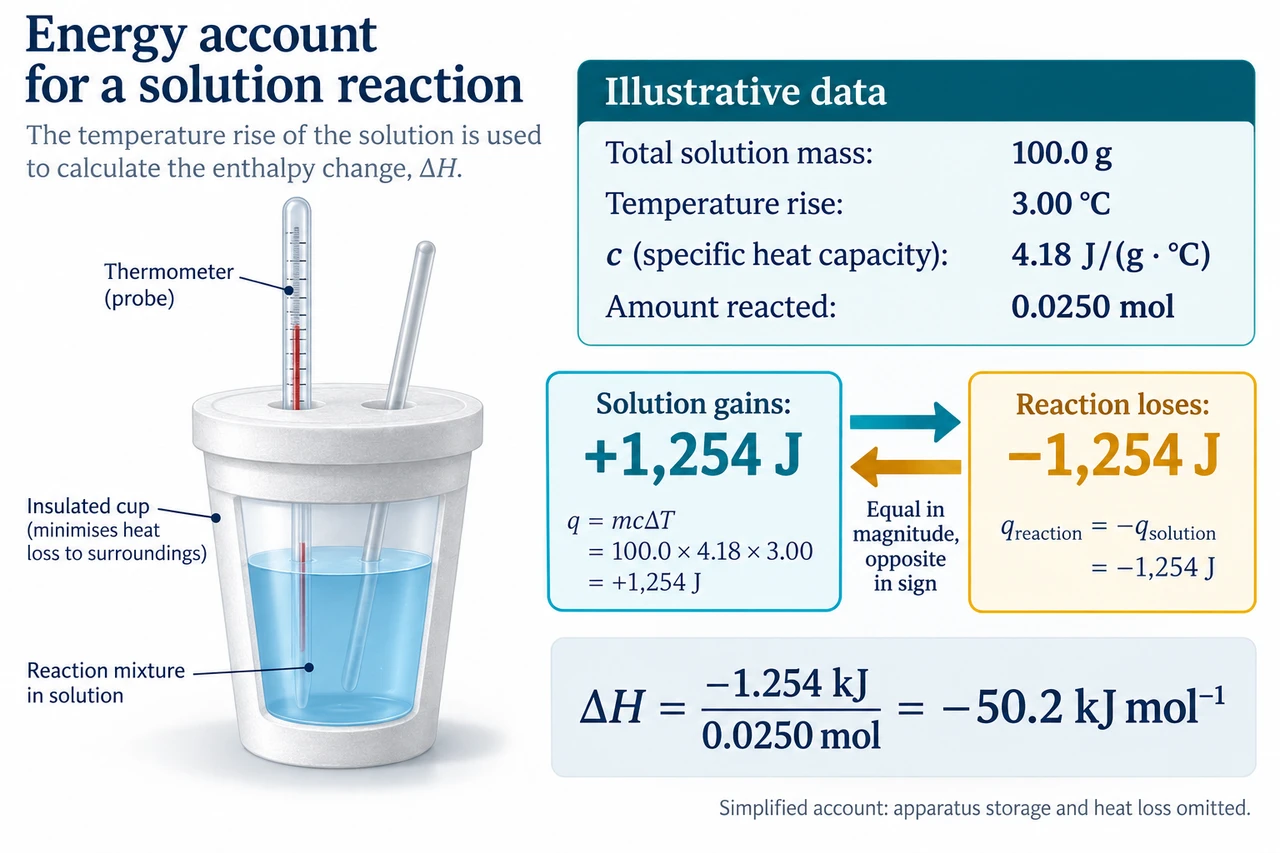
Image: illustration, not a documentary photograph. Supplied calorimetry data with apparatus storage and heat loss omitted; no practical completion or measured trace is implied. · Original AI-generated illustration; independently reviewed scientific teaching model.
Calorimetry with a reaction boundary
Calorimetry estimates a reaction’s energy change from the temperature response of its surroundings. The equation q=m c ΔT calculates the heat gained or lost by the material whose temperature changes. That material may be the whole mixed solution, not merely the mass of one reactant. Use supplied specific heat in compatible units: if c is in J/(g·°C), mass must be in grams. A rise from 20.0°C to 23.0°C is 3.0°C, not 23.0°C. The measured thermal account and reaction amount account are separate steps.
For a simplified constant-pressure reaction, heat gained by the solution is opposite in sign to heat lost by the reaction: q_reaction=−q_solution. Converting that reaction heat into a molar enthalpy requires the amount reacting according to the chosen balanced equation. The limiting reagent and its stoichiometric coefficient determine that amount. Moles in excess cannot be counted as though they all reacted, and solution volume does not itself determine a mass without a stated density or supplied mass. These distinctions often matter more than calculator arithmetic.
Consider supplied hypothetical data for mixing 50.0 cm³ of 0.500 mol dm⁻³ acid with an equal amount of a 1:1-reacting base. Each amount is 0.0500 dm³×0.500 mol dm⁻³=0.0250 mol, so the reaction extent is 0.0250 mol. Take the total solution mass as 100.0 g, c=4.18 J/(g·°C), and temperature rise 3.00°C. Solution heat gain is 100.0×4.18×3.00=1254 J. These values describe an original illustrative account rather than a completed experiment or an assumed density measurement.
Omitting apparatus storage and heat loss gives reaction heat −1254 J, or −1.254 kJ. Divide by 0.0250 mol: the unrounded molar result is −50.16 kJ mol⁻¹, reasonably reported as −50.2 kJ mol⁻¹ for these supplied values. A positive solution temperature rise is therefore consistent with a negative exothermic reaction enthalpy. Using only one 50 g solution in q would halve the estimated heat, while using 0.0500 mol as the reaction extent would halve the molar magnitude. Both errors confuse different physical quantities.
A more complete boundary can include the cup, probe and other apparatus, plus transfer to surroundings beyond the measured solution. Suppose independent information supplies 60 J apparatus storage and 126 J outward transfer. Then the reaction released 1254+60+126=1440 J, giving −57.6 kJ mol⁻¹ for the same reaction extent. Ignoring these terms made the exothermic magnitude too small. The correction is justified only if those terms have evidence; they must not be chosen simply to force agreement with an expected answer.
In an actual required practical, measurement design would specify masses or densities, temperature readings, controlled mixing, appropriate equipment and how the highest or extrapolated temperature is identified. The method must address transfer during the measurement interval rather than assume insulation eliminates it. Repeated measurements help examine variation; a consistent omitted energy term is a systematic problem. Safe supervised laboratory procedures and a real risk assessment are separate from this reading. A rendered cup and supplied data do not satisfy practical-performance requirements.
The illustration’s positive solution heat and negative reaction heat are equal only in its stated simplified boundary. Its thermometer is not a calibrated record of a measured run. Before reporting ΔH, identify the heated mass, supplied c, temperature interval, reaction amount, sign, unit conversion and excluded transfers. Then report precision consistent with the evidence. An unfamiliar endothermic process would cool its surroundings in the simplified model; the same signed reasoning should work without memorising that every calorimetry answer must be negative.
Worked example: Calculate the simplified molar reaction enthalpy and its corrected value with the supplied additional transfers.
Reacting amount 0.500×0.0500=0.0250 mol for the 1:1 equation.
q_solution=100.0×4.18×3.00=1254 J.
ΔH=−1.254/0.0250=−50.16 kJ mol⁻¹; report −50.2.
With 60 J apparatus storage and 126 J outward transfer, reaction releases 1440 J.
Corrected ΔH=−1.440/0.0250=−57.6 kJ mol⁻¹.
Answer: Simplified −50.2 kJ mol⁻¹; corrected supplied-boundary −57.6 kJ mol⁻¹.
Check your understanding: An unfamiliar 1:1 reaction uses 0.0200 mol of the limiting reagent. A supplied 80.0 g solution with c=4.00 J/(g·°C) cools by 2.50°C. Ignoring other transfers, determine ΔH and identify the sign.
Answer: ΔT=−2.50°C, so q_solution=80.0×4.00×(−2.50)=−800 J. The reaction gains 800 J=0.800 kJ. Dividing by 0.0200 mol gives +40.0 kJ mol⁻¹, an endothermic change. The 80.0 g heated/cooled solution is not a reacting amount, and an excess reagent cannot replace the limiting-reagent extent. This result assumes no apparatus-storage or external-transfer term.
Why: Use the stated equation, conservation account, units and representation limits. Supplied illustrative reasoning is not observed practical performance, completed formal assessment or evidence of mastery.