Mean bond enthalpies as an approximation
By UK A Level Chemistry · independent study · myAudience
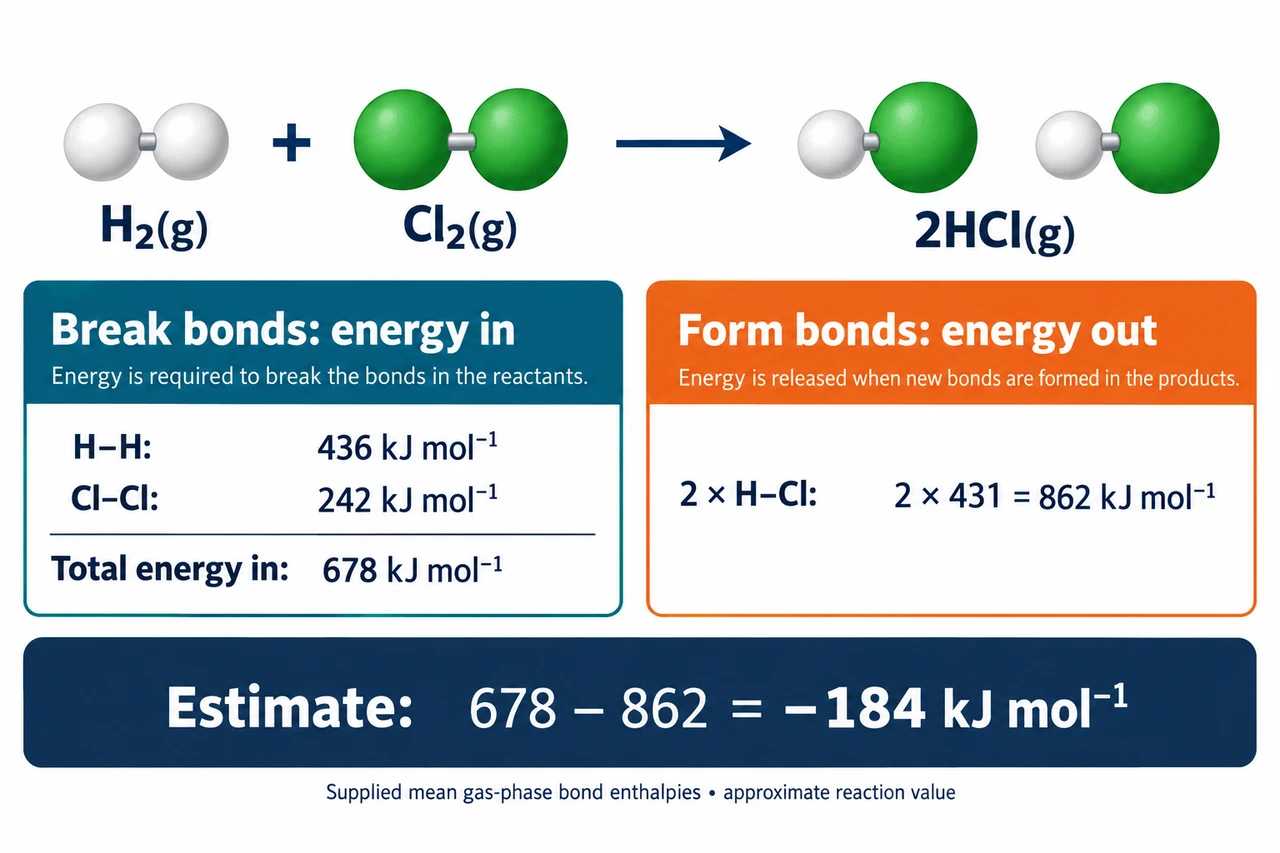
Image: illustration, not a documentary photograph. Supplied mean gas-phase bond values; molecular count and bond inventory conserve hydrogen and chlorine, while sizes and bond lengths are schematic. · Original AI-generated illustration; independently reviewed scientific teaching model.
Mean bond enthalpies as an approximation
Chemical bond breaking requires energy; making bonds releases it. An exothermic reaction does not occur because breaking its reactant bonds releases energy. Instead, the bond-forming energy release outweighs the bond-breaking input in the overall account. Mean bond enthalpy describes the average enthalpy needed to break a specified bond in gaseous molecules, reported in kJ mol⁻¹ of bonds. The word mean matters because the same labelled bond can have different enthalpies in different molecular environments.
A mean-bond calculation estimates a gas-phase reaction enthalpy by summing energy needed to break reactant bonds and subtracting energy released when product bonds form. The balanced equation determines bond counts. A coefficient multiplies all bonds in that molecule. Double and triple bonds use their own supplied values; they are not automatically two or three times a single-bond value. Counting only the molecules, or leaving out unchanged atoms, can produce a believable number that belongs to the wrong reaction.
For the supplied gas-phase equation H₂(g)+Cl₂(g)→2HCl(g), one H–H bond and one Cl–Cl bond are broken, and two H–Cl bonds are formed. Take supplied illustrative mean values 436, 242 and 431 kJ mol⁻¹ respectively. Energy needed is 436+242=678 kJ per mole of reaction. Energy released is 2×431=862 kJ. The estimate is 678−862=−184 kJ mol⁻¹. Both hydrogen and chlorine atoms are conserved; the negative sign describes the net reaction, not either individual bond-breaking step.
For many bond types, a tabulated mean averages over different molecular environments, so exact arithmetic does not make a general mean-bond calculation exact. This simple diatomic H₂/Cl₂/HCl model avoids the structural variety of a C–H bond in many different compounds; its supplied rounded values still define an illustrative calculation rather than an independently verified measurement. All three substances are explicitly gaseous. If an experimental endpoint instead uses a solution or a liquid, phase changes, solvation and other energy terms must enter the account. A Hess calculation with reaction-specific formation values can therefore differ from a bond-table estimate without contradicting energy conservation.
Reversing the reaction reverses the estimated sign, giving +184 kJ mol⁻¹ for 2HCl(g)→H₂(g)+Cl₂(g) under the same supplied approximation. Producing one mole of HCl corresponds to half the original reaction extent, giving −92.0 kJ for that extent. These are amount-scaling statements, not evidence that the reverse reaction will occur rapidly or that either gas mixture is safe to prepare. An energy estimate alone does not supply activation energy, equilibrium composition or an operating procedure.
For larger molecules, write a bond inventory on each side before inserting numbers. If a bond type appears unchanged on both sides, its corresponding identical terms cancel algebraically, but the full inventory must still conserve atoms and follow the equation. Check which bonds actually differ rather than relying on a decorative molecular render. An unfamiliar carbon-containing molecule may include several C–H, C–C and multiple bonds. A structural formula, not just a molecular formula, may be required to distinguish those possibilities.
The illustration displays two intact diatomic reactants and two HCl products, with separate energy-in and energy-out totals. Sphere sizes and connector lengths are explanatory, not measured radii or bond lengths. Before accepting the result, check equation balance, molecular structures, supplied gas-phase mean values, bond counts, units, sign and endpoint limitations. To explain a discrepancy with another method, identify which assumptions differ instead of saying one method is always wrong. The estimate is valuable precisely when its approximation is kept visible.
Worked example: Calculate the supplied mean-bond estimate and the value per one mole of HCl formed.
Broken bonds 1H–H +1Cl–Cl: 436+242=678 kJ.
Formed bonds 2H–Cl: 2×431=862 kJ.
Reaction estimate 678−862=−184 kJ mol⁻¹ as written.
One mole HCl is half the extent: −92.0 kJ.
Reverse of the written reaction gives +184 kJ mol⁻¹.
Answer: −184 kJ mol⁻¹ as written; −92.0 kJ for one mole HCl formed.
Check your understanding: For a hypothetical gas reaction, the complete inventory requires breaking two bonds valued 300 kJ mol⁻¹ each and forming three bonds valued 250 kJ mol⁻¹ each. Find ΔH and explain a claimed exact experimental agreement.
Answer: Energy in=2×300=600 kJ; energy out=3×250=750 kJ. Estimated ΔH=600−750=−150 kJ mol⁻¹ for the supplied balanced inventory. Breaking bonds still takes energy. Exact arithmetic does not make mean-bond data an exact reaction-specific measurement; molecular environment and physical-state differences may change an experimental value. The inventory is a supplied abstract model, not a claim that any invented unbalanced chemical formula is real.
Why: Use the stated equation, conservation account, units and representation limits. Supplied illustrative reasoning is not observed practical performance, completed formal assessment or evidence of mastery.