Dynamic equilibrium and conditional changes in yield
By UK A Level Chemistry · independent study · myAudience
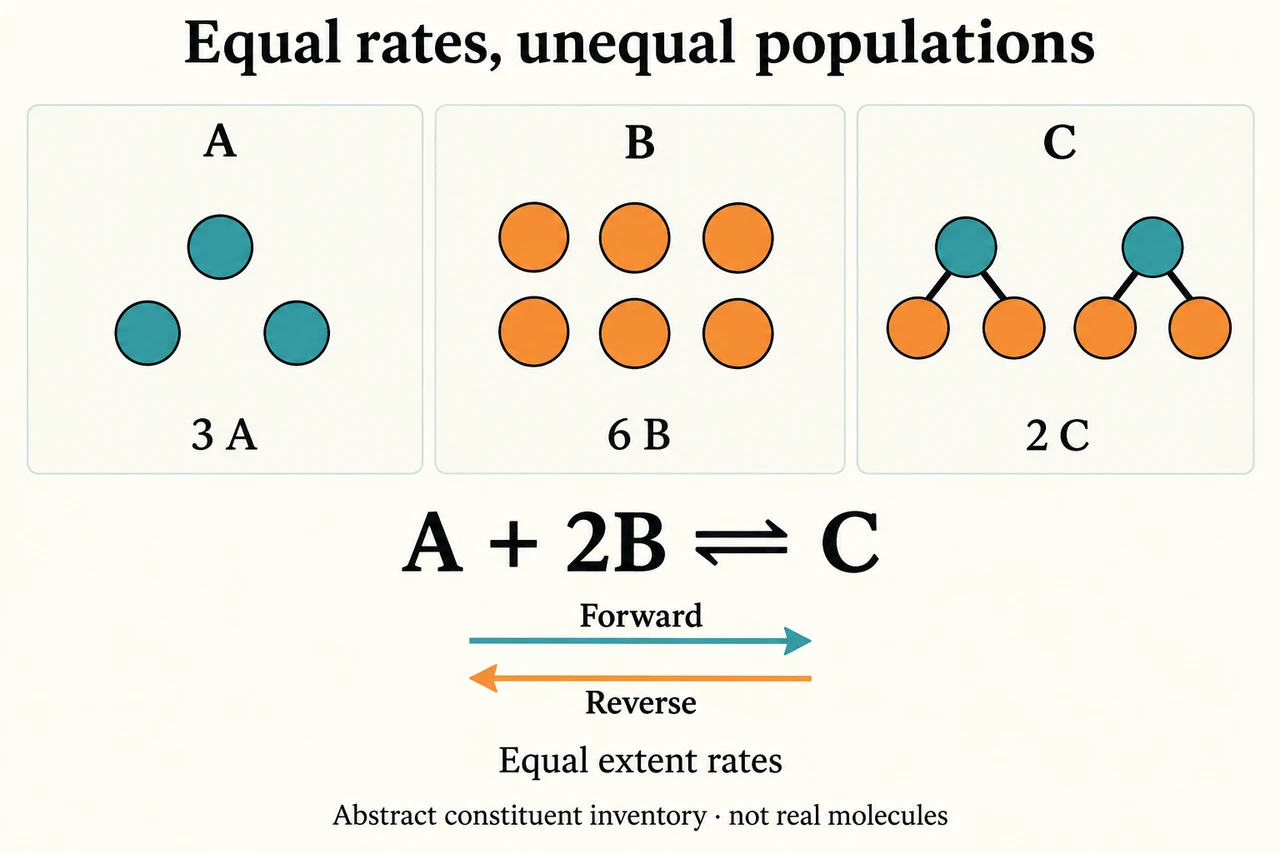
Image: illustration, not a documentary photograph. Abstract constituent-conserving A + 2B ⇌ C inventory; arrows indicate continuing reversible processes, not measured trajectories or rates. Equal rates do not require equal populations. · Original AI-generated illustration; independently reviewed scientific teaching model.
Dynamic equilibrium and conditional changes in yield
A reversible reaction can proceed in both directions. In a closed system at dynamic equilibrium, the forward and reverse rates are equal, so there is no net change in the amounts or concentrations under unchanged conditions. Reactions have not stopped: particles continue to interconvert. Equal rates do not imply equal concentrations, and a constant concentration is not evidence that every particle is inactive. A closed container permits gases to remain available for the reverse process; losing one species from an open vessel can prevent the closed-system equilibrium described here.
For an abstract gas reaction A(g) + 2B(g) ⇌ C(g), each mole of forward reaction consumes one mole of A and two moles of B while producing one mole of C. Starting with 1.00 mol A, 2.00 mol B and no C, a forward extent of 0.40 mol gives 0.60 mol A, 1.20 mol B and 0.40 mol C. The 1:2:1 coefficients determine the changes, not an equality of final amounts. This abstract inventory is consistent if one C particle contains the constituent material of one A and two B; it is not a claim about unnamed real chemicals.
At a particular equilibrium, forward and reverse extents might each occur at 0.030 mol s⁻¹. Their net extent rate is zero even though C is continually made and consumed. Expressing the disappearance of B instead gives twice the forward extent rate because its coefficient is two. Comparing differently defined species rates without that normalization can falsely suggest that equilibrium requires unequal forward and reverse rates. In the illustration, opposite arrows represent processes rather than a count of particles per second; read the stated rate convention in the worked example before using numerical values.
Le Chatelier’s principle predicts the qualitative response when a system at equilibrium is disturbed and is then allowed to equilibrate under its new conditions. Adding A or B can favour the forward change that consumes part of the added reactant; adding C can favour the reverse change. The added concentration jumps first, then reaction changes follow. The system does not necessarily return to its original concentrations or completely remove the added material. Distinguish the immediate physical intervention from the later chemical response, and check which concentrations were actually altered.
For the supplied gaseous equation, the forward side contains three moles of gas per written extent and the product side one. Compression at constant temperature increases all partial concentrations immediately and favours the side with fewer gas particles, C. If both sides had the same total gas coefficient, this particular pressure argument would give no shift in the ideal homogeneous model. Adding an inert gas at fixed volume is not compression: it increases total pressure without changing the reactant partial concentrations in the ideal-gas account. An inert-gas addition at constant total pressure can instead expand the volume, so its conditions must be stated.
Suppose the supplied forward reaction is exothermic, with ΔH = −40 kJ mol⁻¹. Raising temperature favours the endothermic reverse direction, while lowering temperature favours the forward equilibrium position. This is a statement about the new equilibrium yield, not the speed at which it is reached. Lower temperature can improve equilibrium yield but slow reaction progress; higher pressure can improve some gas yields but increases compression and equipment demands. Industrial choices can therefore involve compromises among rate, yield, energy, safety and cost. No particular plant pressure or temperature is universal, and this hypothetical example supplies no real operating recommendation.
A catalyst provides faster pathways in both directions and helps equilibrium be reached sooner without shifting the final position at a fixed temperature. It therefore cannot be counted as another yield disturbance in the same way as changing temperature or a reactant concentration. When explaining a proposed improvement, identify whether the goal is a faster approach, a different final equilibrium, or removal of product in a process that is no longer the original closed mixture. Qualitative prediction comes first; calculating the new composition requires equilibrium data such as Kc and a conserved starting inventory. Formal assessment remains open.
Worked example: For the supplied A(g) + 2B(g) ⇌ C(g), start with 1.00 mol A, 2.00 mol B and no C. At equilibrium the forward extent is 0.40 mol, and forward/reverse extent rates are each 0.030 mol s⁻¹. Find final amounts and net rate; predict compression and heating effects if forward ΔH = −40 kJ mol⁻¹.
Forward changes are −0.40 mol A, −0.80 mol B and +0.40 mol C.
Final amounts are 0.60 mol A, 1.20 mol B and 0.40 mol C; all are nonnegative and preserve the supplied constituent inventory.
Net extent rate = 0.030 − 0.030 = 0 mol s⁻¹; equal rates coexist with unequal amounts.
Compression at fixed temperature favours the side with fewer gas moles: C, because 3 become 1 per extent.
Heating favours the endothermic reverse direction, so the new equilibrium contains a smaller proportion of C. A catalyst changes neither equilibrium conclusion.
Answer: Final amounts are 0.60, 1.20 and 0.40 mol A/B/C; net extent rate is zero. Compression favours C and heating favours A/B for the stated exothermic forward model.
Check your understanding: A different closed ideal-gas equilibrium is X(g) ⇌ 2Y(g), with forward ΔH = +25 kJ mol⁻¹. Predict effects of heating, compression, a catalyst, and inert gas added at fixed volume.
Answer: Heating favours the endothermic forward direction and increases the equilibrium proportion of Y. Compression favours X, the side with fewer gas moles. A catalyst speeds approach to the same equilibrium position at fixed temperature. Adding inert gas at fixed volume changes total pressure but not X or Y partial concentrations in this ideal model, so does not by itself shift the equilibrium. These are qualitative predictions; numerical final amounts require additional equilibrium data.
Why: Use the stated equation, conservation account, units and representation limits. Supplied illustrative reasoning is not observed practical performance, completed formal assessment or evidence of mastery.