Kc, conserved inventories and temperature-specific results
By UK A Level Chemistry · independent study · myAudience
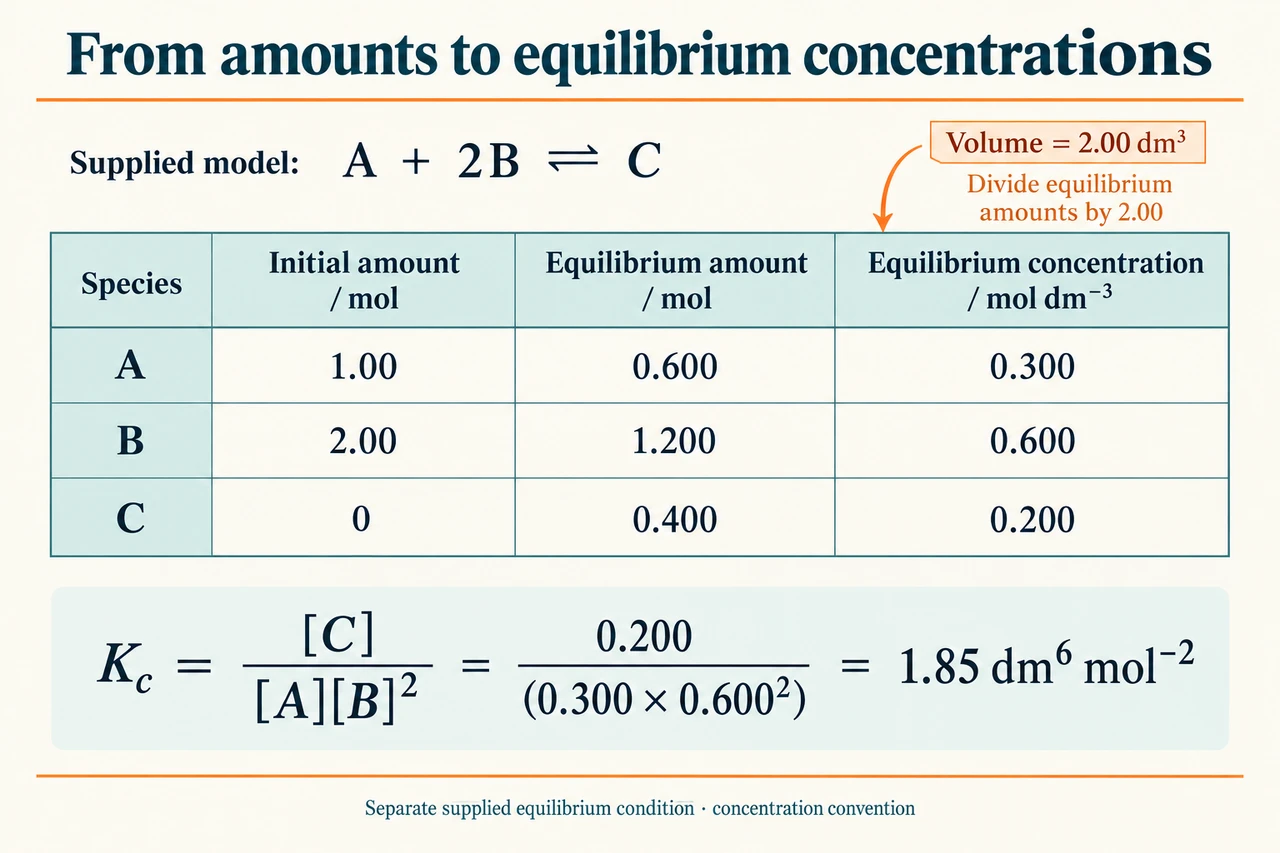
Image: illustration, not a documentary photograph. Supplied amount-to-concentration accounting for a separate equilibrium condition; the abstract A/B/C inventory conserves constituents, and symbol size is not a physical scale or an equilibrium percentage. · Original AI-generated illustration; independently reviewed scientific teaching model.
Kc, conserved inventories and temperature-specific results
For a homogeneous equilibrium, every species in the expression is in the same phase. The balanced equation determines the concentration powers in Kc. For A(g) + 2B(g) ⇌ C(g), write Kc = [C] / ([A][B]²), where brackets mean equilibrium concentration in mol dm⁻³. Coefficients become powers; the coefficient two is not a factor of two multiplied by [B]. The expression belongs to the equation as written. Reversing or multiplying that equation changes the numerical constant associated with it, even though the chemical system is described by related statements.
The input must be equilibrium concentration, not the initial amount or an amount of product measured before equilibrium. Convert amounts using the common equilibrium volume when amounts are supplied. For concentrations [A] = 0.200, [B] = 0.400 and [C] = 0.0800 mol dm⁻³ at one stated temperature, the denominator is 0.200 × 0.400² = 0.0320. Dividing 0.0800 by 0.0320 gives Kc = 2.50 in the concentration convention. A calculation with a simple arithmetic result still depends on valid equilibrium data and controlled temperature.
Units follow the concentration powers. Here, (mol dm⁻³) divided by (mol dm⁻³)³ gives (mol dm⁻³)⁻² = dm⁶ mol⁻². Other equations can give different powers or cancel them entirely; no single unit belongs to every Kc. The school concentration form must be distinguished from a thermodynamic equilibrium constant expressed through dimensionless activities relative to standard states. They are related conventions, not a reason to erase units from this supplied calculation or to mix activity values with unnormalized molar concentrations. State which convention is being used.
Amounts at equilibrium can be reconstructed from a conserved starting inventory. At a separate specified condition, put 1.00 mol A and 2.00 mol B in a 2.00 dm³ vessel with no C. If equilibrium contains 0.400 mol C, its forward extent is 0.400 mol. A has fallen to 0.600 mol and B to 1.200 mol. The concentrations are therefore 0.300, 0.600 and 0.200 mol dm⁻³. Substituting gives 0.200 / (0.300 × 0.600²) = 50/27, about 1.85 dm⁶ mol⁻². These data describe a separate condition; they are not another measurement of the earlier 2.50 constant at the same temperature.
The amount table exposes impossible solutions. If x mol of C forms from that 1.00:2.00:0 inventory, final amounts are 1.00 − x, 2.00 − 2x and x, so the physical interval is 0 ≤ x ≤ 1.00 mol. A mathematical root outside that interval cannot represent the stated mixture. Substitute a selected root back into both the inventory and the equilibrium expression, and check nonnegative amounts. Concentration is amount divided by volume, not a new independent conserved quantity; if the volume changes, the conservation statement remains about amounts and constituent material.
At a fixed temperature, changing an initial concentration or compressing a suitable gas mixture can change the final composition while leaving Kc unchanged. Immediately after the disturbance, the concentration ratio need not equal Kc; reaction proceeds until it reaches the temperature-specific equilibrium value again. A catalyst also leaves Kc unchanged. Temperature can change it: for the supplied exothermic forward model, raising temperature favours reactants and reduces Kc, whereas lowering temperature increases it. This is consistent with the equilibrium predictions rather than an exception to them.
The magnitude of Kc is not a reaction-rate measurement. A large value can favour products for the written expression without proving that equilibrium is reached quickly. Nor can constants for different equations with different concentration powers be ranked as simple percentages of yield. Reversing A + 2B ⇌ C gives a reciprocal constant with reciprocal units; doubling the written equation squares its constant. Keep sufficient digits during intermediate calculations, then report a final result appropriate to the supplied data. The original illustration shows accounting steps and schematic particles, not a measured experiment or assessed practical completion.
Worked example: At a separate specified condition, 1.00 mol A and 2.00 mol B begin in 2.00 dm³ with no C for A + 2B ⇌ C. Equilibrium C is 0.400 mol. Find all equilibrium concentrations, Kc with units, and the constant for the reversed equation.
The forward extent is 0.400 mol; final A = 1.00 − 0.400 = 0.600 mol and B = 2.00 − 0.800 = 1.200 mol.
Divide every amount by 2.00 dm³: [A] = 0.300, [B] = 0.600 and [C] = 0.200 mol dm⁻³.
Kc = 0.200 / (0.300 × 0.600²) = 0.200 / 0.108 = 50/27 ≈ 1.85 dm⁶ mol⁻².
For C ⇌ A + 2B, Kc(reverse) = 27/50 = 0.540 mol² dm⁻⁶.
All amounts are positive and x = 0.400 lies in the allowed 0 to 1.00 mol interval. This separate dataset is not assumed to share the temperature of the 2.50 example.
Answer: Equilibrium concentrations are 0.300/0.600/0.200 mol dm⁻³; forward Kc ≈ 1.85 dm⁶ mol⁻² and reverse Kc = 0.540 mol² dm⁻⁶ under the supplied concentration convention.
Check your understanding: For a different homogeneous equilibrium D ⇌ 2E at its stated temperature, equilibrium concentrations are [D] = 0.500 and [E] = 0.200 mol dm⁻³. Find Kc and its units. Would adding more E or a catalyst change this temperature-specific Kc?
Answer: Kc = [E]² / [D] = 0.200² / 0.500 = 0.0800 mol dm⁻³. Adding E disturbs the composition and drives a response towards D, but the equilibrium value of Kc remains 0.0800 at the same temperature. A catalyst does not change that value. The expression and units differ from A + 2B ⇌ C, so the two constants are not directly comparable yield percentages or rate indicators. The units come from concentration squared divided by concentration, leaving one concentration power; they are derived from this equation rather than copied from the earlier example.
Why: Use the stated equation, conservation account, units and representation limits. Supplied illustrative reasoning is not observed practical performance, completed formal assessment or evidence of mastery.