Who is sovereign, and what does that answer leave unresolved?
By UK A Level Politics · independent study · myAudience
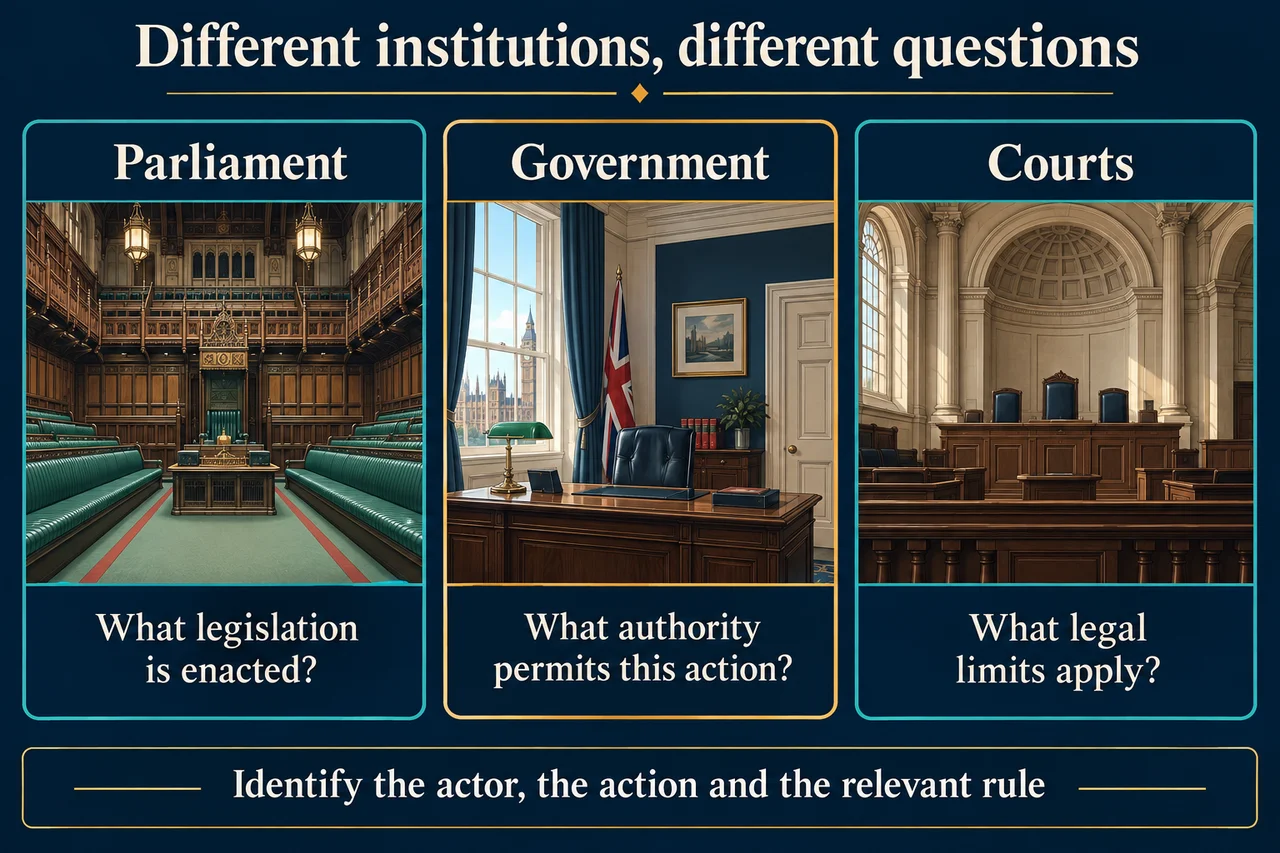
Image: illustration, not a documentary photograph. Original generated constitutional study aid, not an official institutional diagram or automatic legal verdict. · Original generated project artwork; no source-edition figures or documentary photographs reused.
Who is sovereign, and what does that answer leave unresolved?
A student hears that Parliament is sovereign and concludes that the Prime Minister can do anything. The conclusion changes the subject. Parliament and government are different institutions. The orthodox doctrine concerns the authority of legislation enacted by Parliament, not an unlimited personal power held by a minister. To evaluate a constitutional claim, identify the actor and the kind of act before judging its strength. A parliamentary statute, an executive instruction and a political promise can all affect public life without having the same legal status. Treating them as interchangeable prevents a student from explaining which institution can authorise, scrutinise or challenge a decision.
The UK constitution is uncodified, but that does not make every constitutional rule an unwritten custom. Statutes and judicial decisions are written; conventions and practices also contribute to how institutions operate. Uncodified describes the absence of a single consolidated constitutional text. It does not tell you that rules are absent, that a minister can invent them at will, or that all sources are equally enforceable. When analysing a proposed limit, ask whether it is a legal rule, a convention or a political expectation, then investigate its source and consequence. The category is the beginning of an explanation, not a substitute for one.
Under the orthodox account presented by the Library, Parliament can alter primary legislation and cannot permanently remove the ability of a later Parliament to change it. This explains why the phrase permanent reform needs care. A reform may have substantial institutional effects while remaining legally capable of repeal. The doctrine also distinguishes Parliament's primary legislation from subordinate action. A court's examination of the lawfulness of a ministerial decision is not automatically a claim to invalidate an Act of Parliament. A useful comparison names the challenged object and the remedy, instead of treating every judicial intervention as a struggle for the same power.
Legal authority and practical effectiveness are different questions. A government may face opposition from electors, MPs, public bodies or organised groups even when a legal power exists. Those pressures can affect whether a proposal is attempted, passed or accepted in practice. Their importance does not necessarily turn each pressure into a judicially enforceable prohibition. Conversely, a government that enjoys political support still needs the relevant legal authority for its actions. Analyse both dimensions: what permits the action, and what might discourage, delay or defeat it politically? This produces a more precise account than either unlimited power or complete powerlessness.
Sovereignty is also the subject of genuine scholarly dispute. The Library describes disagreements over whether the doctrine is a political fact or a common-law rule, and over proposals that Parliament could regulate the procedure for future legislation. Do not present these theories as if they were identical or as if every proposal were an established current requirement. Their value in an essay is to identify a disputed question, explain its implications and test it against institutional practice. A student can explain the orthodox account clearly while acknowledging that its origins and limits are debated.
Now use a concrete change carefully. The 2022 Dissolution and Calling of Parliament Act, as enacted, repealed the 2011 Fixed-term Parliaments Act and revived specified dissolution and calling powers. The current Parliament dissolution guidance directs readers to this 2022 legislation, while the 2025 Library sovereignty briefing identifies the 2011 Act as repealed. That supports a bounded illustration of statutory change; it does not establish that every constitutional reform is easily reversed in political practice. Nor does it make dissolution interchangeable with prorogation. A comparison must identify both the earlier rule and the later enactment rather than quoting an old judgment's description as present law.
Question: A reform can be repealed by a later Act. Does that prove it has no meaningful constitutional effect while it operates?
Answer: No. Repealability describes a capacity for future legal change, not an absence of present consequences. An operating reform can redistribute functions or constrain how institutions act. To assess its strength, discuss the current rule, the lawful route to change it, and the practical obstacles to doing so. Do not confuse durability, effectiveness and legal entrenchment.
Worked example: A student says, “Because Parliament can change the law, the Prime Minister may ignore any existing law until Parliament tells them to stop.” Identify the missing step.
Name the institutions; distinguish authority to enact a change from authority to disregard the existing rule; identify the relevant power for the executive action; then explain why political support alone cannot supply it.
Answer: The student transfers Parliament's legislative capacity to a different actor. A minister's wish to change a rule is not itself the enacted change. An executive decision needs lawful authority under the applicable rule or power. Parliament's capacity to legislate can explain how a change might be made, but it does not show that the Prime Minister can act as though that change has already occurred. A parliamentary majority may make legislation politically achievable; it does not automatically convert every ministerial instruction into an Act.
Check your understanding: Why is “uncodified” more precise than “there are no written constitutional rules”?
Answer: The absence of one consolidated constitution does not erase written statutes or recorded judicial decisions. A constitution can draw on several kinds of sources. The stronger analysis identifies those sources and their effects, rather than assuming that uncodified means legally empty.
Why: Identify the exact institution, rule and consequence before making the broader constitutional inference.