Prorogation in 2019: a court protecting Parliament's ability to act
By UK A Level Politics · independent study · myAudience
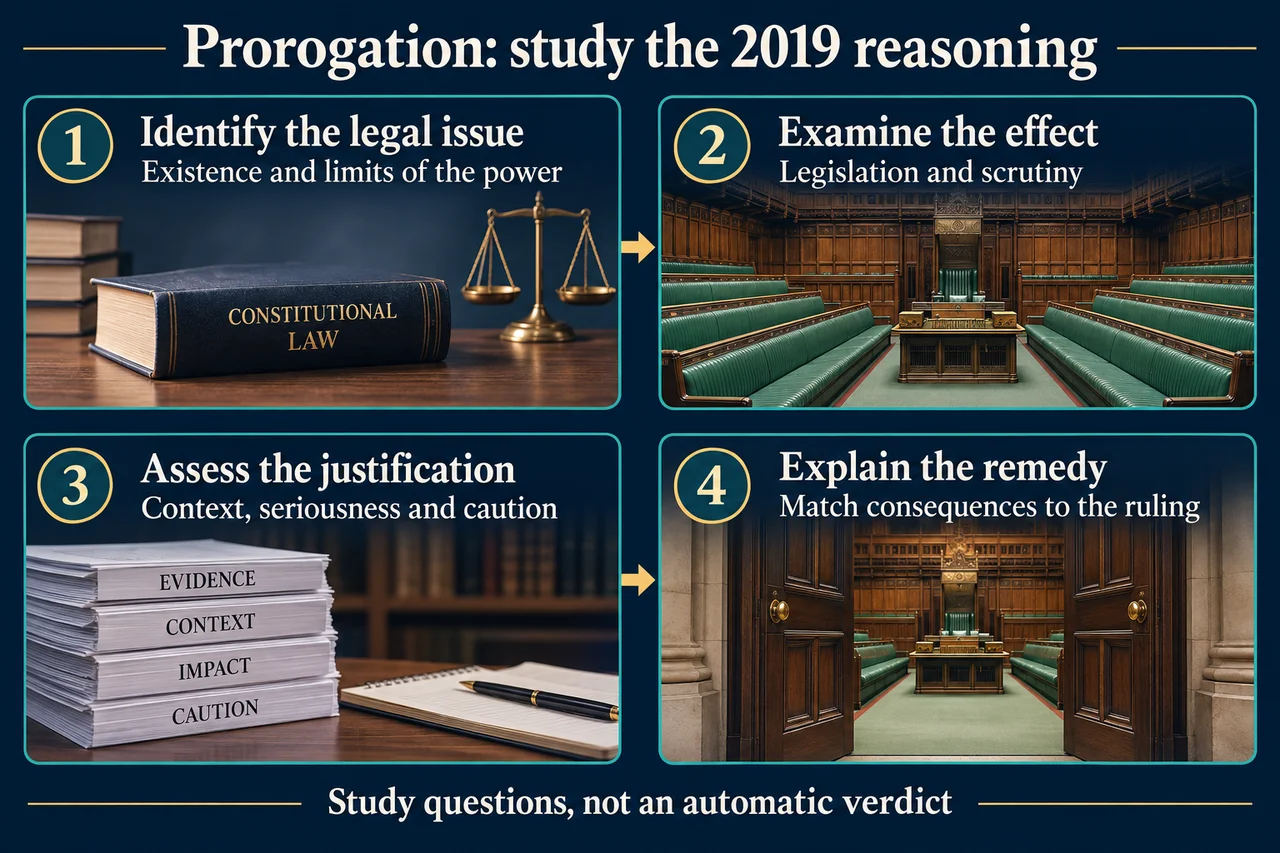
Image: illustration, not a documentary photograph. Original generated constitutional study aid, not an official institutional diagram or automatic legal verdict. · Original generated project artwork; no source-edition figures or documentary photographs reused.
Prorogation in 2019: a court protecting Parliament's ability to act
The case concerned advice to prorogue Parliament in 2019 and its legal consequences. Prorogation ends a parliamentary session; it is distinct from dissolution, which ends a Parliament before a new Commons is elected, and from recess, during which some parliamentary work can continue. The differences matter because they change opportunities for legislation and scrutiny. The judgment's historical explanation of dissolution law included the 2011 Act then operating. The 2022 enacted statute is a later change relating to dissolution and calling, with a specific non-justiciability provision for those revived powers. Do not transfer that provision indiscriminately to every prerogative power or treat it as a generic answer to the 2019 prorogation reasoning.
The first analytical question is whether there is a legal issue for a court to determine. In paragraphs 35–38 the court separates the existence and limits of a prerogative power from challenges to an exercise within lawful limits. Political controversy alone does not make every related legal question disappear. The government's objection emphasised political accountability and separation of powers. The court's answer treated the legal boundaries of the power as a judicial question and argued that protecting Parliament's proper functions could give effect to institutional separation. Explain the competing arguments before stating the result; naming separation of powers without identifying which function is threatened will not evaluate the dispute.
The court then identified parliamentary sovereignty and parliamentary accountability as relevant constitutional principles. These were connected to functions, not simply ceremonial status. Parliament must be able to legislate and supervise the executive. If the executive could suspend those functions indefinitely through a prerogative power, the formal authority of legislation would not be an adequate description of Parliament's practical constitutional position. Paragraphs 41–48 connect this concern to the limits of prorogation while recognising that Parliament need not sit continuously. The court did not declare every ordinary short prorogation incompatible with the constitution.
Paragraph 50 gives the relevant standard for this case. The inquiry concerns whether prorogation obstructs Parliament's legislative and supervisory functions without reasonable justification, with an effect serious enough to warrant exceptional intervention. Paragraph 51 adds sensitivity to the Prime Minister's responsibilities and political judgment. For teaching, keep three parts together: functional effect, justification and seriousness. A claim that any lost sitting day is unlawful deletes those qualifications. A claim that any explanation supplied by a minister must be sufficient deletes the court's evaluative role. Neither is a fair account of the reasoning.
Application requires evidence. In paragraphs 55–61 the court considered the prolonged interruption and the exceptional constitutional context. It distinguished a reason for holding a new Queen's Speech on a particular date from a reason for stopping Parliament's business for the preceding five weeks. The documents before it did not supply an adequate explanation for that lengthy interruption. Do not substitute a guessed private motive for this reasoning. Paragraph 54 states the ordering: the effect-based ground was considered first, and the alternative motive ground would need consideration only if necessary. The lesson therefore cannot claim that the Supreme Court established every alleged intention of the Prime Minister.
The remedy was equally specific. In paragraphs 62–71 the court addressed whether the prorogation itself could be reviewed despite the government's parliamentary-privilege argument. It held that the unlawful advice led to an unlawful Order in Council and a prorogation without legal effect. Parliament had therefore not been prorogued, and the parliamentary authorities could take steps for the Houses to meet. That is not a ruling that courts can replace Parliament in making policy or freely invalidate any primary legislation they dislike. A complete case explanation connects the object challenged, the legal standard, the evidence and the consequence, then states what has not been decided.
Question: An invented case involves a short prorogation, evidence of routine session preparation and limited effects on scrutiny. Can we declare it unlawful simply by citing the 2019 outcome?
Answer: No. Apply the standard rather than importing the outcome. Investigate the actual impact on Parliament's functions, the reasonable justification offered and whether the effects are serious enough for intervention. The judgment recognises ordinary short prorogations and calls for sensitivity to executive responsibilities. The fictional facts suggest reasons to distinguish the case, but they do not supply a complete record or authorise a certain legal prediction. A changed outcome is possible because the evidence and application may differ while the analytical questions remain relevant.
Worked example: “The court ruled on a politically controversial event, so it must have decided whether Brexit was good or bad.” What does the judgment actually establish?
Identify the question in paragraph 1; compare it with the legal issues in paragraph 27; state the standard and consequence; separate the setting of the dispute from the matter adjudicated.
Answer: The judgment identifies the lawfulness of the advice to prorogue and its consequences as the issue, rather than the terms or desirability of leaving the EU. Political context helped explain the importance of Parliament's functions, but it was not itself the policy question the court resolved. The legal reasoning concerned the limits of a power, its effects and the absence of sufficient justification for the interruption. The remedy addressed unlawful advice and prorogation. A politically significant judgment need not be an adjudication of the underlying policy's merits.
Check your understanding: Why does a reason for scheduling a Queen's Speech not necessarily explain the length of the preceding prorogation?
Answer: One proposition concerns the desired date and new legislative programme; the other concerns why Parliament's functions must stop for the intervening period. The former does not logically supply the latter without an explanation linking the length to a justified need. That gap was important in the court's assessment of the 2019 evidence.
Why: Distinguish the programme date from the justification for suspending legislative and supervisory functions.