Original model: Evaluate the claim that parliamentary sovereignty makes government unconstrained
By UK A Level Politics · independent study · myAudience
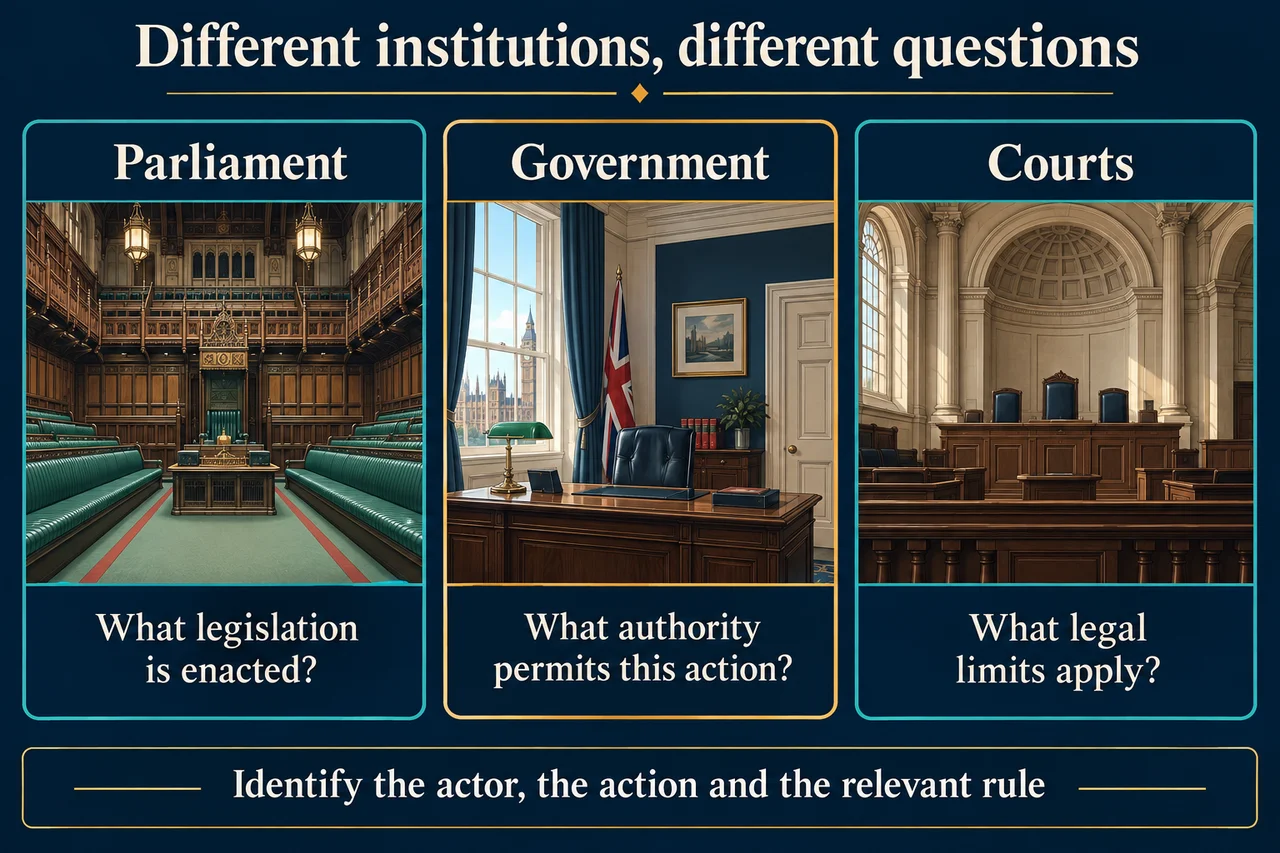
Image: illustration, not a documentary photograph. Original generated constitutional study aid, not an official institutional diagram or automatic legal verdict. · Original generated project artwork; no source-edition figures or documentary photographs reused.
Original model: Evaluate the claim that parliamentary sovereignty makes government unconstrained
Parliamentary sovereignty gives a central place to legislative authority, but it does not establish that government is unconstrained. The claim merges different institutions and different types of constraint. A convincing evaluation should distinguish Parliament's capacity to enact legislation, the executive's authority to act under existing law, and political pressures that influence how legal powers are used. The doctrine may help explain a powerful government with parliamentary support, but it cannot by itself prove unlimited ministerial authority.
The orthodox account described by the Commons Library recognises Parliament's capacity to alter primary legislation and rejects the idea that an ordinary Parliament can permanently prevent a successor from changing it. This can make reform possible without the special entrenched amendment procedure associated with some codified constitutions. It therefore supports part of the argument for constitutional flexibility. The 2022 Act's repeal of the 2011 Fixed-term Parliaments Act provides a bounded example of statutory change. However, the fact that legislation can change does not mean that a minister's intention to change it has already acquired legal effect.
Executive action must still be identified and examined under its relevant authority. The 2019 prorogation judgment is particularly useful because it addresses a prerogative power rather than replacing an Act with the judges' preferred policy. The court reasoned that Parliament's ability to legislate and supervise the executive would be undermined by an unrestricted power to suspend those functions. In this account, judicial intervention protected Parliament's role instead of transferring its general legislative capacity to the court. The example challenges the inference that sovereignty necessarily makes the executive legally immune.
Political constraints also require separate attention. The ability to pass a proposal depends on support and institutional circumstances, while the consequences of a controversial change may affect future electoral or parliamentary decisions. Such pressures can matter greatly even where they are not identical to a legal prohibition. Conversely, popularity cannot make an unauthorised decision lawful merely because many people approve of it. Treating every obstacle as a legal rule exaggerates one kind of constraint; ignoring practical obstacles exaggerates the ease with which legal authority can be exercised.
There are also disputed theories about the basis and possible procedural limits of sovereignty. The Library's account of those debates prevents the orthodox doctrine from being mistaken for an uncontested explanation of every constitutional question. A student should explain the dispute without pretending that a scholarly proposal is already a settled requirement. On balance, sovereignty is an essential part of analysing the constitution, but the claim about unconstrained government fails. It substitutes the executive for Parliament and leaves both legal accountability and practical politics unexplained.
Worked example: Evaluate the claim that parliamentary sovereignty makes government unconstrained.
Distinguish Parliament’s capacity to legislate from executive authority under existing law.
Use the bounded statutory change and prorogation examples while retaining legal versus political constraints.
Evaluate disputed theory as attributed debate, then reach the essay’s qualified conclusion.
Answer: There are also disputed theories about the basis and possible procedural limits of sovereignty. The Library's account of those debates prevents the orthodox doctrine from being mistaken for an uncontested explanation of every constitutional question. A student should explain the dispute without pretending that a scholarly proposal is already a settled requirement. On balance, sovereignty is an essential part of analysing the constitution, but the claim about unconstrained government fails. It substitutes the executive for Parliament and leaves both legal accountability and practical politics unexplained.
Check your understanding: Does the model establish unrestricted ministerial permission?
Answer: No. It rejects that inference by distinguishing legislative capacity, executive authority and political pressures.
Why: A complete argumentative model remains unmarked original practice, not proof of all assessed demands.