Changed-case essay: repealability and significance
By UK A Level Politics · independent study · myAudience
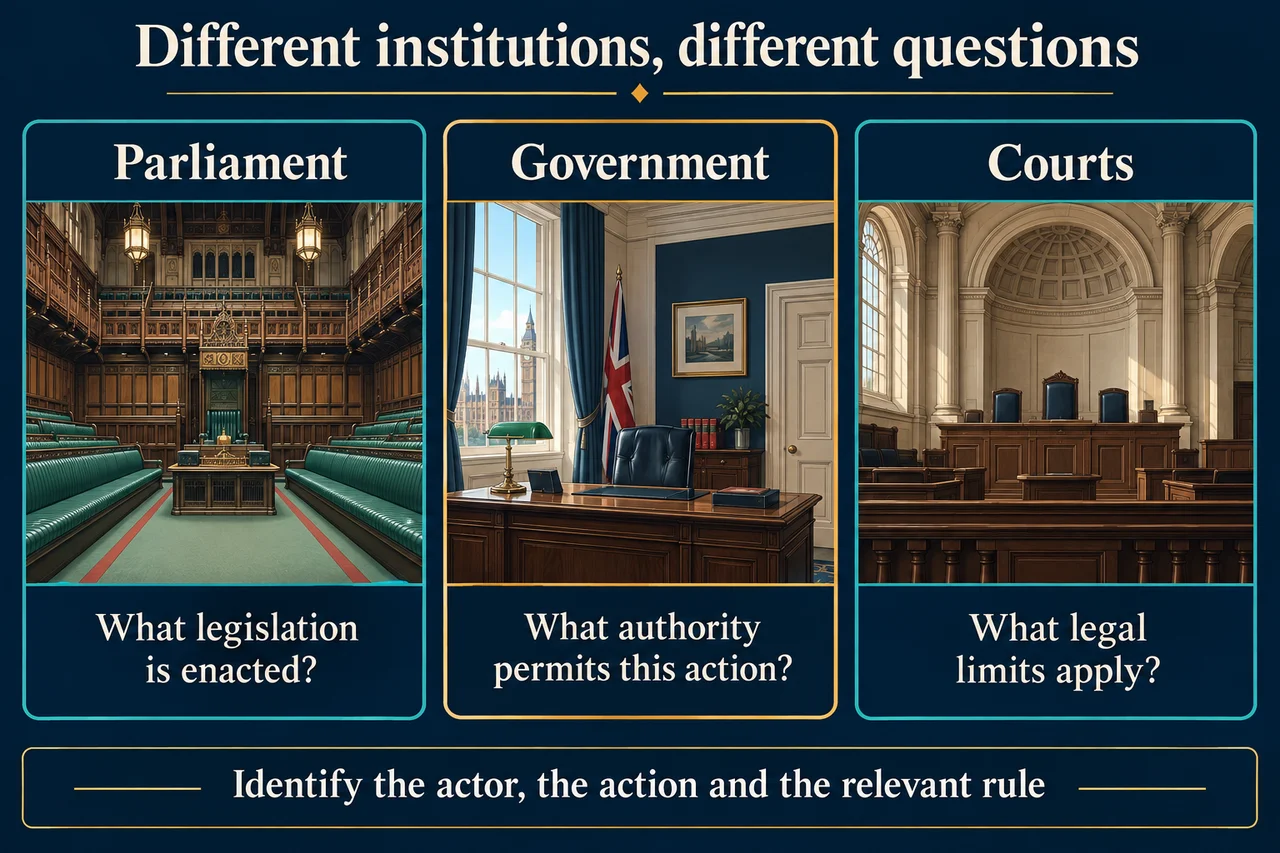
Image: illustration, not a documentary photograph. Original generated constitutional study aid, not an official institutional diagram or automatic legal verdict. · Original generated project artwork; no source-edition figures or documentary photographs reused.
Changed-case essay: repealability and significance
Repealability and symbolic effect are different properties. A rule that can be changed may still govern institutions while it remains in operation. Calling it symbolic requires an argument about its actual influence, not simply evidence that a later legislature could alter it. The starting point should be the rule's present legal consequences and the mechanisms through which those consequences affect conduct.
The change from the 2011 legislation to the 2022 dissolution legislation illustrates the distinction. The later Act repealed the earlier scheme, but that does not show that the earlier rules had no significance during their period of operation. It shows that Parliament used legislation to change the arrangement. To evaluate either scheme, a student would need to examine its effects, the circumstances in which its powers were used and the political reasons for changing it. Repeal is evidence of change, not retrospective proof of irrelevance.
Nevertheless, legal language can be stronger than practical effectiveness. A government may find ways to work within a rule while achieving much of its preferred outcome, and institutional actors may be reluctant to invoke a power. Those are reasons to study implementation and political behaviour. They do not justify assuming weakness in advance. The strongest conclusion is conditional: a repealable rule can be consequential, but its strength must be demonstrated through legal operation and practical evidence rather than inferred from its label.
Worked example: If a legal rule can be repealed, is it reasonable to dismiss it as merely symbolic?
Identify the property tested: capacity for future repeal versus present consequence.
Use the 2011→2022 change as bounded evidence, not proof of retrospective irrelevance.
Evaluate implementation and political behaviour before asserting a symbolic effect.
Answer: Nevertheless, legal language can be stronger than practical effectiveness. A government may find ways to work within a rule while achieving much of its preferred outcome, and institutional actors may be reluctant to invoke a power. Those are reasons to study implementation and political behaviour. They do not justify assuming weakness in advance. The strongest conclusion is conditional: a repealable rule can be consequential, but its strength must be demonstrated through legal operation and practical evidence rather than inferred from its label.
Check your understanding: Does future repeal erase the earlier rule’s effects while it operated?
Answer: No. Repeal demonstrates a change; significance requires evidence about the operating rule.
Why: The full paragraphs above answer the altered argument with qualified evidence; subsequent authority and wider assessed work remain open.