Original model: Evaluate the argument that judicial review of the 2019 prorogation undermined the separation of powers
By UK A Level Politics · independent study · myAudience
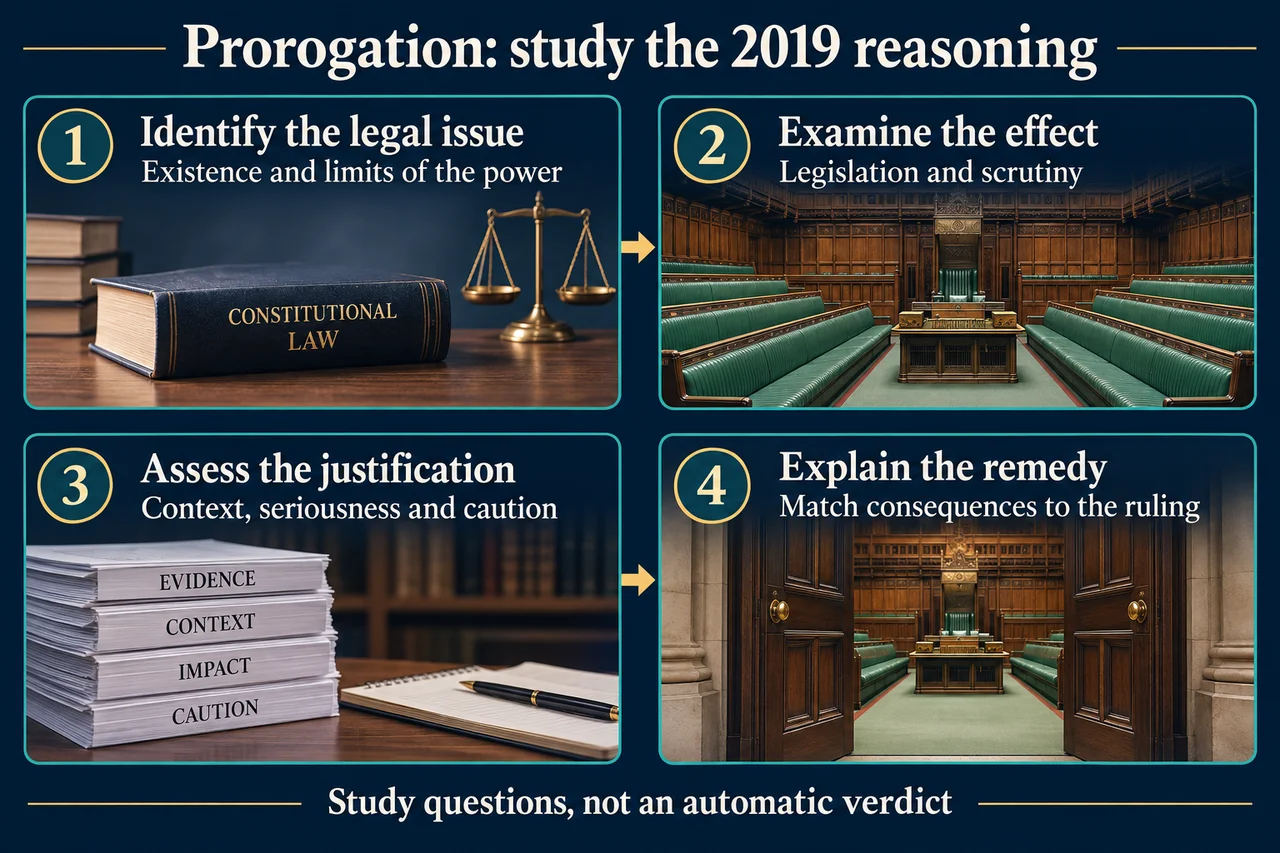
Image: illustration, not a documentary photograph. Original generated constitutional study aid, not an official institutional diagram or automatic legal verdict. · Original generated project artwork; no source-edition figures or documentary photographs reused.
Original model: Evaluate the argument that judicial review of the 2019 prorogation undermined the separation of powers
The argument deserves consideration because the case concerned a politically sensitive decision about Parliament's timetable. Courts should not simply substitute their preferences for the executive's policy choices. However, identifying political consequences is not enough to establish a violation of the separation of powers. The central questions are what function the court performed and whether the decision protected or displaced the proper functions of the other institutions.
The government's objection placed weight on political accountability and the danger of courts entering a political arena. The court's reasoning answered this by distinguishing the legal existence and limits of a prerogative power from a review of how a power was exercised within those limits. Determining a legal boundary was treated as a judicial function. This matters because the argument for non-intervention could not merely assume that a power was unlimited and then present every possible boundary as an inappropriate policy choice.
The court also connected the boundary to parliamentary sovereignty and accountability. A power capable of stopping legislation and scrutiny for an unlimited period would threaten Parliament's functions. During prorogation, the ordinary mechanisms of holding ministers to account cannot operate in the same way. The court therefore argued that political accountability was not a complete answer to the legal challenge, particularly where the decision itself impeded that accountability. On this reasoning, intervention supported institutional separation by preventing one branch from disabling another's constitutional work.
There is nonetheless an evaluative difficulty. Assessing effects, justification and seriousness involves judgment, and critics may question how far courts should go when weighing an executive explanation. A strong defence of the ruling must retain the safeguards in the actual standard: the court recognised ordinary short prorogations, required sufficiently serious effects and emphasised sensitivity to the Prime Minister's responsibilities. Deleting those qualifications would turn a particular exceptional intervention into a much broader claim of judicial management of parliamentary scheduling.
The application and remedy support a qualified conclusion. The court did not adjudicate the merits of Brexit, and it did not need to decide the alternative motive challenge. It found that the evidence did not justify the five-week interruption, then addressed the consequences of unlawful advice, the Order in Council and prorogation. The Houses' next steps remained for parliamentary authorities. Thus the judgment can be criticised over the scope of legal reasoning without being accurately described as judges taking over legislation or government. On the court's stated rationale, it protected Parliament's capacity to perform its own functions; it did not claim unrestricted control over the executive's policy programme.
Worked example: Evaluate whether review of the 2019 prorogation displaced the functions of Parliament or government.
State the political-accountability objection before analysing the court’s legal-limits response.
Retain effect, reasonable justification, sufficient seriousness and executive caution.
Relate the specific evidence and remedy to institutional separation, without inventing a motive finding.
Answer: The application and remedy support a qualified conclusion. The court did not adjudicate the merits of Brexit, and it did not need to decide the alternative motive challenge. It found that the evidence did not justify the five-week interruption, then addressed the consequences of unlawful advice, the Order in Council and prorogation. The Houses' next steps remained for parliamentary authorities. Thus the judgment can be criticised over the scope of legal reasoning without being accurately described as judges taking over legislation or government. On the court's stated rationale, it protected Parliament's capacity to perform its own functions; it did not claim unrestricted control over the executive's policy programme.
Check your understanding: Does the model say every short prorogation is unlawful?
Answer: No. It retains ordinary short prorogation, seriousness and reasonable justification; the conclusion depends on the case evidence.
Why: A complete argumentative model remains unmarked original practice, not proof of all assessed demands.