Changed-case essay: dissolution versus prorogation
By UK A Level Politics · independent study · myAudience
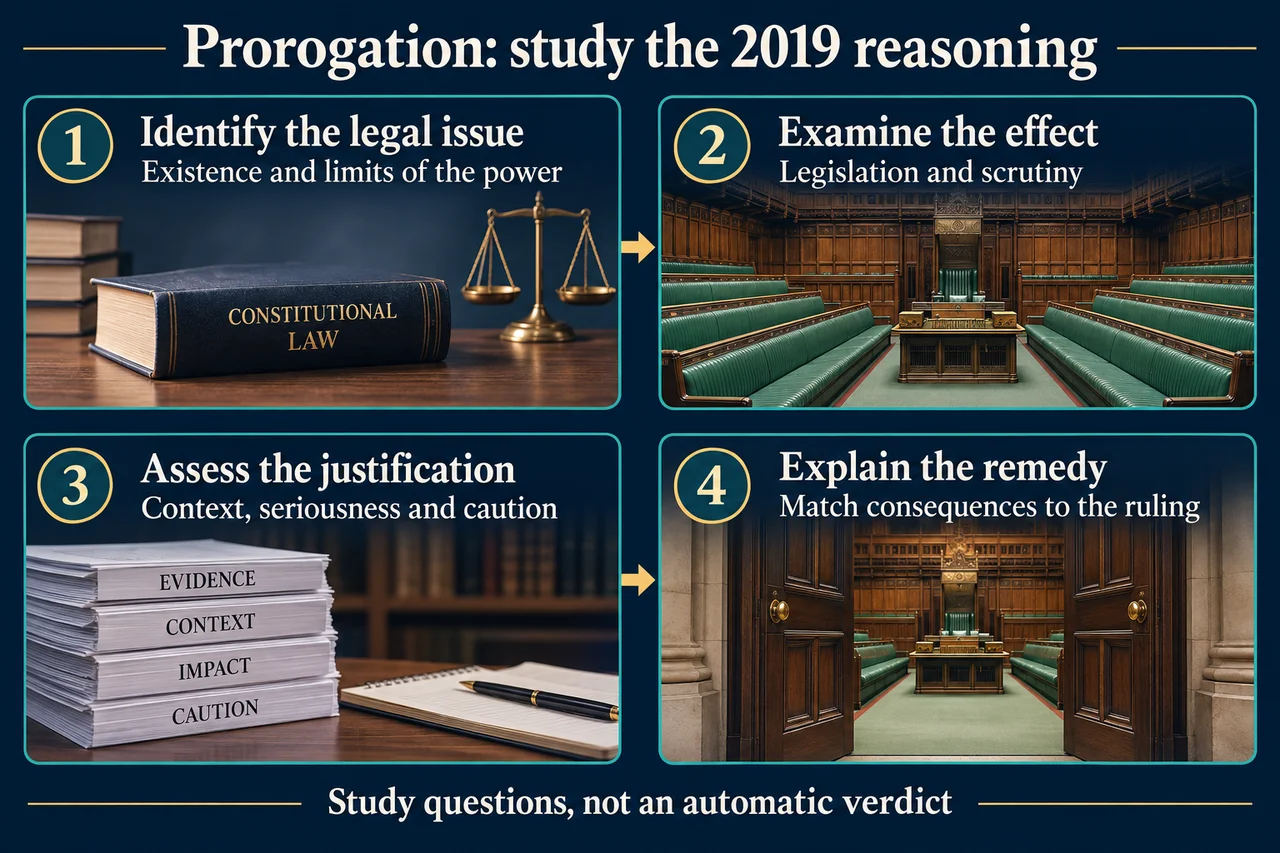
Image: illustration, not a documentary photograph. Original generated constitutional study aid, not an official institutional diagram or automatic legal verdict. · Original generated project artwork; no source-edition figures or documentary photographs reused.
Changed-case essay: dissolution versus prorogation
The conclusion confuses different powers and different dates. The 2019 case addressed the legal limits of prorogation under the circumstances before the court. The 2022 Act's enacted provisions concern revived powers of dissolution and calling a new Parliament, with a specific non-justiciability clause for those powers. A student cannot transfer that clause to another power merely because both affect Parliament's timetable.
Dissolution ends a Parliament; prorogation ends a session. That functional distinction matters to both the applicable law and the institutional consequences. To establish the proposed conclusion, the argument would need a legal connection between the later statute and the earlier prorogation issue, rather than a shared topic or a general preference for executive discretion. The enacted text does not make its dissolution terminology interchangeable with every prerogative power.
The later statute is still useful evidence for constitutional debate. It shows that Parliament legislated on dissolution and made an express choice about court scrutiny of the specified powers. It can prompt questions about how statutory wording interacts with judicial reasoning and what balance of accountability legislators prefer. But it does not retroactively demonstrate that the 2019 court lacked jurisdiction over a different legal issue. The sound answer identifies the scope and chronology before evaluating the wider political implications; a full current-law conclusion would also require revised-law and subsequent-authority checks beyond this lesson.
Worked example: “The 2022 dissolution legislation proves that the 2019 court had no authority to consider prorogation.” Evaluate the reasoning.
Separate 2019 prorogation from 2022 dissolution and calling powers.
Require an actual statutory connection rather than transferring an ouster provision across powers.
Keep later policy debate distinct from a retrospective jurisdictional conclusion.
Answer: The later statute is still useful evidence for constitutional debate. It shows that Parliament legislated on dissolution and made an express choice about court scrutiny of the specified powers. It can prompt questions about how statutory wording interacts with judicial reasoning and what balance of accountability legislators prefer. But it does not retroactively demonstrate that the 2019 court lacked jurisdiction over a different legal issue. The sound answer identifies the scope and chronology before evaluating the wider political implications; a full current-law conclusion would also require revised-law and subsequent-authority checks beyond this lesson.
Check your understanding: Can the 2022 dissolution clause be applied automatically to every prerogative power?
Answer: No. Its specified powers and chronology must be examined; shared effects on Parliament’s timetable are insufficient.
Why: The full paragraphs above answer the altered argument with qualified evidence; subsequent authority and wider assessed work remain open.