A travelling wave moves energy, not the medium
By UK A Level Physics · independent study · myAudience
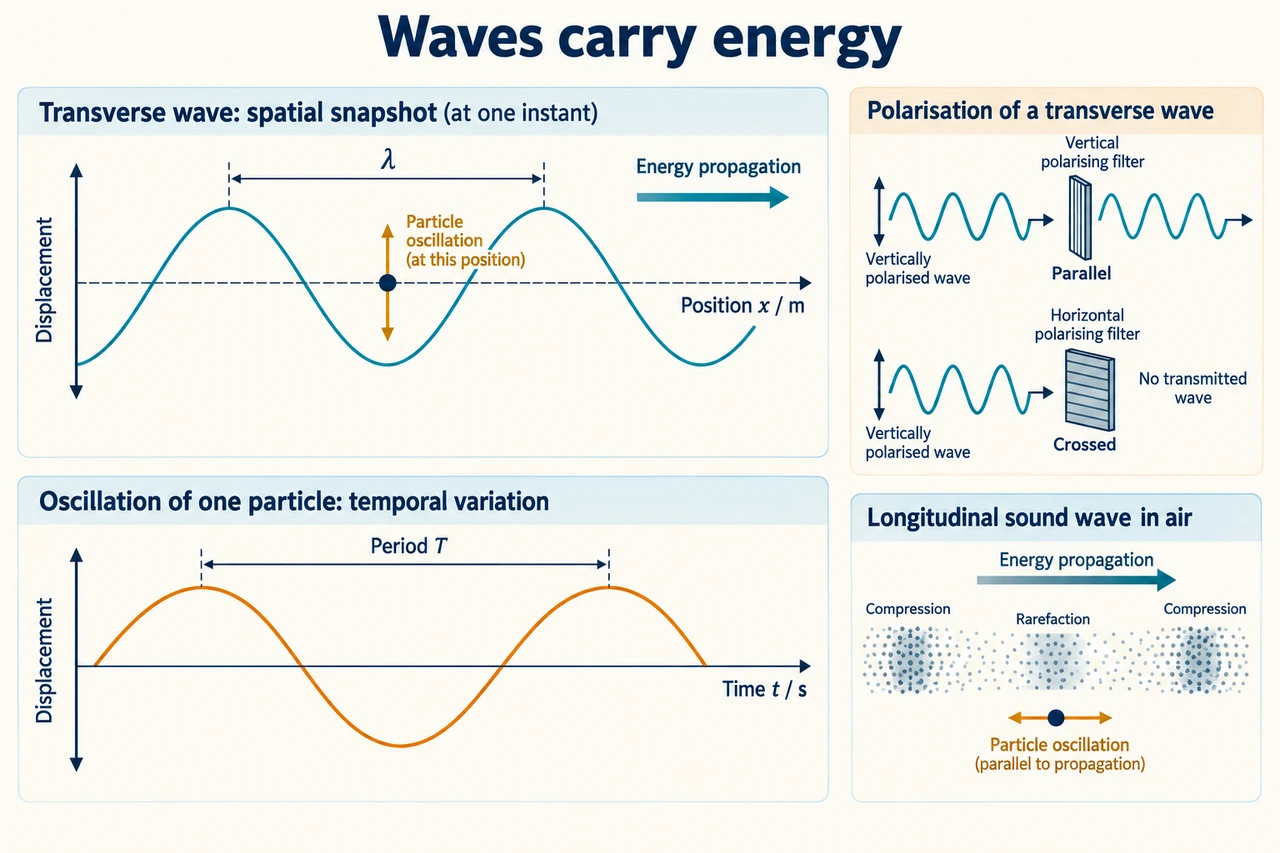
Image: illustration, not a documentary photograph. A travelling wave transfers energy while the medium oscillates locally. Spatial and temporal graphs have different axes; polarisation selects transverse field directions. · Operator-authored generated illustration; scientific model and source limits reviewed separately.
A travelling wave moves energy, not the medium
A wave lets one region disturb another without carrying the whole medium along with it. When a pulse travels down a taut string, a marked piece of string moves away from its equilibrium position and back; it does not race to the far end with the pulse. Disturbances transfer energy through the interactions between neighbouring parts. Keep three descriptions separate: the direction in which the pattern propagates, the direction in which a particle or field oscillates, and the speed of that oscillation. They answer different questions. Our examples assume small disturbances in a uniform medium whose properties stay constant, rather than a string changing tension while we observe it.
A displacement–position graph is a snapshot of many positions at one instant. A displacement–time graph follows one position through successive instants. Their curves can look similar, but their horizontal axes have different units and meanings. Wavelength λ is the distance between corresponding points on successive cycles of a spatial graph, such as crest to crest. Period T is the time between corresponding stages at one position. Amplitude is the greatest displacement from equilibrium, not the crest-to-trough separation, which is twice the amplitude for a symmetric oscillation. A particle at the top of the snapshot is not necessarily staying there; a later snapshot can put it elsewhere.
Frequency f counts cycles per second and is measured in hertz. One period contains one cycle, so f = 1/T. In one period a progressive pattern advances one wavelength; its propagation speed is therefore v = λ/T = fλ. The symbol c is also used for wave speed in the specification, but here v avoids confusing a string speed with vacuum light speed. These equations connect the same wave and the same medium. If a driving frequency changes while the medium speed remains fixed, wavelength must change inversely. A larger amplitude alone does not require a larger propagation speed in the small-disturbance model.
Phase says where an oscillation has reached within its repeating cycle. At one instant, a separation Δx along a sinusoidal progressive wave corresponds in magnitude to Δx/λ cycles, or 360Δx/λ degrees, or 2πΔx/λ radians. At one position, a time separation Δt gives fΔt cycles. Specify the comparison before calculating: a spatial snapshot and a temporal delay are not interchangeable data. One complete cycle is both 360 degrees and 2π radians. Phase differences differing by a whole number of cycles describe the same relative stage. Direction determines which point leads; a quoted magnitude alone does not identify the leading point.
In a transverse wave, the oscillation is perpendicular to the direction of propagation. The string's up-and-down displacement is an example. In a longitudinal wave, the displacement is parallel to propagation: sound in air creates changing compressions and rarefactions while molecules oscillate around their local positions. A compression travels through the gas; it is not a permanently compressed parcel being carried to the listener. A drawing of a longitudinal wave as a sine curve usually graphs pressure or displacement against position, not a sideways shape of the gas. State what the vertical axis means before using the drawing as evidence.
Electromagnetic waves need no material medium. Their electric and magnetic fields vary transversely to the propagation direction, so the marked object in a field diagram is not a molecule being shaken. All electromagnetic frequencies have the same speed c in vacuum; radio and visible light differ in frequency and wavelength, not vacuum speed. In a material, propagation can depend on frequency and the material itself, which later refraction lessons will examine. That distinction prevents a useful vacuum relationship from becoming a claim that every wave travels equally quickly through glass, water, air and a string.
Polarisation selects a direction of transverse oscillation. An ideal linear polariser transmits the field component along its transmission direction; a second ideal polariser crossed at a right angle blocks that component. Real filters can leak or absorb light, so complete darkness is an ideal-model statement, not an unconditional specification for a product. An aligned transmitting and receiving aerial offers another application of direction-sensitive transverse electromagnetic fields. Ordinary longitudinal sound in a fluid has no corresponding choice between two transverse oscillation directions, so the same polarisation test does not apply. This study topic includes this directional reasoning; a numerical Malus-law intensity calculation is outside the stated requirement.
To estimate a wave speed, decide whether the data measure travel over a known distance or relate frequency to a spatial pattern. A microphone timing comparison needs a defined separation, a clear event and treatment of electronic delays and echoes. Timing several cycles can reduce the relative influence of a fixed timing resolution, but it cannot remove an uncorrected shared clock or distance offset. In the illustration, the vertical oscillation arrow and the separate propagation arrow deliberately have different meanings. The blue position marker sits on the equilibrium reference line; it is not the instantaneous displaced point on the drawn string. The graph panels and sound inset are explanatory drawings, not experimental traces. Reading them prepares method and uncertainty reasoning; it does not demonstrate apparatus use or a completed practical.
Worked example: A stipulated sinusoidal string wave has frequency 50 Hz, wavelength 0.80 m and amplitude 4.0 mm. Find its propagation speed and period, compare phase at two positions 0.10 m apart at one instant, then compare phase at one position 0.005 s apart. Explain what the speed does not describe.
Identify the model before substituting. The wave is progressive and sinusoidal in a uniform string, and the given wavelength belongs to the given 50 Hz drive. Convert amplitude to 0.0040 m if needed; it is not a distance travelled by the wave in one period and does not enter v = fλ.
Propagation speed is v = 50 × 0.80 = 40 m/s. A unit check gives cycles/s multiplied by metres/cycle. This is the speed of a constant-phase feature through the string, not a constant horizontal velocity assigned to a piece of the string.
Period is T = 1/50 = 0.020 s. During one period the pattern advances 0.80 m; multiplying 40 m/s by 0.020 s recovers the supplied wavelength. This second relationship checks that frequency, wavelength and speed describe one internally consistent wave.
For the spatial comparison, Δx/λ = 0.10/0.80 = 0.125 cycle. Multiplying by 360 gives 45°, and by 2π gives π/4 rad. These are alternative units for the same phase-difference magnitude, not three independent physical results.
For the temporal comparison at one position, fΔt = 50 × 0.005 = 0.25 cycle. The difference is 90° = π/2 rad. The time interval is one quarter of the period, while the spatial separation was only one eighth of a wavelength, so their phase differences need not match.
The marked string element oscillates transverse to propagation and reaches displacements between −4.0 and+4.0 mm. Its vertical velocity changes through the cycle; it is not moving horizontally at 40 m/s. Which of two spatial points leads also depends on propagation direction, which the magnitude calculation alone did not specify.
Answer: Wave speed 40 m/s; period 0.020 s; spatial phase magnitude 45° = π/4; temporal phase magnitude 90° = π/2. The speed describes pattern propagation, not transport of a string element.
Check your understanding: The same uniform medium is driven at 80 Hz while its propagation speed remains 40 m/s. A learner says that both the old 0.10 m spatial separation and a new 0.003125 s temporal delay must still represent 90°. Calculate each comparison, and explain whether a crossed polariser test changes the vacuum speed of light.
Answer: The new wavelength is 40/80 = 0.50 m and the new period is 1/80 = 0.0125 s. The spatial separation is 0.10/0.50 = 0.20 cycle, so its phase magnitude is 72° = 0.4π rad. The temporal delay is 80 × 0.003125 = 0.25 cycle, so its phase magnitude is 90° = π/2 rad. The learner has treated two different comparisons as if their fractions of a cycle were the same. A crossed-polariser test selects or rejects a transverse field component; it does not establish a change in the vacuum propagation speed of transmitted light. A real filter can introduce material effects, but those are separate from the claim that polarisation itself changes vacuum c.
Why: Use the unchanged medium speed to recalculate wavelength, then identify whether the supplied separation is spatial or temporal. The physical direction selected by a polariser must not be confused with propagation speed.