Conserve system momentum while kinetic energy changes
By UK A Level Physics · independent study · myAudience
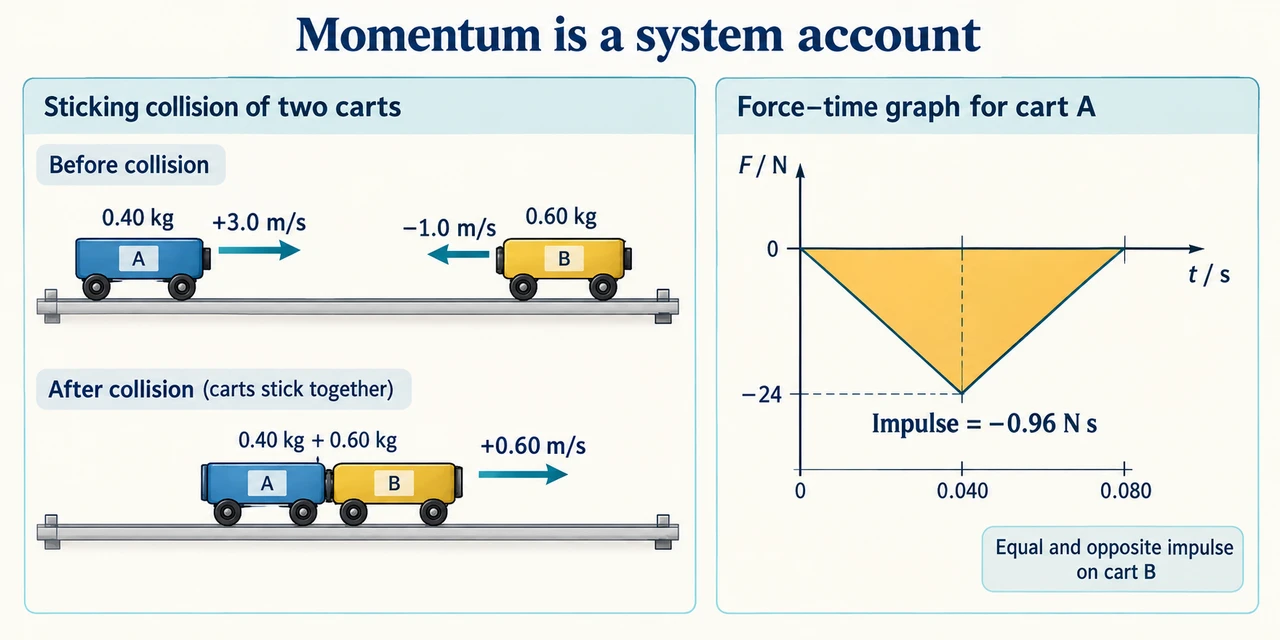
Image: illustration, not a documentary photograph. Cart momentum is conserved for an isolated system; a signed force–time area gives impulse. · Operator-authored generated illustration; scientific model and source limits reviewed separately.
Conserve system momentum while kinetic energy changes
Momentum is mass multiplied by velocity, p = mv in the nonrelativistic model used here. It is a vector, so one-dimensional problems use signs to preserve direction. A cart travelling left and one travelling right can have momenta that partly cancel even though both move rapidly. The system's total momentum is conserved when its net external impulse is zero or negligible over the interval. Name the system before using that condition. Track forces between its parts as internal, and separately consider forces exerted by objects outside it. A short collision can make some external impulses small, but short duration alone does not prove they are negligible.
During a collision, contact forces on two interacting bodies are equal and opposite. Their impulses change the individual momenta by equal and opposite amounts, leaving the combined momentum unchanged when external impulse is negligible. That does not mean either body's velocity stays fixed. Their masses may differ, so equal momentum changes produce different velocity changes. For two carts that stick, both have one common final velocity, and the initial signed momentum equals their combined mass multiplied by that velocity. Adding the incoming speeds without signs or assigning the final velocity of one cart to the total mass before sticking would use the wrong physical account.
Momentum conservation does not guarantee conservation of kinetic energy. An elastic collision conserves total kinetic energy as well as momentum in the specified isolated model; an inelastic collision transfers some kinetic energy into other forms. Sticking is a useful completely inelastic example. Energy itself is not destroyed: deformation, internal motion and heating can receive the difference. Conversely an explosion can increase the parts' total kinetic energy by converting stored internal energy while their combined momentum remains unchanged. Calculate the kinetic-energy account with squared speeds and the momentum account with signed velocities. Their different mathematics reflects different physical quantities, not a contradiction. As a supplied alternative final state for the worked carts, velocities −1.8 m/s and +2.2 m/s give total momentum 0.40(−1.8) + 0.60(2.2) = +0.60 kg m/s and kinetic energy 0.648 + 1.452 = 2.10 J: both accounts match, consistent with an elastic collision in the stated one-dimensional model. For an original ideal explosion illustration, a stationary system separates into 0.20 kg travelling at+3.0 m/s and 0.30 kg at −2.0 m/s. The momenta sum to zero, while the kinetic energies sum to 1.50 J supplied by an internal energy decrease. These examples check different energy accounts without assuming a balanced momentum ledger predicts which outcome occurs.
Force is the rate of change of momentum. A constant resultant force acting for timeΔt produces impulse FΔt equal to the change in momentum. If force varies, the impulse is the signed area under its force–time graph. A triangular pulse uses half its base times its signed height; its peak is not the constant force that would produce the same impulse over the same time. Average force equals impulse divided by duration. A graph label must specify the body receiving the force and the positive direction. A negative area means a momentum change in the negative direction, not a negative duration or a failure of energy conservation.
For a fixed change in momentum, a longer contact time gives a smaller average force. Peak force still depends on the time profile: two pulses with the same area and duration can have different peaks. A rectangular pulse has peak equal to its average, whereas a symmetric triangular pulse has peak twice its average magnitude. Real impact curves can contain several peaks and changing directions. Measuring only contact time does not reveal the complete waveform, and measuring only the largest force does not give the impulse unless the rest of the graph is known. Use the supplied shape rather than inventing one to finish a calculation.
Transport design uses momentum and energy reasoning alongside material behaviour, geometry and the motion of occupants or objects. A crumple region can extend stopping time and transfer energy through deformation, but the benefit depends on the actual collision and the protected person's deceleration. A toy cart result is not an injury threshold, crash certification or instruction to modify safety equipment. Ethical decisions include the people outside the vehicle, accessibility, repair implications and the evidence used to compare risks. The physical model can explain one mechanism while leaving those broader engineering and social decisions open for proper investigation.
The earlier particle lessons required complete momentum and energy accounts for photons and reactions. Here p = mv describes slow macroscopic objects, so it must not be copied into a photon calculation or an unqualified near-light-speed example. The useful connection is the discipline of selecting a system, including relevant participants and checking every conservation account. In the worked collision, the carts' equal and opposite impulses are internal to the combined system. A force–time pulse on the first cart is therefore not added as an external impulse on both carts together. Changing that boundary would change which force account is being calculated.
The illustration names the cart masses and signed velocities, then shows the force on the first cart as a negative triangular pulse. Its shaded area is an impulse, not work: force multiplied by time has unit N s, equivalent to kg m/s, whereas work needs force and displacement. Generated cart positions and curves are schematic and are not calibrated recordings. Our original and changed problems test sticking, reversal, sign, pulse shape and energy transfer. They do not complete the separate work/power or full energy-conservation sections merely because kinetic energy appears. Performed practical skills, assessed mastery and complete qualification coverage remain separate open requirements.
Worked example: A 0.40 kg cart moving at+3.0 m/s meets a 0.60 kg cart moving at −1.0 m/s and they stick. Assume negligible external impulse. Find their common velocity and kinetic-energy transfer. For the first cart, compare its momentum change with a triangular force pulse of duration 0.080 s and peak −24 N.
Take both carts as the system and rightwards as positive. Initial total momentum is 0.40 × 3.0 + 0.60 × (−1.0) = +0.60 kg m/s. The negative sign is essential: adding the speeds as positive would describe different incoming motion.
After sticking, combined mass is 1.00 kg and both carts have common velocity v. Conservation gives 1.00 v = 0.60, so v = +0.60 m/s. The combined system continues rightwards even though the second cart initially moved left; individual velocities do not have to be conserved.
Initial kinetic energy is (1/2)(0.40)(3.0²) + (1/2)(0.60)(1.0²) = 1.80 + 0.30 = 2.10 J. Squaring the negative velocity makes its kinetic-energy contribution positive. Final kinetic energy is (1/2)(1.00)(0.60²) = 0.18 J.
The difference 2.10 − 0.18 = 1.92 J transfers to forms such as internal energy and deformation in this inelastic process. It is not missing total energy and does not invalidate the momentum result. No supplied information divides that transfer among heating, sound and different deformations.
For the first cart alone, Δp = 0.40(0.60 − 3.0) = −0.96 kg m/s. The second cart changes by 0.60(0.60 − (−1.0)) = +0.96 kg m/s. Their changes cancel in the combined account, while each has a nonzero individual impulse.
The signed triangular pulse area is (1/2)(0.080)(−24) = −0.96 N s, matching the first cart's change. Average force is −0.96/0.080 = −12 N, half the triangular peak. The supplied waveform is consistent with that impulse, but it is a model rather than a recorded collision trace.
Answer: Common velocity+0.60 m/s; kinetic energy changes from 2.10 to 0.18 J, transferring 1.92 J internally. First-cart impulse −0.96 N s, matched by the triangle; average −12 N and peak −24 N.
Check your understanding: A 0.20 kg ball reverses from+4.0 to −3.0 m/s. A triangular force pulse lasts 0.020 s. Find momentum change, average force and peak force, then compare a rectangular pulse with the same impulse and duration. Does the calculation establish an injury risk, or prove that the ball's momentum was conserved by itself?
Answer: Momentum change is 0.20(−3.0 − 4.0) = −1.40 kg m/s. The change of velocity is −7.0 m/s, not −1.0 m/s; reversal requires preserving both signs. Average force is −1.40/0.020 = −70 N. For the stipulated triangle, area is half base times height, so peak is −140 N. A rectangle with the same area and duration has constant force −70 N, giving a smaller peak magnitude even though its impulse is identical. The ball's own momentum is not conserved because it receives an external impulse; including the interacting object can make a larger system's momentum account appropriate. Initial and final ball kinetic energies are 1.60 and 0.90 J, but the 0.70 J difference alone does not locate every energy transfer. Neither impulse nor peak force in this simplified model determines injury risk or certifies a safety design.
Why: Keep signed velocity changes, the chosen system and the force profile explicit. Equal impulse does not establish equal peaks, identical energy transfer or an actual safety outcome.