A conceded fact can still use the subjunctive
By UK A Level Spanish · independent study · myAudience
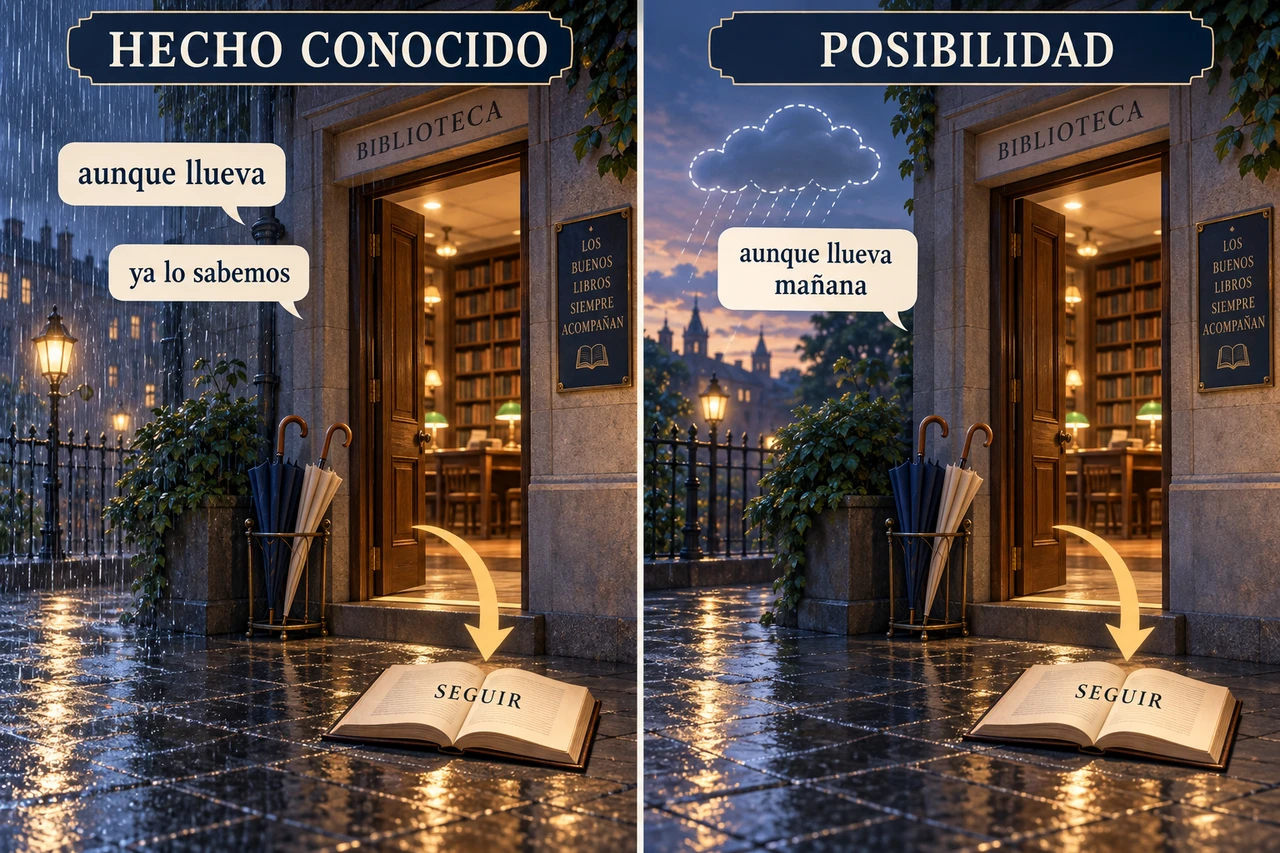
Image: illustration, not a documentary photograph. Context distinguishes acknowledged rain from an open future possibility; subjunctive alone does not mean an obstacle is false. The wet setting and outlined cloud are schematic, not a forecast. · Original operator-generated illustration; no institutional artwork or edition illustrations copied.
A conceded fact can still use the subjunctive
A concession recognises a possible obstacle while maintaining another conclusion. It does not have the same logical role as a cause. In an original sentence, aunque el curso cuesta dinero, asistiré, the cost is presented as a fact that does not prevent attendance. Porque would instead offer a reason. Translate the relation between ideas before choosing the verb ending. A sentence can be grammatically formed and still mistranslate the speaker's argument if it turns an obstacle into a motive or makes a qualified commitment unconditional.
The indicative can assert information as part of the speaker's account. In aunque llueve, salimos, the rain is presented as a current fact alongside the decision to go out. The subjunctive can leave a condition open: aunque llueva mañana, saldremos. Here the commitment does not depend on whether tomorrow's rain occurs. These are useful contrasts, but they are not a complete equation between indicative and reality, or subjunctive and unreality. Mood also depends on what information is already shared and how the speaker treats it within the exchange.
Imagine a dialogue in which both speakers can see the rain. One says está lloviendo; the other replies aunque esté lloviendo, vamos a salir. The second speaker need not deny the weather or express uncertainty about it. They can accept the already introduced information while treating it as insufficient to change the decision. This is a concession to known or presupposed information. A careful English rendering might be even though it is raining, we are going out. Automatically translating esté as might be raining would introduce doubt that this context does not require.
Time and assertion must be checked separately. Compare aunque el taller fue caro, aprendimos mucho with aunque el taller haya sido caro, no me arrepiento de haber asistido. The first presents a past expense and a past result. The second can acknowledge the already discussed expense from the standpoint of a current evaluation. Its compound subjunctive does not erase the past event. Our examples establish a contextual reading, not a rule that these are the only possible combinations. Reconstruct who knows what, when the event takes place, and what conclusion survives the concession.
Do not use the known-information explanation as a licence to insert any subjunctive tense. In aunque llueva mañana, iremos, the present subjunctive has future reference through mañana and the context. In aunque lloviera mañana, iríamos, the imperfect subjunctive and conditional can frame a more hypothetical scenario. This lesson practises the first pattern and recognises the contrast; it does not complete the full sequence-of-tense inventory. The choice must fit the intended stance as well as the time, so a verb chart alone cannot establish the appropriate sentence.
Concession can alter the strength of a claim. Although the tickets are expensive, I will buy one recognises a specific obstacle. Even if tickets become expensive, I will buy one presents a commitment that extends to a possibility. Even though you already told me the tickets are expensive, I will buy one can concede shared information without announcing it again as the main news. English and Spanish do not divide these readings into a perfectly identical set of labels. Preserve the context and commitment; avoid a rigid one-word translation table.
An effective translation procedure has four checks. First, underline the main commitment. Second, identify the obstacle and whether the passage asserts it, leaves it open or treats it as already acknowledged. Third, keep its time reference visible. Fourth, reread the translated sentence as an argument: does the main commitment still hold despite the obstacle? This method transfers to a new passage without requiring its vocabulary to match a memorised example. Where the context permits more than one reading, explain your chosen interpretation instead of declaring every other grammatical version incorrect.
Worked example: two people have already established that a museum closes early. One says, 'Even though it closes early, I still want to visit it.' Step 1: the closing time is shared information, not a predicted possibility. Step 2: the wish to visit remains. Step 3: choose a present-time concession whose context acknowledges that fact. Answer: aunque cierre temprano, sigo queriendo visitarlo is defensible in this dialogue. Aunque cierra temprano, sigo queriendo visitarlo is also grammatical if the speaker reasserts the closing time as information. A full answer identifies the difference in presentation; it must not invent a difference in the actual museum schedule.
Worked example: two people have already established that a museum closes early. One says, 'Even though it closes early, I still want to visit it.'
the closing time is shared information, not a predicted possibility.
the wish to visit remains.
choose a present-time concession whose context acknowledges that fact.
Answer: aunque cierre temprano, sigo queriendo visitarlo is defensible in this dialogue. Aunque cierra temprano, sigo queriendo visitarlo is also grammatical if the speaker reasserts the closing time as information. A full answer identifies the difference in presentation; it must not invent a difference in the actual museum schedule.
Check your understanding: For the museum in the original worked example, the conversation has no established closing time and instead says 'Even if it closes early tomorrow, I will visit it.'
Answer: aunque cierre temprano mañana, lo visitaré preserves the open future possibility and commitment. Translating it as although it definitely closes early tomorrow would add certainty. The same verb form can serve different contextual readings; the evidence lies in the whole exchange, not in the ending alone.
Why: aunque cierre temprano mañana, lo visitaré preserves the open future possibility and commitment. Translating it as although it definitely closes early tomorrow would add certainty. The same verb form can serve different contextual readings; the evidence lies in the whole exchange, not in the ending alone.