Check and changed task: A conceded fact can still use the subjunctive
By UK A Level Spanish · independent study · myAudience
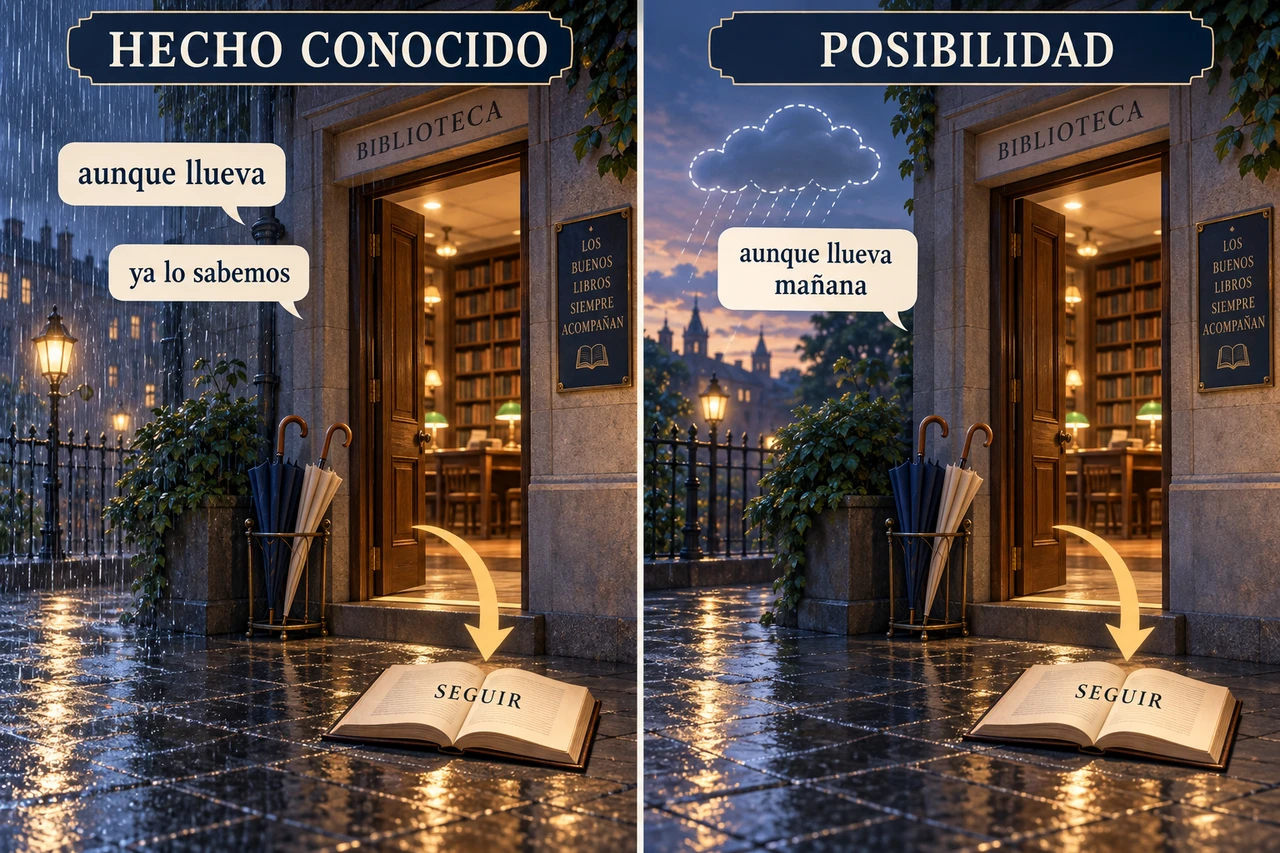
Image: illustration, not a documentary photograph. Context distinguishes acknowledged rain from an open future possibility; subjunctive alone does not mean an obstacle is false. The wet setting and outlined cloud are schematic, not a forecast. · Original operator-generated illustration; no institutional artwork or edition illustrations copied.
Check and changed task: A conceded fact can still use the subjunctive
Check: does a subjunctive after aunque prove that the obstacle is false? Answer: no. In a suitable dialogue, it can acknowledge a known fact and minimise its force as an objection. Changed task: the conversation has no established closing time and instead says 'Even if it closes early tomorrow, I will visit it.' Answer: aunque cierre temprano mañana, lo visitaré preserves the open future possibility and commitment. Translating it as although it definitely closes early tomorrow would add certainty. The same verb form can serve different contextual readings; the evidence lies in the whole exchange, not in the ending alone.
An effective translation procedure has four checks. First, underline the main commitment. Second, identify the obstacle and whether the passage asserts it, leaves it open or treats it as already acknowledged. Third, keep its time reference visible. Fourth, reread the translated sentence as an argument: does the main commitment still hold despite the obstacle? This method transfers to a new passage without requiring its vocabulary to match a memorised example. Where the context permits more than one reading, explain your chosen interpretation instead of declaring every other grammatical version incorrect.
Worked example: For the museum in the original worked example, the conversation has no established closing time and instead says 'Even if it closes early tomorrow, I will visit it.'
aunque cierre temprano mañana, lo visitaré preserves the open future possibility and commitment.
Translating it as although it definitely closes early tomorrow would add certainty.
The same verb form can serve different contextual readings; the evidence lies in the whole exchange, not in the ending alone.
Answer: aunque cierre temprano mañana, lo visitaré preserves the open future possibility and commitment. Translating it as although it definitely closes early tomorrow would add certainty. The same verb form can serve different contextual readings; the evidence lies in the whole exchange, not in the ending alone.
Check your understanding: does a subjunctive after aunque prove that the obstacle is false?
Answer: no. In a suitable dialogue, it can acknowledge a known fact and minimise its force as an objection.
Why: An effective translation procedure has four checks. First, underline the main commitment. Second, identify the obstacle and whether the passage asserts it, leaves it open or treats it as already acknowledged. Third, keep its time reference visible. Fourth, reread the translated sentence as an argument: does the main commitment still hold despite the obstacle? This method transfers to a new passage without requiring its vocabulary to match a memorised example. Where the context permits more than one reading, explain your chosen interpretation instead of declaring every other grammatical version incorrect.