Translation 1 — English into Spanish — full source, model and six decisions
By UK A Level Spanish · independent study · myAudience
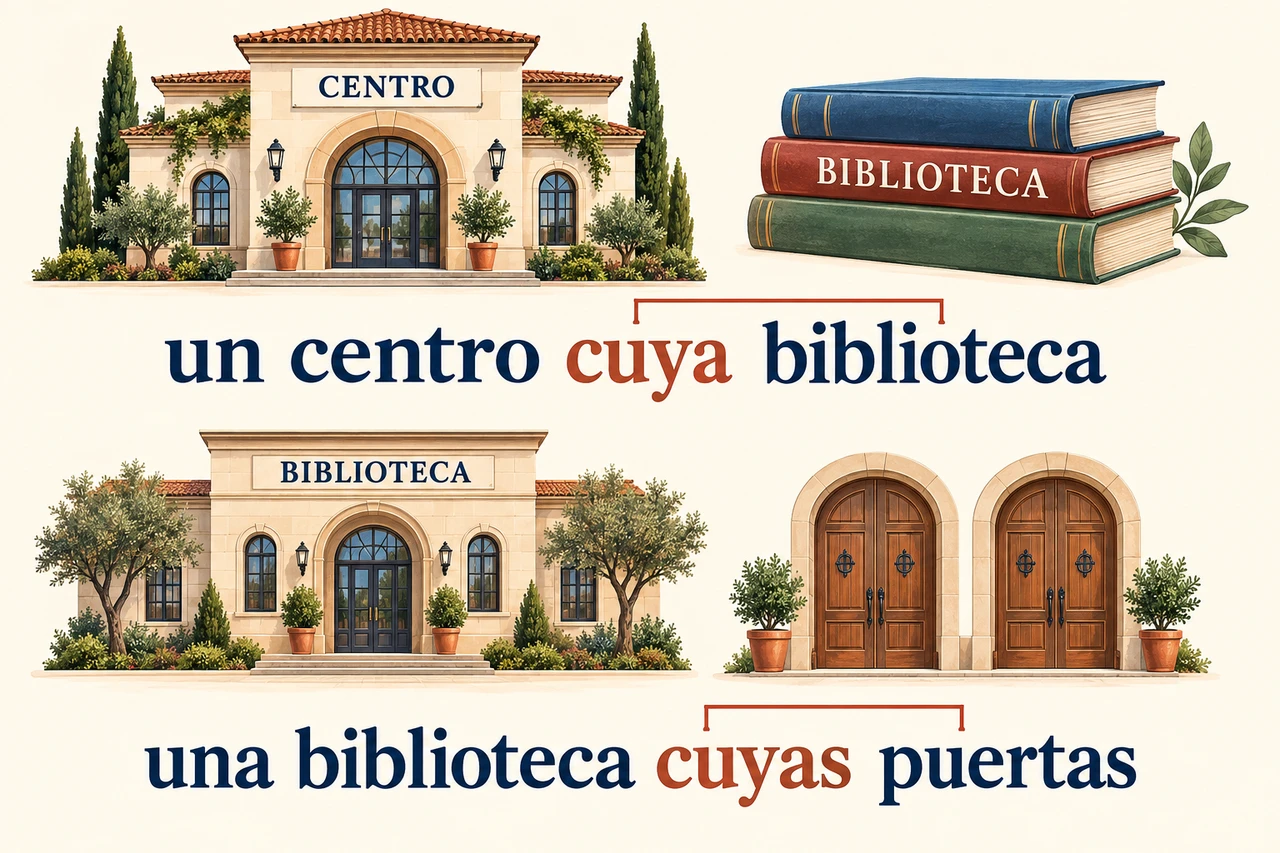
Image: illustration, not a documentary photograph. The relative determiner agrees with the following noun: biblioteca or puertas. Phrase fragments illustrate agreement, not complete declarative sentences or real institutions. · Original operator-generated illustration; no institutional artwork or edition illustrations copied.
Translation 1 — English into Spanish — full source, model and six decisions
Last week, our group visited a small cultural centre whose library had recently reopened. The guide, whose colleagues had organised the visit, explained that some workshops were free, although the centre needed money to repair its roof. We were looking for a room where we could discuss the books without disturbing other visitors. The only available room was rather small, but everyone could sit down. Before leaving, I asked whether students would be able to return on Saturdays. The guide said that the timetable had not yet been confirmed. Even if the centre closes early next month, I will try to return, because I would like to learn more about the people whose stories appear in the exhibition.
La semana pasada, nuestro grupo visitó un pequeño centro cultural cuya biblioteca había vuelto a abrir recientemente. La guía, cuyos compañeros habían organizado la visita, explicó que algunos talleres eran gratuitos, aunque el centro necesitaba dinero para reparar el tejado. Buscábamos una sala donde pudiéramos comentar los libros sin molestar a otros visitantes. La única sala disponible era bastante pequeña, pero todos podían sentarse. Antes de marcharme, pregunté si los estudiantes podrían volver los sábados. La guía dijo que todavía no se había confirmado el horario. Aunque el centro cierre temprano el mes que viene, intentaré volver, porque me gustaría saber más sobre las personas cuyas historias aparecen en la exposición.
1. Biblioteca determines cuya; compañeros determines cuyos; historias determines cuyas. Matching the relative form to centro, guía or personas would test the wrong noun. The first relative identifies the centre; the second adds information about the already introduced guide, so the model retains its commas.
2. Había vuelto a abrir preserves reopening before the visit. Había reabierto is another concise option. Simply abre would move the event to present time and remove the sequence. Algunos talleres preserves some, rather than asserting that every workshop was free.
3. Buscábamos frames the ongoing search. Donde pudiéramos describes a sought suitable room within that past-time search; it does not assert that a room had already been found when the search began. This is an additional relative-clause application requiring review, not complete mastery of every subjunctive relative.
4. Tejado is a natural roof choice in this context; techo may be acceptable where it preserves the intended meaning. The fictional passage does not locate the centre in a particular country, so the model does not declare one regional noun uniquely correct.
5. Si introduces the indirect yes/no question, not an if-condition imposing a result. Podrían retains future possibility viewed from the past question. The model chooses a female guide; el guía and corresponding masculine reference are equally acceptable because the English does not specify gender.
6. Aunque cierre gives the open future concession required by even if, with el mes que viene retaining its time. Me gustaría preserves would like, rather than making it a promise that the learning will definitely occur. Personal preference and future certainty are different meanings.
Worked example: Last week, our group visited a small cultural centre whose library had recently reopened. The guide, whose colleagues had organised the visit, explained that some workshops were free, although the centre needed money to repair its roof. We were looking for a room where we could discuss the books without disturbing other visitors. The only available room was rather small, but everyone could sit down. Before leaving, I asked whether students would be able to return on Saturdays. The guide said that the timetable had not yet been confirmed. Even if the centre closes early next month, I will try to return, because I would like to learn more about the people whose stories appear in the exhibition.
1. Biblioteca determines cuya; compañeros determines cuyos; historias determines cuyas. Matching the relative form to centro, guía or personas would test the wrong noun. The first relative identifies the centre; the second adds information about the already introduced guide, so the model retains its commas.
2. Había vuelto a abrir preserves reopening before the visit. Había reabierto is another concise option. Simply abre would move the event to present time and remove the sequence. Algunos talleres preserves some, rather than asserting that every workshop was free.
3. Buscábamos frames the ongoing search. Donde pudiéramos describes a sought suitable room within that past-time search; it does not assert that a room had already been found when the search began. This is an additional relative-clause application requiring review, not complete mastery of every subjunctive relative.
4. Tejado is a natural roof choice in this context; techo may be acceptable where it preserves the intended meaning. The fictional passage does not locate the centre in a particular country, so the model does not declare one regional noun uniquely correct.
5. Si introduces the indirect yes/no question, not an if-condition imposing a result. Podrían retains future possibility viewed from the past question. The model chooses a female guide; el guía and corresponding masculine reference are equally acceptable because the English does not specify gender.
6. Aunque cierre gives the open future concession required by even if, with el mes que viene retaining its time. Me gustaría preserves would like, rather than making it a promise that the learning will definitely occur. Personal preference and future certainty are different meanings.
Answer: La semana pasada, nuestro grupo visitó un pequeño centro cultural cuya biblioteca había vuelto a abrir recientemente. La guía, cuyos compañeros habían organizado la visita, explicó que algunos talleres eran gratuitos, aunque el centro necesitaba dinero para reparar el tejado. Buscábamos una sala donde pudiéramos comentar los libros sin molestar a otros visitantes. La única sala disponible era bastante pequeña, pero todos podían sentarse. Antes de marcharme, pregunté si los estudiantes podrían volver los sábados. La guía dijo que todavía no se había confirmado el horario. Aunque el centro cierre temprano el mes que viene, intentaré volver, porque me gustaría saber más sobre las personas cuyas historias aparecen en la exposición.
Check your understanding: Original model sentence: Aunque el centro cierre temprano el mes que viene, intentaré volver, porque me gustaría saber más sobre las personas cuyas historias aparecen en la exposición.
change only the final source sentence to 'Although the centre closed early last month, I returned twice.' Can the model's cierre and el mes que viene remain? Explain and translate the changed sentence.
Answer: no. The changed source asserts a completed past closing and completed returns, rather than an open future possibility. A defensible translation is aunque el centro cerró temprano el mes pasado, volví dos veces. Both time markers and verb forms must change; replacing cierre while retaining the future month would leave conflicting meanings. Volví does not mean that all members of the group returned. In a different dialogue treating the closing as already acknowledged, a subjunctive concession might be defensible, but that does not justify preserving an open-future reading here. This transfer changes the source evidence, not the answer by an arbitrary tense rule.
Why: 6. Aunque cierre gives the open future concession required by even if, with el mes que viene retaining its time. Me gustaría preserves would like, rather than making it a promise that the learning will definitely occur. Personal preference and future certainty are different meanings.