Changed translation: past concession
By UK A Level Spanish · independent study · myAudience
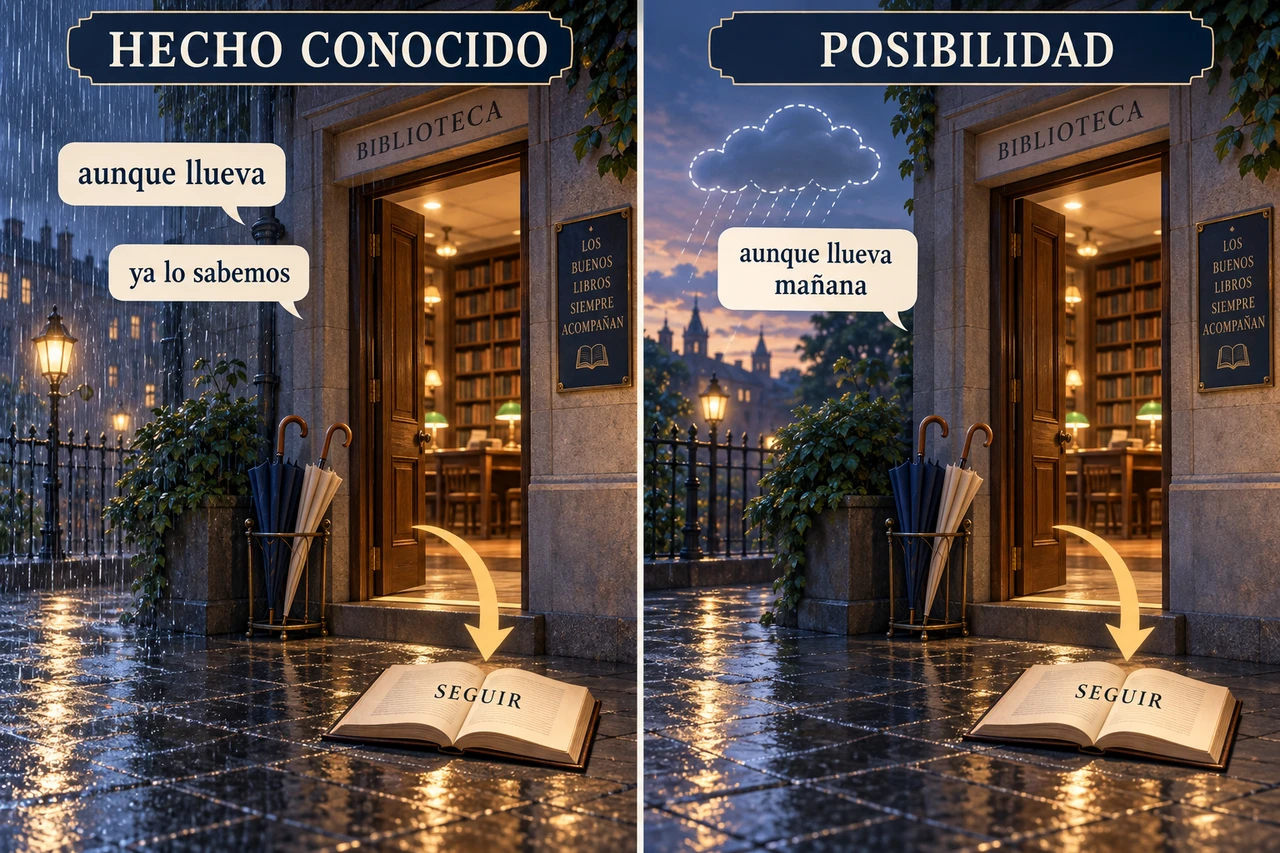
Image: illustration, not a documentary photograph. Context distinguishes acknowledged rain from an open future possibility; subjunctive alone does not mean an obstacle is false. The wet setting and outlined cloud are schematic, not a forecast. · Original operator-generated illustration; no institutional artwork or edition illustrations copied.
Changed translation: past concession
Question: change only the final source sentence to 'Although the centre closed early last month, I returned twice.' Can the model's cierre and el mes que viene remain? Explain and translate the changed sentence.
Answer: no. The changed source asserts a completed past closing and completed returns, rather than an open future possibility. A defensible translation is aunque el centro cerró temprano el mes pasado, volví dos veces. Both time markers and verb forms must change; replacing cierre while retaining the future month would leave conflicting meanings. Volví does not mean that all members of the group returned. In a different dialogue treating the closing as already acknowledged, a subjunctive concession might be defensible, but that does not justify preserving an open-future reading here. This transfer changes the source evidence, not the answer by an arbitrary tense rule.
Worked example: change only the final source sentence to 'Although the centre closed early last month, I returned twice.' Can the model's cierre and el mes que viene remain? Explain and translate the changed sentence.
The changed source asserts a completed past closing and completed returns, rather than an open future possibility.
A defensible translation is aunque el centro cerró temprano el mes pasado, volví dos veces.
Both time markers and verb forms must change; replacing cierre while retaining the future month would leave conflicting meanings.
Answer: no. The changed source asserts a completed past closing and completed returns, rather than an open future possibility. A defensible translation is aunque el centro cerró temprano el mes pasado, volví dos veces. Both time markers and verb forms must change; replacing cierre while retaining the future month would leave conflicting meanings. Volví does not mean that all members of the group returned. In a different dialogue treating the closing as already acknowledged, a subjunctive concession might be defensible, but that does not justify preserving an open-future reading here. This transfer changes the source evidence, not the answer by an arbitrary tense rule.
Check your understanding: Why must both cierre and el mes que viene change in this revised sentence?
Answer: The changed source asserts a completed past closing and completed returns, rather than an open future possibility. A defensible translation is aunque el centro cerró temprano el mes pasado, volví dos veces. Both time markers and verb forms must change; replacing cierre while retaining the future month would leave conflicting meanings. Volví does not mean that all members of the group returned. In a different dialogue treating the closing as already acknowledged, a subjunctive concession might be defensible, but that does not justify preserving an open-future reading here. This transfer changes the source evidence, not the answer by an arbitrary tense rule.
Why: Both time markers and verb forms must change; replacing cierre while retaining the future month would leave conflicting meanings.