Translation 2 — Spanish into English — full source, model and six decisions
By UK A Level Spanish · independent study · myAudience
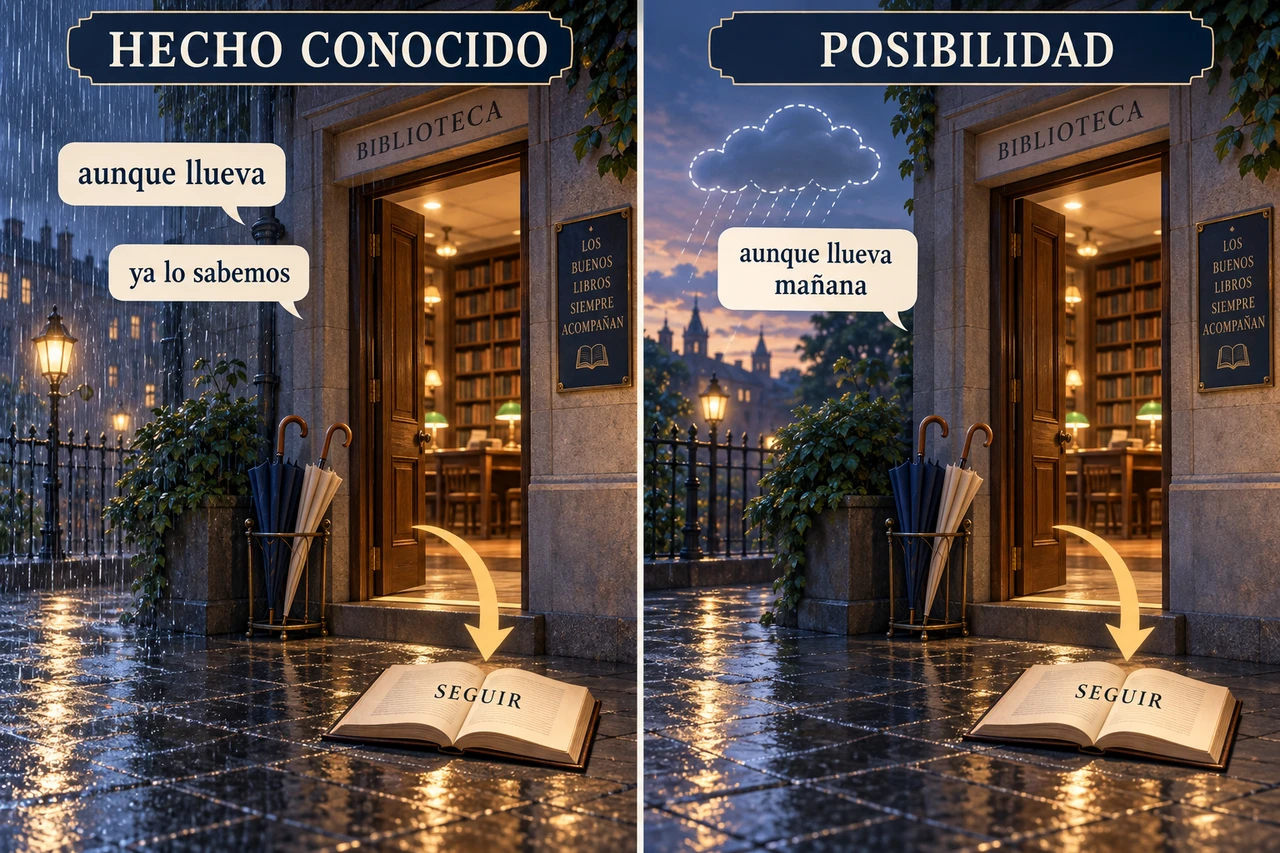
Image: illustration, not a documentary photograph. Context distinguishes acknowledged rain from an open future possibility; subjunctive alone does not mean an obstacle is false. The wet setting and outlined cloud are schematic, not a forecast. · Original operator-generated illustration; no institutional artwork or edition illustrations copied.
Translation 2 — Spanish into English — full source, model and six decisions
El barrio tiene una asociación cuya biblioteca abre tres tardes por semana. Sus responsables buscan voluntarios cuyos conocimientos puedan ayudar a los nuevos lectores, pero no exigen que todos hayan estudiado literatura. Ayer una vecina explicó que ya había trabajado en otra biblioteca y que quería ofrecer una hora de su tiempo. Aunque el local es pequeño, los organizadores han encontrado una manera de compartir las mesas. Una de las personas presentes recordó que hacía frío dentro. Su amiga respondió que, aunque hiciera frío, prefería seguir allí porque la conversación le interesaba. Todavía no se sabe si habrá otro encuentro el viernes. Si se confirma, la asociación publicará un mensaje para que nadie tenga que adivinar el horario.
The neighbourhood has an association whose library opens three afternoons a week. Its organisers are looking for volunteers whose knowledge can help new readers, but they do not require everyone to have studied literature. Yesterday a neighbour explained that she had already worked in another library and wanted to offer an hour of her time. Although the premises are small, the organisers have found a way to share the tables. One of those present pointed out that it was cold inside. Her friend replied that, even though it was cold, she preferred to stay because the conversation interested her. It is not yet known whether there will be another meeting on Friday. If it is confirmed, the association will publish a message so that nobody has to guess the timetable.
1. Whose library preserves the relation between association and library. Three afternoons a week is not three evenings or every afternoon. A translation must retain the frequency, not merely the general idea of regular opening.
2. Buscan and puedan describe people being sought with a desired useful capacity. The English relative need not contain an overt might: volunteers whose knowledge could help is also defensible if it preserves the desired suitability rather than an established list of appointed volunteers. Do not infer that such volunteers definitely do not exist.
3. No exigen que todos hayan estudiado means that prior literary study is not required of everyone. It does not mean they require nobody to have studied literature. The scope of negation matters: a permission to include different backgrounds is not a prohibition of expertise.
4. Had already worked places that experience before yesterday's account. The neighbour is female because vecina supplies that information; the later amiga likewise supports her friend. The English model retains those features without supplying any age, nationality or biography.
5. The cold has already been introduced in the conversation. Aunque hiciera frío can concede it within the past report; translating this as even though it was cold is justified by this context. Even if it might be cold would unnecessarily turn acknowledged conditions into an uncertain future forecast. Subjunctive form alone does not establish unreality.
6. Si habrá means whether there will be within the statement of what is not known. The later si se confirma is a genuine condition on publishing the message. These two instances of si do different jobs. Para que expresses the purpose of the message; nobody has to guess preserves the intention without asserting that every reader actually saw it.
Worked example: El barrio tiene una asociación cuya biblioteca abre tres tardes por semana. Sus responsables buscan voluntarios cuyos conocimientos puedan ayudar a los nuevos lectores, pero no exigen que todos hayan estudiado literatura. Ayer una vecina explicó que ya había trabajado en otra biblioteca y que quería ofrecer una hora de su tiempo. Aunque el local es pequeño, los organizadores han encontrado una manera de compartir las mesas. Una de las personas presentes recordó que hacía frío dentro. Su amiga respondió que, aunque hiciera frío, prefería seguir allí porque la conversación le interesaba. Todavía no se sabe si habrá otro encuentro el viernes. Si se confirma, la asociación publicará un mensaje para que nadie tenga que adivinar el horario.
1. Whose library preserves the relation between association and library. Three afternoons a week is not three evenings or every afternoon. A translation must retain the frequency, not merely the general idea of regular opening.
2. Buscan and puedan describe people being sought with a desired useful capacity. The English relative need not contain an overt might: volunteers whose knowledge could help is also defensible if it preserves the desired suitability rather than an established list of appointed volunteers. Do not infer that such volunteers definitely do not exist.
3. No exigen que todos hayan estudiado means that prior literary study is not required of everyone. It does not mean they require nobody to have studied literature. The scope of negation matters: a permission to include different backgrounds is not a prohibition of expertise.
4. Had already worked places that experience before yesterday's account. The neighbour is female because vecina supplies that information; the later amiga likewise supports her friend. The English model retains those features without supplying any age, nationality or biography.
5. The cold has already been introduced in the conversation. Aunque hiciera frío can concede it within the past report; translating this as even though it was cold is justified by this context. Even if it might be cold would unnecessarily turn acknowledged conditions into an uncertain future forecast. Subjunctive form alone does not establish unreality.
6. Si habrá means whether there will be within the statement of what is not known. The later si se confirma is a genuine condition on publishing the message. These two instances of si do different jobs. Para que expresses the purpose of the message; nobody has to guess preserves the intention without asserting that every reader actually saw it.
Answer: The neighbourhood has an association whose library opens three afternoons a week. Its organisers are looking for volunteers whose knowledge can help new readers, but they do not require everyone to have studied literature. Yesterday a neighbour explained that she had already worked in another library and wanted to offer an hour of her time. Although the premises are small, the organisers have found a way to share the tables. One of those present pointed out that it was cold inside. Her friend replied that, even though it was cold, she preferred to stay because the conversation interested her. It is not yet known whether there will be another meeting on Friday. If it is confirmed, the association will publish a message so that nobody has to guess the timetable.
Check your understanding: replace no exigen que todos hayan estudiado literatura with exigen que todos hayan estudiado literatura. A learner still writes 'they do not require everyone to have studied literature'. Is that a minor stylistic difference?
Answer: no. Removing no changes the policy expressed by the fictional source. The new sentence requires prior literary study from everyone; the proposed translation says that requirement does not apply to everyone. A correct model is they require everyone to have studied literature. Require all applicants to have studied literature could be defensible if applicants accurately describes the volunteers in context, but adding applicants is unnecessary. The answer must preserve both the universal todos and the affirmative exigen. Recognising the subjunctive haya(n) without checking negation would produce fluent English with the opposite practical meaning.
Why: 3. No exigen que todos hayan estudiado means that prior literary study is not required of everyone. It does not mean they require nobody to have studied literature. The scope of negation matters: a permission to include different backgrounds is not a prohibition of expertise.